
Introduction: Biography of Nusrat Fateh Ali Khan
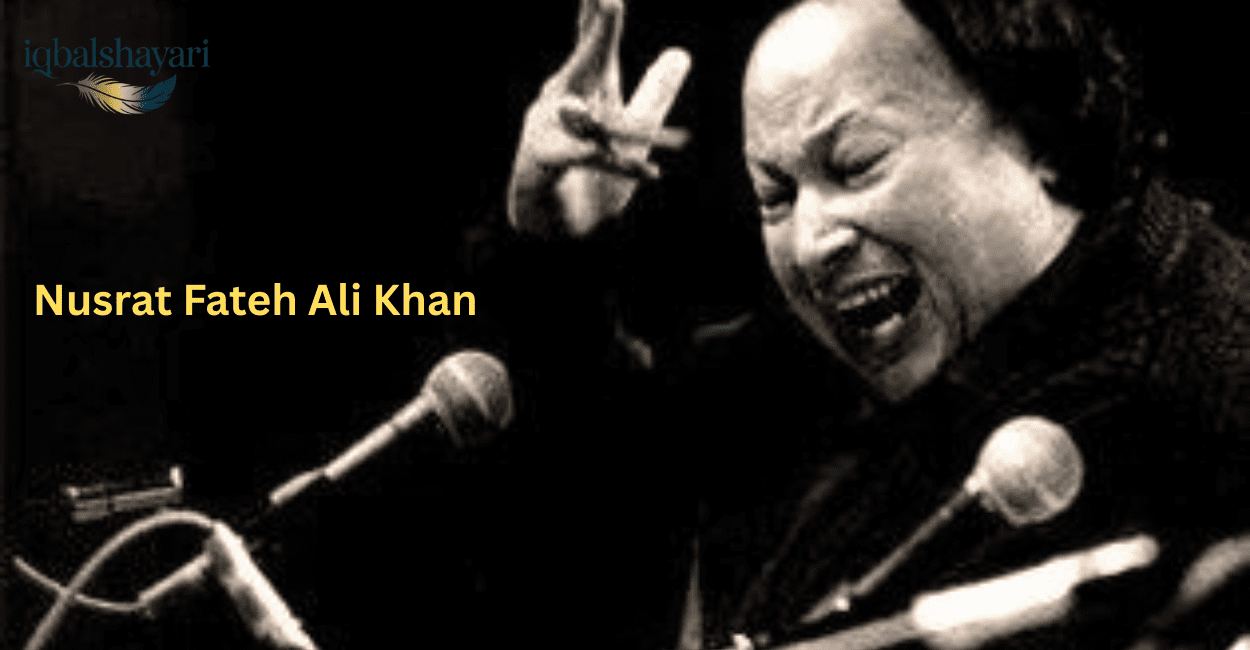
When Nusrat Fateh Ali Khan first stepped onto the stage at the 1985 WOMAD festival in England, Western audiences had never heard anything like it. His voice—powerful yet tender, capable of sustaining notes that seemed to defy human physiology—introduced millions to Qawwali, a centuries-old form of Sufi devotional music that had remained largely within South Asian spiritual circles.
By the time of his death in 1997 at just 48 years old, Nusrat had recorded over 125 albums, collaborated with rock legends like Peter Gabriel and Eddie Vedder, and fundamentally changed how the world understood devotional music. His influence extends far beyond his genre, touching everything from film soundtracks to electronic music.
The Man Behind the Music
Born on October 13, 1948, in Faisalabad, Pakistan (then called Lyallpur), Nusrat Fateh Ali Khan came from a family with a 600-year tradition of Qawwali performance. His father, Ustad Fateh Ali Khan, was himself a renowned Qawwal, but initially hoped his son would pursue medicine or engineering rather than music.

When his father died, Nusrat was only 16. His uncle, Ustad Mubarak Ali Khan, took over his training, and the young singer made his public debut at his father’s chelum—the 40-day memorial ceremony. What started as a tribute became a calling.
The training regimen was intense. Traditional Qawwali education involves mastering ragas (melodic frameworks), memorizing hundreds of Urdu and Persian poems, developing the stamina for hours-long performances, and understanding the deep spiritual texts of Sufism. Nusrat absorbed it all, but he brought something extra—an innovative spirit that would eventually bridge Eastern devotional traditions with Western musical sensibilities.
Understanding Qawwali: More Than Just Music
To appreciate Nusrat’s genius, you need to understand what Qawwali actually is. The word comes from the Arabic “qawl,” meaning “utterance.” This isn’t simply religious music—it’s a spiritual practice designed to induce “hal,” a state of ecstatic connection with the divine.
Qawwali emerged in the 13th century through Amir Khusrow, a Sufi mystic and poet in Delhi. The tradition combines Islamic devotional poetry with South Asian musical forms, creating something unique to the Indian subcontinent. Traditionally performed at Sufi shrines called dargahs, Qawwali sessions can last six to eight hours, building intensity through repetition, improvisation, and call-and-response between the lead vocalist and chorus.
The instrumentation is relatively simple: harmonium, tabla drums, and rhythmic hand-clapping. But what Qawwali lacks in instrumental complexity, it makes up for in vocal virtuosity. The lead Qawwal must be able to improvise melodically, execute rapid vocal runs called taans, and maintain power and clarity for extraordinary durations.
This is where Nusrat’s three-octave range and seemingly limitless stamina set him apart. Other Qawwals were technically proficient, but Nusrat’s voice carried an emotional weight and spiritual intensity that transcended technique.
The Breakthrough: From Shrines to World Stages
Throughout the 1970s, Nusrat dominated Pakistan’s devotional music scene. His performances at major Sufi shrines—particularly Data Ganj Bakhsh in Lahore and Shah Rukn-e-Alam in Multan—drew massive crowds. But his music remained largely unknown outside South Asian communities.
Everything changed when Peter Gabriel, the former Genesis frontman who had founded Real World Records and the WOMAD festival, heard Nusrat’s recordings and invited him to perform in 1985. Gabriel understood that Nusrat’s music could speak to anyone, regardless of language or religious background.
The WOMAD performance was revelatory. Audiences who couldn’t understand a word of Urdu or Punjabi found themselves moved to tears by the sheer emotional force of Nusrat’s voice. Real World Records signed him immediately, beginning a partnership that would produce some of his most accessible work for Western audiences.
“Shahen-Shah,” released in 1988, was his first album for Real World. It maintained the traditional Qawwali structure while using studio production to make the music more digestible for listeners accustomed to three-minute pop songs rather than hour-long improvisations.
The Fusion Years: Breaking Boundaries
Nusrat’s willingness to experiment set him apart from purists who insisted Qawwali should never change. His 1990 album “Mustt Mustt,” produced by Canadian musician Michael Brook, added ambient textures and subtle electronic elements while preserving the essence of his vocal performances.
The title track became an unlikely crossover hit, later remixed by Massive Attack and introduced to club audiences who had never heard traditional Sufi music. Critics worried about commercialization, but Nusrat saw it differently—this was simply another way to share the spiritual message at Qawwali’s core.
His collaboration with Pearl Jam’s Eddie Vedder on “The Face of Love” for the 1995 film “Dead Man Walking” brought together grunge rock intensity with Qawwali devotion. The pairing shouldn’t have worked on paper, but Nusrat’s ability to find emotional common ground with musicians from vastly different traditions made the impossible routine.
Perhaps most famously, Martin Scorsese featured Nusrat’s music in “The Last Temptation of Christ” (1988), using those haunting vocals to underscore spiritual crisis and transcendence. Suddenly, Qawwali wasn’t just music—it was a cinematic language for exploring the divine.
The Voice: What Made It Special
Music critics and vocal coaches have spent years trying to articulate what made Nusrat’s voice so extraordinary. The technical aspects are impressive enough: a three-octave range, the ability to sustain notes for what seemed like minutes, and the capacity to perform at full power for six to eight hours without vocal fatigue.
But technique alone doesn’t explain the impact. Nusrat possessed what Sufi tradition calls “dam“—breath control that goes beyond mere physiology into something almost supernatural. He could execute rapid melodic passages with crystalline clarity, then shift instantly to sustained notes that seemed to vibrate through the listener’s entire body.
His improvisational abilities were legendary. In traditional Qawwali, much of the performance is spontaneous—the Qawwal reads the audience’s spiritual state and adjusts accordingly. Nusrat could spin out variations on a single melodic phrase for thirty minutes, each iteration building on the last, creating a hypnotic effect that induced trance states in listeners.
Western musicians who worked with him were consistently amazed. Michael Brook described watching Nusrat record: “He would do a take, and it would be perfect. Then he’d do another take, completely different, equally perfect. His creative well never ran dry.”
Essential Albums: Where to Start
With over 125 albums, approaching Nusrat’s discography can feel overwhelming. Here’s a practical guide based on listener experience:
For Complete Beginners: Start with “Mustt Mustt” (1990). The fusion production makes it accessible, but Nusrat’s voice remains central. If you respond to this, you’re ready for deeper exploration.
For Those Ready for Traditional Qawwali: “Shahen-Shah” (1988) offers authentic Qawwali in a relatively digestible format—songs are condensed compared to hours-long shrine performances, but the spiritual intensity remains intact.
For Deep Spiritual Experience: “The Last Prophet” (1994) is pure devotional Qawwali, poems in praise of Prophet Muhammad performed with extraordinary passion. This requires more patience but offers profound rewards.
For Understanding His Range: “Intoxicated Spirit” (1996), a BBC compilation, showcases different facets of his artistry from devotional to romantic poetry to ecstatic improvisation.
His posthumous releases continue to emerge, with archival recordings revealing performances never intended for commercial release. These offer glimpses of Nusrat in his natural element—the all-night shrine performances where Qawwali’s true purpose manifests.
The Cultural Bridge
What made Nusrat unique wasn’t just his voice but his vision. Many traditional artists resist change, viewing innovation as corruption. Nusrat saw Western collaboration as an opportunity to fulfill Qawwali’s fundamental purpose: creating spiritual connection.
He never dumbed down the tradition or compromised its essence. Instead, he found musicians who understood that devotional music transcends specific religious frameworks. Peter Gabriel, though not Muslim, deeply respected the spiritual dimension. Eddie Vedder brought his own searching intensity. Michael Brook approached production with reverence rather than ego.
For Pakistani culture, Nusrat became an ambassador. At a time when Western media often portrayed Muslim societies through conflict and extremism, here was a Muslim artist sharing a tradition of love, mystical poetry, and transcendence. His music demonstrated Islam’s rich spiritual and artistic heritage.
For Western audiences, he opened doors to Sufism—the mystical Islamic tradition emphasizing direct experience of the divine through love rather than law. Qawwali became a bridge, showing that spiritual yearning sounds remarkably similar regardless of cultural context.
The Legacy: Who Carries the Torch
Nusrat’s nephew, Rahat Fateh Ali Khan, has achieved massive success in Bollywood film music while maintaining traditional Qawwali performances. His voice shares some of Nusrat’s warmth, and he’s introduced younger South Asian audiences to the family tradition.
But Rahat represents just one tributary of Nusrat’s influence. A.R. Rahman, the Indian composer who scored “Slumdog Millionaire,” cites Nusrat as transformative. Electronic producers from Massive Attack to contemporary beatmakers sample his vocals, layering them over trip-hop and ambient soundscapes. Jeff Buckley spoke of feeling spiritually connected to Nusrat’s music despite never meeting him.
The influence extends beyond direct musical descendants. Nusrat proved that devotional music from any tradition could find global audiences if the spiritual authenticity was genuine. His success paved the way for other traditional artists to reach beyond their geographic and cultural origins.
The Tragic End
By the mid-1990s, Nusrat’s health was deteriorating. His weight exceeded 300 pounds, and he struggled with diabetes and liver complications. Friends and family urged him to slow down, but he maintained a punishing international touring schedule.
In summer 1997, he traveled to London for medical treatment. Doctors discovered severe liver and kidney failure. He underwent a kidney transplant at Cromwell Hospital, but on August 16, 1997, he suffered cardiac arrest. He was 48 years old.
His body was returned to Faisalabad for burial near his ancestors. Thousands attended the funeral, and his grave has become a pilgrimage site. Every year on the anniversary of his death, fans gather to remember the man who gave voice to divine longing.
The medical details are straightforward—obesity, organ failure, cardiac arrest. But many who loved his music couldn’t help feeling that his body simply couldn’t contain the spiritual force he channeled. He had given everything to his art.
Where to Listen Today
Nusrat’s music remains widely available across streaming platforms. Spotify and Apple Music carry most of his major albums, including both traditional recordings and fusion experiments. YouTube hosts countless concert videos, offering glimpses of his live performances in their full glory.
For those seeking the highest audio quality, Tidal offers high-fidelity versions. Physical collectors can find vinyl reissues and CD box sets, though some of his Pakistani releases remain harder to source internationally.
The challenge isn’t access—it’s knowing where to begin. Start with the accessible fusion work, then gradually move toward traditional Qawwali as your ear adjusts. Don’t worry about understanding the lyrics initially. Nusrat always insisted that the emotional and spiritual content transcends language.
Consider exploring live recordings once you’re familiar with his studio work. The spontaneity and extended improvisations of concert performances reveal dimensions that studio albums can only hint at. These marathon sessions capture Qawwali’s true nature—not as entertainment, but as spiritual practice.
Beyond the Music: Cultural Significance
Nusrat’s importance extends beyond individual artistry. He preserved a 600-year tradition while ensuring its relevance for contemporary audiences. In an era of globalization that often homogenizes culture, he demonstrated how traditions can evolve without losing their essence.
For Sufi communities, his music remains central to spiritual practice. At dargahs throughout Pakistan and India, his recordings accompany meditation and prayer. The hypnotic repetition, the building intensity, the moments of ecstatic release—these aren’t just aesthetic choices but technologies for inducing mystical states.
For world music as a concept, Nusrat was transformative. Before him, “world music” often meant watered-down versions of traditional forms packaged for Western consumption. He proved that authentic traditional music could connect globally without compromise. His success encouraged other artists to trust their traditions rather than diluting them.
The Spiritual Dimension
It’s impossible to fully understand Nusrat without acknowledging the spiritual framework of Sufism. Unlike orthodox Islamic practice focused on law and ritual, Sufism emphasizes direct mystical experience of God through love.
Sufi poetry, which forms Qawwali’s lyrical foundation, uses metaphors of earthly love to describe divine longing. The beloved in these poems might seem to be a human lover, but Sufis understand the true beloved is God. This ambiguity allows the poetry to work on multiple levels simultaneously.
Qawwali performances at Sufi shrines aim to induce “wajd“—a state of spiritual ecstasy where the individual ego dissolves into divine presence. The repetitive melodies, the building intensity, the extended duration—all of these serve this purpose. Listeners who find themselves crying or swaying aren’t simply enjoying music; they’re experiencing a form of prayer.
Nusrat took this seriously. He wasn’t a performer in the Western sense; he was a vehicle for spiritual transmission. His pre-performance rituals included prayer and meditation. He saw his audiences not as consumers but as fellow seekers.
This is why his music affects people regardless of their religious background or lack thereof. The spiritual yearning it expresses is universal. You don’t need to believe in Allah to recognize the longing for transcendence that Nusrat’s voice embodies.
Frequently Asked Questions
What made Nusrat Fateh Ali Khan’s voice so special?
Nusrat possessed an extraordinary three-octave vocal range combined with seemingly unlimited stamina—he could perform at full power for six to eight hours without losing clarity or strength. Beyond technical ability, his voice carried an emotional and spiritual intensity that affected listeners regardless of whether they understood the lyrics. His breath control and improvisational genius allowed him to create spontaneous variations that built hypnotic intensity over extended performances.
What is Qawwali music and why is it important?
Qawwali is a form of Sufi devotional music originating in 13th century South Asia. The word means “utterance” in Arabic. It combines Islamic spiritual poetry in Urdu, Punjabi, and Persian with repetitive melodies, improvisation, and call-and-response vocals. Traditionally performed at Sufi shrines, Qawwali aims to induce spiritual ecstasy and connection with the divine. It represents a bridge between Islamic spirituality and South Asian musical traditions.
What are the best Nusrat Fateh Ali Khan albums for beginners?
Start with “Mustt Mustt” (1990), which blends traditional Qawwali with accessible Western production. “Shahen-Shah” (1988) offers authentic Qawwali in digestible formats. For deeper spiritual experience, try “The Last Prophet” (1994). “Intoxicated Spirit” (1996) showcases his range across different styles. These albums balance accessibility with the authentic power of his artistry.
How did Nusrat Fateh Ali Khan die?
Nusrat died on August 16, 1997, at age 48 in London. He suffered from obesity (over 300 pounds), diabetes, and organ failure. He traveled to London for medical treatment and underwent kidney transplant surgery at Cromwell Hospital, but suffered cardiac arrest and died. His body was returned to Pakistan for burial in Faisalabad, where his grave has become a pilgrimage site.
Who is continuing Nusrat’s legacy today?
Rahat Fateh Ali Khan, Nusrat’s nephew, is the primary musical heir, achieving major success in Bollywood while maintaining traditional Qawwali. Nusrat’s other nephews, Rizwan and Muazzam, perform as a traditional Qawwali duo. Beyond family, his influence extends to artists like A.R. Rahman, electronic producers who sample his vocals, and countless Qawwals throughout South Asia who cite him as inspiration.
What language did Nusrat sing in and does it matter if I don’t understand?
Nusrat sang primarily in Urdu, Punjabi, and Persian. However, he consistently emphasized that emotional and spiritual content transcends language barriers. Many Western fans who don’t understand a single word report profound experiences with his music. The spiritual intensity, vocal power, and melodic beauty communicate directly without requiring linguistic comprehension.
Where can I listen to Nusrat Fateh Ali Khan’s music now?
His music is widely available on Spotify, Apple Music, YouTube, Amazon Music, and Tidal. Major albums are on all platforms, though some rare Pakistani releases may be harder to find. YouTube hosts extensive concert footage. Physical media collectors can find vinyl reissues and CD box sets. Real World Records and Oriental Star Agencies released much of his catalog internationally.
Did Nusrat Fateh Ali Khan win any major awards?
Yes, he received Pakistan’s Pride of Performance award in 1987, the country’s highest civilian honor for arts. He won UNESCO’s Music Prize in 1995 for contributions to world music. He received numerous other international recognitions and continues to be celebrated in “greatest vocalist” rankings by music publications worldwide. Advocacy continues for a Grammy Lifetime Achievement Award recognition.
Conclusion
Nusrat Fateh Ali Khan’s voice was more than an instrument—it was a bridge between worlds, cultures, and spiritual traditions. From Sufi shrines in Pakistan to concert halls in New York, from film soundtracks to electronic remixes, his music demonstrated that devotional expression transcends all boundaries when delivered with genuine spiritual force.
His legacy lives not only in recordings but in the countless listeners who discovered that mystical longing sounds the same in any language. Whether you approach his music as spiritual practice, cultural exploration, or simply extraordinary artistry, Nusrat’s voice remains an invitation to experience something beyond ordinary consciousness.
Start with a single song. Let yourself feel rather than understand. That’s what Nusrat always wanted—not admiration for technique, but connection to the divine longing his voice embodied.