Introduction:
There is a moment every year that feels unlike any other. The crescent moon appears on the horizon, phones light up across households from Houston to New York, and millions of people reach for the one thing they know will carry their feelings better than a plain “Eid Mubarak” ever could — a beautifully written Eid Shayari.
Eid Shayari (عید شاعری) is the living heart of how South Asian Muslim communities express the joy, longing, gratitude, and spiritual depth of Eid. It is not simply a greeting. It is a poetic tradition rooted in centuries of Urdu literature, shaped by masters like Mirza Ghalib, Allama Iqbal, and Faiz Ahmed Faiz, and now carried forward by millions of ordinary people who want their Eid message to mean something real.
Whether you are a Pakistani-American in Chicago searching for the perfect Eid Shayari in Urdu, a second-generation Muslim in New York looking for Roman Urdu verses you can actually read, or a content creator sourcing culturally accurate Eid poetry in English — this guide covers everything. The best verses, the right context, the cultural nuances, and yes, how to write your very own sher if you have always wanted to try.
What Is Eid Shayari — And Why Does It Matter?
Eid Shayari is a form of structured Urdu and Hindi poetry — written, shared, or recited — to celebrate the Islamic festivals of Eid ul Fitr and Eid ul Adha. The word Shayari (شاعری) comes from the Arabic root sha’ar, meaning feeling or perception. It captures what ordinary words cannot.
A simple “Happy Eid” tells someone you remembered them. A well-chosen Eid Mubarak Shayari tells them exactly how you feel about them — their absence, their warmth, the memory of sharing sevaiyaan at the same table, or the quiet dua you say for them every morning of Ramadan.
That emotional specificity is what makes Eid poetry in Urdu irreplaceable in South Asian Muslim culture. It has been that way since the medieval era, when early poets composed verses in praise of Allah’s blessings during Eid. Today, that same tradition lives on in WhatsApp statuses, Instagram captions, handwritten cards, and voice notes sent across time zones.
For the South Asian diaspora across the United States — in cities like New York, Houston, Chicago, Los Angeles, Dallas, and Dearborn — Eid Shayari bridges the distance between here and home. It connects second-generation Americans to a language and cultural identity they may not speak fluently but feel deeply.
Types of Eid Shayari: Choosing the Right Form
Not all Eid Shayari is the same, and choosing the right form matters more than most people realize.
Sher (شعر) is the two-line couplet — the most shared format across WhatsApp and SMS. Both lines carry equal rhythm, and the second lands the emotional punch. It is the format most suited to mobile sharing because it is complete, brief, and instantly quotable.
Ghazal (غزل) is a multi-stanza form with a consistent rhyme and refrain. It is lyrical and musical, best suited for longer Instagram posts, recitation at family gatherings, or YouTube Shorts. Classical Eid ghazals by Ghalib and Faiz are still circulated every year.
Nazm (نظم) is free verse — more narrative in structure. A nazm allows you to tell a small emotional story: the morning of Eid, the smell of your mother’s kitchen, the ache of being far from home. It is the most personal form.
Qata is a four-line verse that sits between a sher and a nazm — detailed enough to carry a complete thought, compact enough for an Instagram caption. It works well for Eid ul Adha Shayari, where the themes of sacrifice and spiritual reflection deserve more than two lines.
The Doha is a Hindi-origin two-line wisdom verse, frequently used in Eid Shayari in Hindi for elder relatives and family groups.
Best 2026 — عید شاعری
The following verses are original Eid Shayari in Urdu written for emotional authenticity. Each is given in Urdu script, Roman Urdu transliteration, and English meaning — because in 2026, the American Muslim reader often needs all three.
For Eid ul Fitr — Celebrating the End of Ramadan
چاند رات کی خوشیاں تم پر سدا رہیں ہر عید پر تمہاری مسکان نئی ہو
Chand raat ki khushiyan tum par sada rahein Har Eid par tumhari muskaan nayi ho
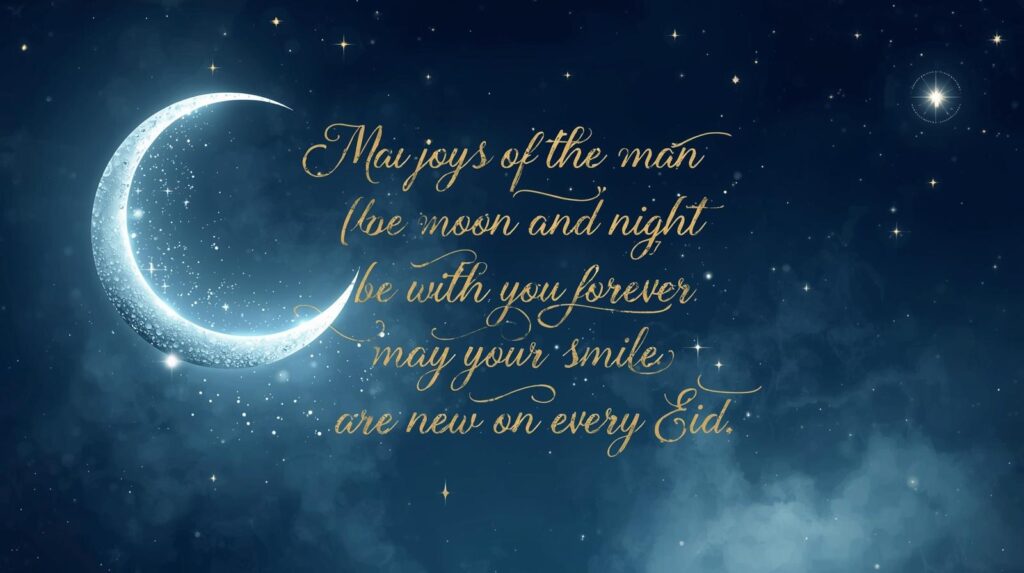
May the joys of Chand Raat always remain with you; may each Eid bring you a new smile.
روزوں کی قبولیت کی دعا ہو تمہاری عید ہر خوشی سے بھری ہو
Rozoun ki qabuliyat ki dua ho Tumhari Eid har khushi se bhari ho
May your fasts be accepted by Allah; may your Eid be filled with every happiness.
رمضان کی رحمتیں سمیٹ کر عید کی خوشیاں لے آئے
Ramzan ki rahmaten samet kar Eid ki khushiyan le aaye
Gathering the mercies of Ramadan, Eid has arrived bearing all its blessings.
For Someone Far Away — The Diaspora Sher
جہاں بھی ہو، جیسے بھی ہو عید مبارک ہو، دل سے مبارک ہو
Jahan bhi ho, jaise bhi ho Eid Mubarak ho, dil se Mubarak ho
Wherever you are, however you are — Eid Mubarak, from the very depth of my heart.
This Eid Shayari resonates especially with American Muslims celebrating thousands of miles from extended family. It says everything without saying too much.
For a Mother — Eid Shayari for Ammi
ماں کے ہاتھوں کی سوائیاں عید کی اصل خوشی ہیں
Maa ke haathon ki sevaiyaan Eid ki asal khushi hain
The vermicelli made by a mother’s hands — that is the true joy of Eid.
Eid Shayari in Hindi — ईद शायरी
For Hindi-speaking audiences across India and within the Indian-American community, Eid Shayari in Hindi maintains the emotional depth of Urdu poetry while being readable in Devanagari script.
ईद का चाँद मुबारक हो तुम्हें हर खुशी नसीब हो, हर दुआ कबूल हो
May the Eid moon be blessed for you; may every happiness be your fortune and every prayer accepted.
यारों की महफ़िल में ईद का मज़ा तेरे बिना यारा अधूरा है यह जश्न
The joy of Eid in the company of friends — without you, this celebration is incomplete.
Hindi Eid Shayari is widely shared across WhatsApp in Indian-American communities in New Jersey, California, and Illinois. Short, readable, and emotionally direct — it works perfectly as a status update or a morning greeting text.
Eid Shayari in English — For the Diaspora Generation
One of the most underserved audiences in the Eid Shayari space is the second-generation American Muslim — someone who grew up hearing Urdu at home but thinks and writes in English. Eid poetry in English preserves the couplet form and emotional weight of classical Shayari while being fully accessible.
The moon has risen, Eid is here, May your heart be light, your soul sincere.
Across the miles, my Eid du’a flies, To you, wherever under Allah’s skies.
Thirty days of patience bloom today, Eid’s joy is the garden after rain.
You are the Eid in my every day, But today, the whole world celebrates you.
These English Eid Shayari verses work equally well as Instagram captions, LinkedIn Eid posts for professional communities, and heartfelt personal messages. For Muslim professionals in US workplaces looking to share Eid with non-Muslim colleagues in a warm and culturally sensitive way, English-language Eid poetry offers the right tone — celebratory, spiritual, and universally understood.
Eid ul Adha Shayari — The Poetry of Sacrifice
Eid ul Adha (عید الاضحی), known as Badi Eid or Bakra Eid, carries a profoundly different emotional register than Eid ul Fitr. This is not the Eid of sweet sevaiyaan and colorful new clothes — it is the Eid of qurbani, of Prophet Ibrahim’s (AS) unwavering submission to Allah, of the spiritual peak of Hajj.
Eid ul Adha Shayari reflects this depth. The best verses on this occasion center on sacrifice, surrender, and the renewal of faith.
ابراہیم کی سنت ادا ہوئی قربانی سے دل کی کدورت گئی
Ibrahim ki sunnat ada hui Qurbani se dil ki kudorat gayi
The tradition of Ibrahim was fulfilled; through sacrifice, the bitterness of the heart was washed away.
خدا کی راہ میں سب کچھ لٹا دو یہی قربانی کا پیغام ہے
Khuda ki raah mein sab kuch luta do Yahi qurbani ka paigham hai
Give everything in the path of Allah — this is the eternal message of sacrifice.
One critical mistake many people make is sending Eid ul Fitr Shayari — filled with references to Ramadan, fasting, and sevaiyaan — during Eid ul Adha. The occasions are spiritually distinct, and so is the appropriate poetry. Always match your verse to the right Eid.
Chand Raat Shayari — The Night Before Eid
Chand Raat (چاند رات) — the night of the new moon — is arguably the most emotionally charged moment of the Eid cycle. Searches for Chand Raat Shayari spike sharply on the evening before Eid ul Fitr as people scramble to find the perfect words for that first joyful announcement.
The best Chand Raat Shayari carries the imagery of the crescent moon, the anticipation of morning, and the warmth of reunion.
چاند رات مبارک، عید مبارک دل کی گہرائیوں سے مبارک
Chand Raat Mubarak, Eid Mubarak Dil ki gehraiyon se Mubarak
Chand Raat Mubarak, Eid Mubarak — from the very depths of my heart, congratulations.
Send this on the evening of moon-sighting, before midnight. Timing your Eid Shayari correctly — Chand Raat or early Eid morning before prayers — dramatically increases its emotional impact. Verses sent three days after Eid feel like afterthoughts.
Eid Shayari for WhatsApp Status and Instagram Captions
Platform choice changes everything about which Eid Shayari works best.
For WhatsApp status, the ideal is a 2-line sher in Roman Urdu or a bilingual format. It must be readable at a glance and emotionally complete in two seconds.
For Instagram captions, a 4-line qata paired with a moon or Eid aesthetic image performs best. Add relevant hashtags: #EidMubarak, #EidShayari, #EidulFitr, #ChandRaat, #UrduPoetry.
For LinkedIn, use English-language Eid poetry with a professional framing. Something like: “Thirty days of patience bloom today / Eid’s joy is the garden after rain. Eid Mubarak to all who celebrate.” This works for Muslim professionals at US companies who want to mark the occasion without alienating non-Muslim colleagues.
For SMS and text messaging, Roman Urdu shers remain the most effective — they are readable, personal, and carry the cultural flavor that a plain English message does not.
Eid Shayari for Missing a Loved One Who Has Passed
This is the most emotionally sensitive — and most underserved — category of Eid Shayari . Every Eid, there are people for whom the celebration is shadowed by the absence of someone who is no longer here. A parent, a sibling, a close friend. Their first Eid without someone they love deeply.
There is a quiet tradition of sad Eid Shayari — not mournful to the point of grief paralysis, but acknowledging. Honest. Human.
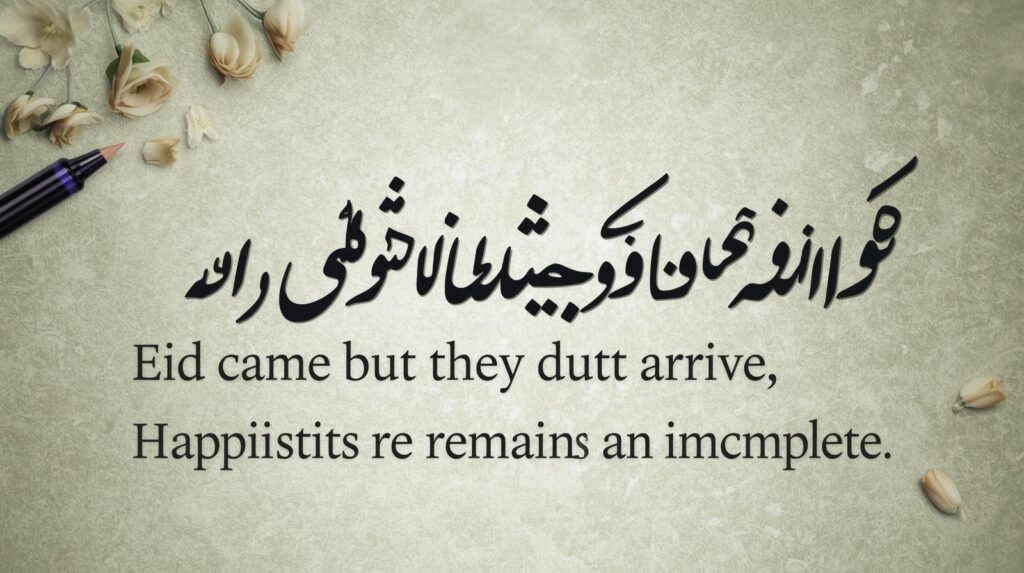
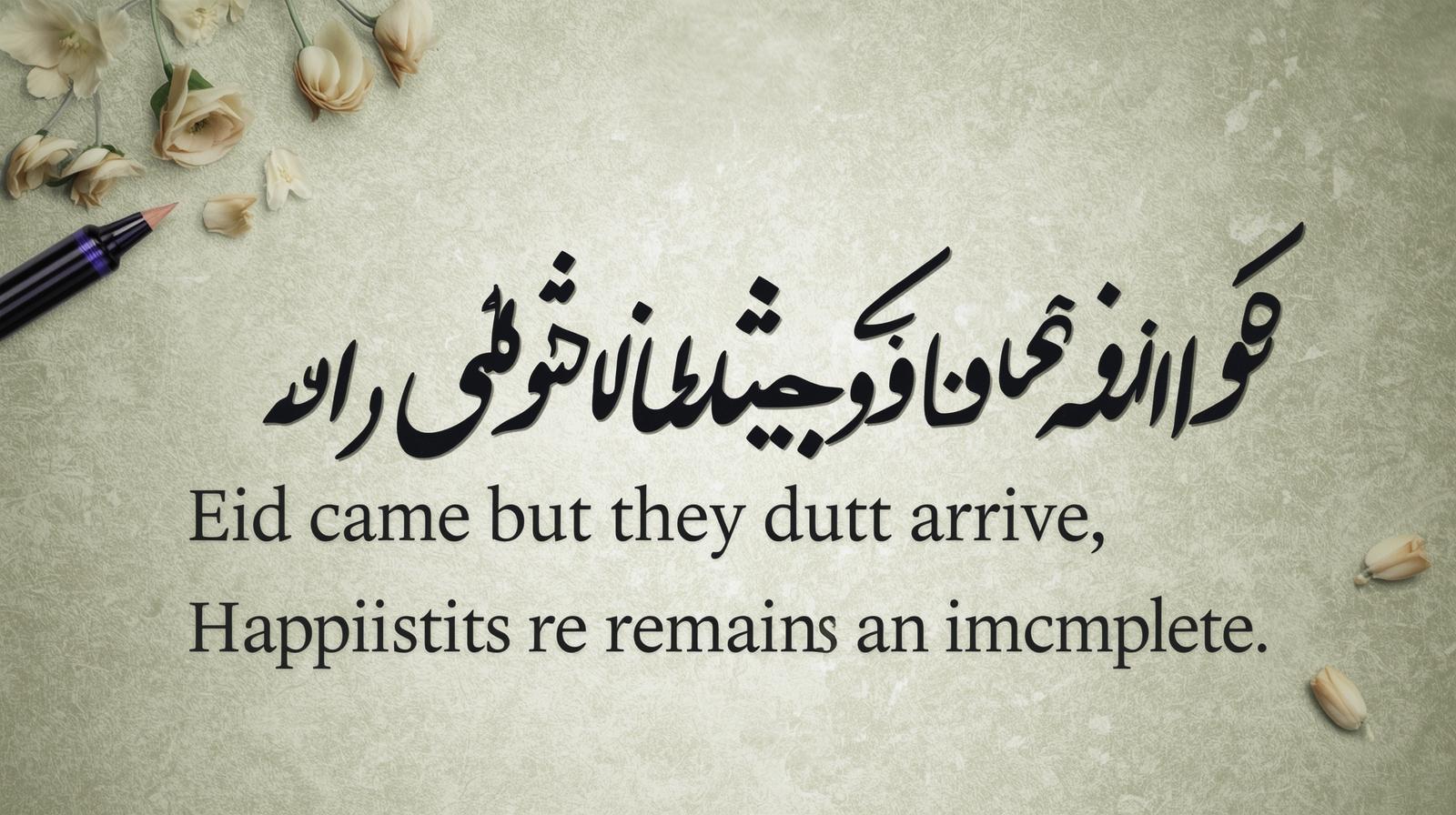
عید آئی پر وہ نہ آئے خوشی رہی ادھوری سی
Eid aayi par woh na aaye Khushi rahi adhoori si
Eid came, but they did not — and joy remained incomplete.
If you know someone spending their first Eid without a loved one, this is the Eid Shayari to send. Not the cheerful verses. Not the moon-and-stars imagery. This one.
How to Write Your Own Eid Shayari — A Practical Guide
Writing an original Eid Shayari is one of the most meaningful gifts you can offer. It does not require a degree in Urdu literature. It requires honesty and a little structure.
Step 1 — Choose one emotion. Joy, longing, gratitude, love, humor, or spiritual awe. Every powerful sher carries exactly one dominant feeling.
Step 2 — Pick a sensory image. Classical Urdu Shayari is rooted in concrete images: the crescent moon (chaand), the garden (gulshan), the lamp (diya), sevaiyaan, new clothes (Eid ka joda). Ground your emotion in something you can see or smell.
Step 3 — Write two lines with matching rhythm. You do not need to know formal Urdu meter (beher) to start. Simply write two lines of roughly equal length. Read them aloud. They should flow naturally.
Step 4 — End on the emotion. The second line of your sher should carry the emotional weight. The first line sets the scene; the second delivers the feeling.
Step 5 — Add Roman Urdu if needed. If your recipient reads Urdu but cannot read the Nastaliq script, transliterate phonetically. Use “kh” for خ, “gh” for غ, “ai” for ے. Read it aloud after writing to check accuracy.
Step 6 — Personalize it. Add the person’s name, a shared memory, or a specific reference. “Tumhari sevaiyaan yaad aa gayi” (I remembered your sevaiyaan) is infinitely more powerful than any generic verse you could copy.
Famous Urdu Poets and Eid Shayari Tradition
The Eid Shayari tradition draws its roots from one of the world’s great literary languages. Understanding the poets who shaped it elevates your appreciation of every verse you share.
Mirza Ghalib (1797–1869) — the undisputed master of the Urdu ghazal — wrote extensively about longing, celebration, and the divine. His verses are frequently adapted for Eid Mubarak Shayari, particularly for their bittersweet quality.
Allama Iqbal (1877–1938) — philosopher-poet and spiritual father of Pakistan — wrote Eid poetry with profound Islamic depth. His verses on sacrifice and submission are especially resonant for Eid ul Adha Shayari.
Faiz Ahmed Faiz (1911–1984) wrote verses of love and resistance that have been adapted for Eid greetings particularly popular among educated South Asian diaspora communities.
Parveen Shakir (1952–1994) brought a feminine, deeply personal voice to Urdu poetry. Her verses on love and longing translate beautifully into Eid Shayari for spouses and partners.
When sharing attributed verses, always name the poet. Misattribution is a common and culturally disrespectful error. If you are unsure of the source, platforms like Rekhta.org — the world’s largest digital archive of Urdu poetry — are the most reliable verification source.
Common Mistakes to Avoid With Eid Shayari
Sending Eid ul Fitr verses during Eid ul Adha. The occasions are distinct. Fasting and Ramadan references belong to Eid ul Fitr. Sacrifice and Hajj belong to Eid ul Adha. Mixing them signals cultural carelessness.
Sending without translation. If your recipient is second-generation American or a non-Urdu speaker, always include a Roman Urdu version or English meaning. The most beautiful sher loses all impact if it cannot be read.
Mass-forwarding without personalization. The moment someone receives a message they have already seen from three other contacts, it loses all meaning. Add one personal line, even if the rest is borrowed.
Late timing. Eid Shayari sent two days after Eid feels obligatory rather than warm. Schedule your message for Chand Raat or Eid morning before prayers.
Humorous Shayari to the wrong person. There is a rich tradition of funny Eid Shayari for close friends. It is deeply inappropriate for someone experiencing their first Eid after a loss, or for professional contacts who do not know you well.
7 Frequently Asked Questions About Eid Shayari
What is Eid Shayari?
Eid Shayari is traditional Urdu and Hindi poetry used to express Eid greetings and emotions. It combines Islamic sentiment, love, and celebration, shared via WhatsApp, SMS, and social media during Eid ul Fitr and Eid ul Adha to convey heartfelt wishes to family and friends.
What is the difference between Eid ul Fitr and Eid ul Adha Shayari?
Eid ul Fitr Shayari focuses on the joy of completing Ramadan, themes of family reunion, gratitude, and sweet foods like sevaiyaan. Eid ul Adha Shayari emphasizes qurbani (sacrifice), the story of Prophet Ibrahim (AS), Hajj, and spiritual renewal. Using the wrong type on the wrong occasion is a common cultural error.
Which famous poets wrote Eid Shayari?
Allama Iqbal, Mirza Ghalib, Faiz Ahmed Faiz, Parveen Shakir, Josh Malihabadi, and Ahmad Faraz all wrote verses that have been adapted as Eid poetry. Iqbal’s spiritually rich poetry is especially popular for Eid ul Adha themes, while Ghalib’s lyrical ghazals are widely used for Eid ul Fitr.
When should I send Eid Shayari?
The ideal timing is Chand Raat — the evening of the moon sighting before Eid — or early Eid morning before prayers. Sending after midday on Eid Day is still warm and appropriate. Avoid sending days after the celebration, as the emotional moment passes quickly.
How do I write Eid Shayari in Roman Urdu?
Write the Urdu verse phonetically in Latin script. Standard conventions include “kh” for خ, “gh” for غ, “ai” for ے, and “oo” for و. Always read it aloud after writing to verify pronunciation. Platforms like Rekhta and Google Translate can assist with checking transliterations.
Can I send Eid Shayari to non-Muslim friends or colleagues in the US?
Yes, with the right approach. English-language Eid poetry is the best choice for non-Muslim recipients — it shares the warmth and celebration of Eid without assuming linguistic or cultural familiarity. Avoid heavily religious verses for professional contexts; opt for universal themes of joy, gratitude, and togetherness.
Is there Eid Shayari for someone who has lost a loved one?
Yes, and it matters enormously. Verses acknowledging the incompleteness of Eid without someone who has passed — like “Eid aayi par woh na aaye / Khushi rahi adhoori si” — are the most compassionate choice for someone experiencing grief. They acknowledge pain without amplifying it.
Conclusion
Eid Shayari is not a trend. It is not a social media format. It is a living extension of one of the world’s most sophisticated poetic traditions — Urdu literature — applied to the most personal and joyful moments of Muslim life.
The right Eid Shayari does what no generic greeting can: it tells someone exactly how much they matter to you, in a language that carries centuries of emotion in two lines.
As you celebrate Eid ul Fitr or Eid ul Adha this year — whether in New York, Houston, Chicago, Los Angeles, or anywhere across America — do not settle for the forwarded message everyone else is sending. Choose a verse that fits your relationship. Translate it if your recipient needs it. Add one personal line. Send it on Chand Raat, before the world wakes up.
That is what Eid Shayari is for. Eid Mubarak — from the heart.