Introduction:
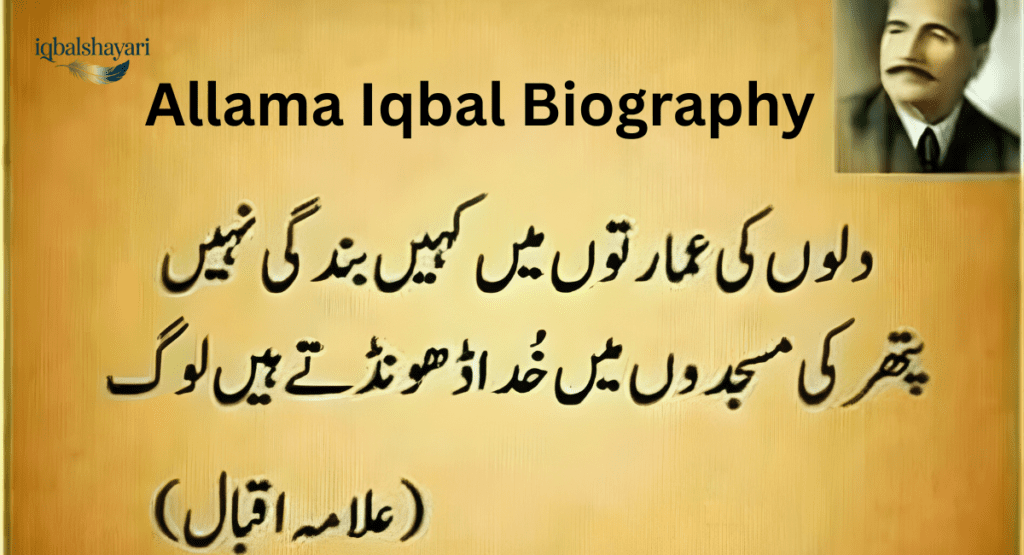
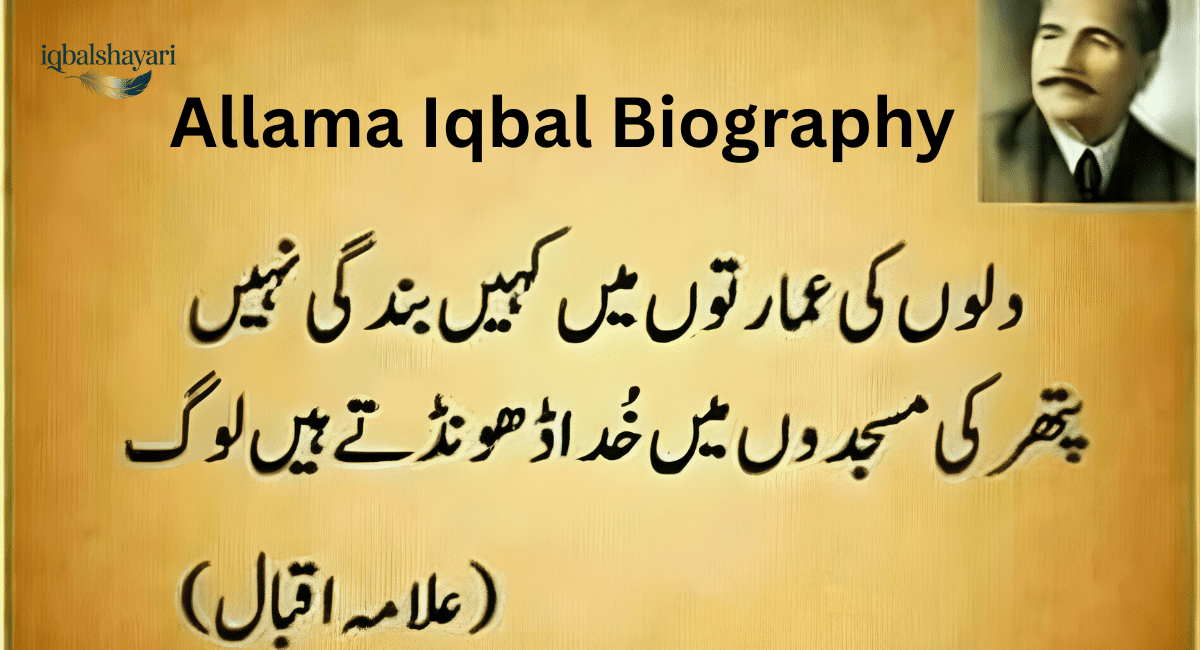
Allama Muhammad Iqbal is not just a historical name taught in textbooks. He is a voice that still speaks to people searching for purpose, identity, and self-respect. Known as the national poet of Pakistan and the spiritual father of the Pakistani nation, Iqbal was a rare combination of poet, philosopher, and visionary leader whose ideas transcended borders and generations.
Many people search for “Allama Iqbal biography in English” but often find content that is either too academic or too brief to understand his real impact. Some accounts reduce him to a political figure, while others focus only on his poetry without exploring the philosophy behind it. This article provides a clear, engaging, and comprehensive life story of Allama Iqbal, covering his childhood, education, poetry, philosophy, political vision, and lasting legacy in accessible yet meaningful language.
Whether you are a student researching for an assignment, a poetry enthusiast discovering Urdu literature, or someone seeking inspiration from historical figures, this biography offers valuable insights into one of the most influential thinkers of the modern Muslim world.
Early Life and Family Background
Allama Muhammad Iqbal was born on November 9, 1877, in Sialkot, a historic city in what was then British India (now in Pakistan). He came from a Kashmiri Muslim family that valued spirituality, honesty, and discipline. His father, Sheikh Noor Muhammad, was a deeply religious man who worked as a tailor but was known throughout the community for his piety and integrity. He believed in earning a lawful living and living according to moral principles, values he passed down to his children.

His mother, Imam Bibi, was known for her kindness, patience, and strong character. She played a crucial role in Iqbal’s early moral and spiritual development. The combination of his father’s religious devotion and his mother’s nurturing wisdom created an environment where young Iqbal could develop both intellectually and spiritually.
From a young age, Iqbal showed exceptional intelligence and curiosity. He was not content with surface-level knowledge but constantly asked questions and sought deeper understanding. His early education took place in Sialkot, where he studied Arabic, Persian, and Islamic studies. The traditional education system of the time emphasized memorization and classical texts, but Iqbal’s teachers recognized something special in him—a mind that could absorb knowledge and then transform it into original thought.
One of his most influential early teachers was Syed Mir Hassan, a renowned scholar who recognized Iqbal’s extraordinary abilities. Under his guidance, Iqbal developed a deep appreciation for Persian poetry and Islamic philosophy. This early exposure to classical Islamic thought, combined with his natural intellectual gifts, laid the foundation for everything that would follow.
The Sialkot of Iqbal’s youth was a culturally rich environment where different intellectual traditions met. This multicultural atmosphere helped shape his worldview, teaching him to appreciate diverse perspectives while remaining grounded in his own cultural and religious identity.
Education and Academic Journey
Allama Iqbal’s education played a crucial role in shaping his worldview and intellectual development. After completing his early education in Sialkot, he moved to Lahore to study at Government College, one of the premier educational institutions in British India. There, he earned his Bachelor’s degree and later a Master’s degree in Philosophy, graduating with distinction.
At Government College, Iqbal came under the influence of Sir Thomas Arnold, a renowned orientalist and philosopher who became his mentor. Arnold recognized Iqbal’s brilliance and encouraged him to pursue higher studies in Europe. This mentorship proved transformative, as Arnold introduced Iqbal to Western philosophical traditions while respecting his Islamic heritage.
In 1905, Iqbal traveled to Europe for advanced studies—a journey that would profoundly influence his thinking. He studied law at Cambridge University, earning his law degree, and later enrolled at the University of Munich in Germany to pursue a doctorate in Philosophy. His doctoral thesis, “The Development of Metaphysics in Persia,” demonstrated his ability to bridge Eastern and Western philosophical traditions.

During his years in Europe (1905-1908), Iqbal immersed himself in Western philosophy, politics, and society. He attended lectures, engaged in intellectual debates, and observed European culture firsthand. However, unlike many colonial subjects who were simply dazzled by Western civilization, Iqbal approached it critically. He appreciated Western achievements in science, organization, and technology, but he also saw its spiritual emptiness, materialism, and moral contradictions.
This critical engagement with the West became central to his philosophy. He realized that Muslims needed to learn from Western strengths (particularly in science and organization) while remaining firmly rooted in their own spiritual and cultural traditions. This balanced approach—neither blind rejection nor uncritical acceptance of the West—became a hallmark of his thought.
His European education also exposed him to the works of philosophers like Nietzsche, Bergson, and Goethe, whose ideas about human potential and creative will influenced his own concept of “Khudi” (selfhood). However, Iqbal always filtered these ideas through an Islamic lens, creating a unique synthesis that was neither purely Eastern nor purely Western.
Literary Career and Poetry
Allama Iqbal is widely celebrated for his powerful poetry in both Urdu and Persian. His poetry was not meant only for aesthetic appreciation or entertainment; it carried deep messages of self-awareness, faith, action, and revival. Iqbal believed poetry was a tool to awaken sleeping nations and inspire people to reach their highest potential.
His poetic journey began in his youth, but his mature work developed after his return from Europe. The experience of seeing the West’s material progress alongside its spiritual decline convinced him that Muslims needed a message of renewal. His poetry became the vehicle for this message.
Major Poetic Works
Bang-e-Dra (The Call of the Marching Bell) – This Urdu collection contains some of his most popular poems. It includes patriotic verses, spiritual reflections, and calls for awakening. The poetry ranges from simple, melodious verses to complex philosophical compositions.
Asrar-e-Khudi (Secrets of the Self) – Written in Persian, this philosophical poem introduces his concept of Khudi (selfhood). It argues that individuals must develop their inner strength and self-awareness to contribute meaningfully to society. This work brought him international recognition when it was translated into English by Professor Nicholson.
Rumuz-e-Bekhudi (Mysteries of Selflessness) – A companion to Asrar-e-Khudi, this work explores how individual self-development must lead to service to the community. Iqbal balances individualism with social responsibility.
Bal-e-Jibril (Gabriel’s Wing) – One of his most celebrated Urdu collections, containing poems of extraordinary depth and beauty. It includes some of his most quoted verses about faith, struggle, and human dignity.
Zarb-e-Kalim (The Strike of Moses) – This collection contains sharp critiques of contemporary Muslim society and calls for reform. Iqbal addresses colonialism, materialism, and spiritual decline with unflinching honesty.
Javid Nama (Book of Eternity) – His masterpiece in Persian, modeled after Dante’s Divine Comedy. In this allegorical journey through the heavens, Iqbal explores philosophical and spiritual themes with profound depth.
Poetic Style and Themes
Iqbal’s poetry is characterized by its passionate intensity and philosophical depth. Unlike purely romantic or ornamental poetry, his verses carry purpose and direction. Consider these famous lines:
خودی کو کر بلند اتنا کہ ہر تقدیر سے پہلے
خدا بندے سے خود پوچھے بتا تیری رضا کیا ہے
This couplet encapsulates Iqbal’s message: humans have dignity and potential that must be realized through self-development and faith.
Common themes in his poetry include self-respect and inner strength, action and dynamism versus passive acceptance, the balance between individual and community, critique of colonialism and materialism, and the revival of Islamic civilization through spiritual renewal.
His poetry continues to inspire students, leaders, and thinkers across the world. This is why searches for “Allama Iqbal poetry in English” stay famous even these days. His verses are recited at national events, quoted in political speeches, and shared on social media, proving their enduring relevance.
Philosophy and Core Ideas
At the heart of Allama Iqbal’s thought lies the concept of Khudi, often translated as “selfhood,” “self-awareness,” or “ego.” According to Iqbal, Khudi is the realization of one’s inner strength, dignity, and divine purpose. He believed that a strong individual leads to a strong society, and that nations rise and fall based on the collective strength of their individuals.
Iqbal’s concept of Khudi is not about arrogance or selfishness. Rather, it is about recognizing one’s potential as a creation of God and striving to fulfill that potential. He wrote:
تو شاہیں ہے پرواز ہے کام تیرا
تیرے سامنے آسماں اور بھی ہیں
“Tu shaheen hai parvaz hai kaam tera
Tere samne aasman aur bhi hain”
(You are a falcon, soaring is your work,
Before you lie skies beyond skies)
This metaphor of the falcon (shaheen) became central to his philosophy. The falcon does not settle for low perches; it constantly seeks higher heights. Similarly, humans should not settle for mediocrity but constantly strive for excellence.
Key Philosophical Principles
Rejection of Passivity – Iqbal strongly opposed the passive acceptance of fate that had crept into Muslim societies. He argued that Islam teaches active engagement with the world, not withdrawal from it.
Balance of Spirituality and Action – Unlike ascetics who reject worldly life or materialists who ignore spirituality, Iqbal advocated for a balance. Spiritual development should lead to action in the world, not escape from it.
Creative Will – Influenced by Bergson and Nietzsche but filtered through Islamic thought, Iqbal emphasized human creativity and will. He believed humans are co-creators with God, shaping their destinies through conscious effort.
Ijtihad (Independent Reasoning) – Iqbal called for the revival of ijtihad in Islamic thought. He believed Muslims should not blindly follow old interpretations but engage with sacred texts dynamically, addressing contemporary challenges.
Critique of Blind Imitation – Whether imitating the West or mindlessly following tradition, Iqbal rejected all forms of taqlid (blind imitation). He wanted Muslims to think independently and creatively.
His philosophy continues to be studied in discussions on Islamic philosophy, education reform, and personal development. Universities offer courses on Iqbal’s thought, and scholars continue to write dissertations on his ideas, proving their enduring intellectual relevance.
Political Thought and Role in Muslim Revival
Allama Iqbal was deeply involved in the political and social circumstances of Muslims in the Indian subcontinent. He believed that without political awareness and self-determination, Muslims would lose their identity and voice. His political thought evolved from his broader philosophical and spiritual concerns.
The Allahabad Address of 1930
Iqbal’s most significant political contribution came in his famous presidential address to the All-India Muslim League in Allahabad on December 29, 1930. In this address, he articulated the idea that Muslims of India constituted a distinct nation with their own culture, history, and values. He proposed that Muslim-majority areas in northwestern India should be consolidated into an autonomous state within a federal India or as a separate entity.
This was not merely a political proposal but flowed from his understanding of Muslim identity and the need for cultural and religious autonomy. He stated:
“I would really like to peer the Punjab, North-West Frontier Province, Sind and Baluchistan amalgamated proper right into a single kingdom. Self-government inside the British Empire, or without the British Empire, the formation of a consolidated North-West Indian Muslim State appears to me to be the very last destiny of the Muslims, at least of North-West India.”
This vision laid the intellectual foundation for the Pakistan Movement, though Iqbal did not live to see Pakistan’s creation in 1947.
Relationship with Quaid-e-Azam
Iqbal recognized Muhammad Ali Jinnah’s leadership potential and wrote letters encouraging him to lead the Muslim cause. These letters show Iqbal’s political acumen and his belief that Muslims needed practical leadership to realize their destiny. The correspondence between these two towering figures represents a crucial chapter in South Asian history.
Political Philosophy
Iqbal’s political thought was not driven by power or nationalism in the narrow sense but by the desire for dignity, justice, and self-determination. He believed political freedom was necessary for spiritual and cultural development. A community living under perpetual subjugation could not fully realize its potential.
He was also critical of nationalism based purely on race or territory. Instead, he advocated for a vision rooted in shared values and ideals. This made his nationalism inclusive rather than exclusive—focused on principles rather than mere ethnicity.
Throughout his lifestyle, Allama Iqbal acquired a reputation for his intellectual and literary contributions. In 1922, he was awarded the title “Sir” by the British government for his services to literature and education. While some criticized this acceptance of a colonial honor, Iqbal saw it as recognition of his work rather than endorsement of colonial rule.
He served as a member of the Punjab Legislative Council, where he participated actively in debates on education, social reform, and Muslim rights. His legislative work showed his commitment to practical engagement alongside his philosophical pursuits.
After his death, Iqbal was officially recognized as the National Poet of Pakistan. His birthday, November 9, is celebrated as Iqbal Day, a national holiday in Pakistan. Schools close, special programs are held, and his poetry is recited in gatherings across the country.
Numerous institutions bear his name, including Allama Iqbal Open University in Islamabad, one of the world’s largest distance learning universities. Iqbal Academy Pakistan, established in 1951, is dedicated to promoting research on his works and philosophy.
Internationally, his works have been translated into numerous languages, and scholars from around the world continue to study his philosophy. Streets, buildings, and institutions in many countries bear his name, testifying to his global influence.
Personal Life and Character
Despite his intellectual achievements, Iqbal remained humble and accessible. Those who knew him personally described him as gentle, contemplative, and deeply spiritual. He maintained a simple lifestyle and was known for his kindness toward ordinary people.
Iqbal was married twice. His first marriage ended in divorce, and he later married Sardar Begum, with whom he had children. Family life was important to him, though his public responsibilities often demanded much of his time.
He suffered from chronic throat illness in his later years, which made speaking difficult—ironic for someone whose words moved millions. Despite physical discomfort, he continued writing and engaging with public affairs until his death.
Friends recalled his sense of humor and love of conversation. He enjoyed discussing philosophy, poetry, and current affairs late into the night. His home in Lahore became a gathering place for intellectuals and seekers.
Death and Lasting Legacy
Allama Iqbal died on April 21, 1938, in Lahore, at the age of 60. He was buried near the Badshahi Mosque, a location that symbolizes spiritual and cultural heritage. His funeral was attended by thousands, and his death was mourned across the subcontinent and beyond.
Though he died nine years before Pakistan’s creation, his ideas and vision lived on. Quaid-e-Azam Muhammad Ali Jinnah acknowledged Iqbal’s crucial role in inspiring the Pakistan Movement. In many ways, Iqbal provided the soul while Jinnah provided the body to the movement for Pakistan.
Continuing Influence
Iqbal’s legacy extends far beyond Pakistan. His poetry is read and appreciated across the Urdu and Persian-speaking world. His philosophical ideas continue to be debated in academic circles. His political vision inspired other movements for self-determination and cultural revival.
In the Muslim world, he is respected as a philosopher who successfully engaged with modernity while remaining rooted in Islamic tradition. His model of critical engagement rather than rejection or uncritical acceptance remains relevant for contemporary Muslims navigating globalization.
Even people who know nothing about his political views or philosophy find inspiration in his poetry. Students memorize his verses for motivation. Leaders quote him in speeches. Artists set his words to music. This widespread appeal testifies to the universal quality of his message.
Why Iqbal Matters Today
In an age of confusion and crisis of identity, Iqbal’s message of self-respect, critical thinking, and balanced engagement with tradition and modernity remains powerfully relevant. He teaches us that we can learn from different civilizations without losing ourselves, that spirituality and action are not opposites, and that individuals matter and can shape history through conscious effort.
His critique of materialism speaks to our consumer-driven age. His emphasis on education and intellectual development addresses contemporary challenges. His vision of balanced civilization—combining spiritual depth with material progress—offers an alternative to both religious extremism and secular materialism.
Conclusion
Allama Muhammad Iqbal was more than a poet, though his poetry alone would have secured his place in history. He was a thinker who challenged minds, a philosopher who reshaped ideas, and a visionary who dreamed of a dignified future for his people. This Allama Iqbal biography in English has highlighted his journey from a curious child in Sialkot to one of the most influential thinkers of the Muslim world.
His message of self-belief, action, and faith remains timeless. Whether you are a student seeking inspiration, a reader exploring Urdu literature, or a researcher studying Islamic thought, Iqbal’s life and works offer valuable lessons for both personal and collective growth.
He demonstrated that one person with vision, courage, and commitment can indeed change the course of history. His life proves that intellectual and spiritual excellence can coexist with practical engagement. And his enduring influence shows that ideas, when rooted in truth and expressed with passion, never die.
Related Reading
Explore more about Allama Iqbal and other great Urdu poets:
- Best 13 Allama Iqbal Love Shayari in English
- Complete Collection of Iqbal’s Poetry
- Mirza Ghalib Biography and Poetry
- Parveen Shakir Biography
- Understanding Urdu Poetry: A Beginner’s Guide
Frequently Asked Questions
Who was Allama Iqbal?
Allama Muhammad Iqbal (1877-1938) become a poet, truth seeker, and politician widely appeared because the religious father of Pakistan. He wrote poetry in Urdu and Persian and inspired Muslims to believe in themselves and work toward social and political revival.
Why is Allama Iqbal called a visionary?
Iqbal is called a visionary because he foresaw the need for Muslim political autonomy in the Indian subcontinent decades before Pakistan’s creation. His 1930 Allahabad Address outlined the idea of a separate Muslim state. Beyond politics, his philosophical vision of human potential and civilizational renewal continues to inspire people worldwide.
What does Khudi mean according to Allama Iqbal?
Khudi means self-awareness, self-respect, and realization of one’s inner potential. Iqbal taught that people should recognize their dignity as creations of God and work hard to achieve their highest potential. It is not about arrogance but about recognizing and fulfilling one’s divine purpose.
What are the famous books of Allama Iqbal?
Iqbal’s major works include Bang-e-Dra, Bal-e-Jibril, Zarb-e-Kalim (in Urdu), and Asrar-e-Khudi, Rumuz-e-Bekhudi, Payam-e-Mashriq, and Javid Nama (in Persian). These books contain poetry and philosophical ideas that continue to influence readers worldwide.
Where did Allama Iqbal study?
Iqbal received his early education in Sialkot and later studied at Government College Lahore, earning degrees in philosophy. He then studied law at Cambridge University in England and earned his PhD in Philosophy from the University of Munich in Germany.
What became Allama Iqbal’s role in the Pakistan Movement?
Iqbal provided the intellectual and philosophical foundation for the Pakistan Movement. His 1930 Allahabad Address articulated the vision of a separate Muslim state. Though he died before Pakistan’s creation, his ideas inspired leaders like Quaid-e-Azam Muhammad Ali Jinnah.
Why is Allama Iqbal important today?
Iqbal’s teachings about self-respect, education, critical thinking, and balanced engagement with tradition and modernity remain highly relevant. His poetry inspires people facing challenges, and his philosophy offers guidance for navigating contemporary issues of identity, purpose, and social progress.
When did Allama Iqbal die?
Iqbal was died on April 21, 1938, in Lahore at the age of 60. He was buried near the Badshahi Mosque, and his mausoleum has become a site of national importance in Pakistan.
Can we read Allama Iqbal’s poetry in English?
Yes, many of Iqbal’s poems and books have been translated into English, making them accessible to non-Urdu speakers. While translations cannot fully capture the beauty and nuance of the original, they convey his essential messages and philosophical ideas effectively.
Did this biography help you understand Allama Iqbal better? Share your thoughts in the comments and explore his poetry to discover the depth of his vision.