Introduction:
The story of Bulleh Shah begins in 1680, in the ancient town of Uch Sharif, a spiritual crossroads in Punjab where Sufi saints had walked for centuries. Born as Abdullah Shah into a family of religious scholars, he seemed destined for a conventional life as an Islamic teacher. Instead, he became one of the most revolutionary voices in South Asian spirituality, challenging everything from religious orthodoxy to the rigid caste system that dominated 18th-century society.
What makes Bulleh Shah extraordinary isn’t just his poetry—it’s the radical choices he made. He abandoned his privileged position as a Syed (a descendant of Prophet Muhammad) to become the disciple of Shah Inayat Qadiri, a spiritual master from the Arain agricultural caste, considered socially inferior. This decision scandalized his family and the religious establishment, but it became the foundation of his most powerful teaching: that authentic spirituality transcends all human-made boundaries.
The Early Years: A Scholar’s Discontent
Bulleh Shah’s father, Shah Muhammad Darwaish, was a respected religious preacher who ensured his son received the finest Islamic education available. Young Abdullah mastered Arabic grammar, Quranic interpretation, Islamic jurisprudence, and Persian literature at madrassas in Pandoke village near Kasur, where the family had relocated from Uch Sharif.
Despite his academic success, something felt hollow. The endless debates about ritual purity, the emphasis on external observances, the scholarly arguments disconnected from lived experience—none of it satisfied the spiritual hunger growing inside him. He watched religious scholars compete for social status while preaching humility, saw them enforce rigid hierarchies while teaching divine equality.

This spiritual crisis intensified in his twenties. He had all the knowledge that was supposed to bring him closer to God, yet felt further away than ever. The conventional path of becoming a religious authority, teaching the same formulas his teachers had taught him, seemed like a life sentence to spiritual emptiness.
The Life-Changing Encounter with Shah Inayat
Everything changed when Bulleh Shah heard about Shah Inayat Qadiri Shatari, a Sufi master teaching in Lahore. Unlike the formal religious scholars Bulleh Shah knew, Shah Inayat was known for his direct, uncompromising approach to spiritual truth. He was also from an Arain background—a farming community that the religious aristocracy looked down upon.
When Bulleh Shah approached Shah Inayat seeking guidance, the master initially rejected him. This wasn’t cruelty; it was a test. Shah Inayat needed to know if this privileged Syed was willing to abandon his social status, his family’s approval, and his community’s respect for the sake of spiritual truth.
Bulleh Shah persisted. He returned again and again, demonstrating his sincerity. Finally, Shah Inayat accepted him as a disciple, beginning a relationship that would transform Bulleh Shah’s understanding of everything.

The training was intense and unconventional. Shah Inayat used paradoxes to shatter Bulleh Shah’s intellectual certainty, employed shock tactics to break down his ego, and demanded complete surrender of his carefully constructed identity. The master taught through practices like dhikr (repetitive remembrance of God), muraqaba (meditation), and periods of khalwa (spiritual seclusion).
Most importantly, Shah Inayat taught by example. Here was a man from a “lower” caste who possessed spiritual realization that the most learned scholars lacked. This living contradiction to society’s hierarchies became central to Bulleh Shah’s revolutionary worldview.
Family Rupture and Social Ostracism
Bulleh Shah’s devotion to his lower-caste master triggered an immediate crisis. His father and brothers, all religious scholars protective of their family’s status, demanded he end this shameful association. When he refused, they essentially disowned him. The religious community joined the condemnation, seeing his choice as a betrayal of social order.
This wasn’t a temporary disagreement. The breach lasted years, causing Bulleh Shah profound pain that echoes through his poetry. Yet he never wavered. His verses from this period reveal the anguish of choosing spiritual authenticity over family acceptance, of standing alone against overwhelming social pressure.
The persecution intensified as Bulleh Shah began expressing his spiritual insights through poetry. Instead of writing in Persian—the language of religious elites—he composed in Punjabi, the everyday language of farmers, artisans, and common people. This choice was itself revolutionary, elevating Punjabi from a vernacular tongue to a vehicle for profound mystical truth.
The Poetry That Changed Everything
Bulleh Shah composed over 200 kafis, a traditional Punjabi poetic form characterized by repetitive refrains that create a meditative, musical effect. His poetry worked on multiple levels simultaneously—accessible enough for illiterate farmers to understand and appreciate, yet sophisticated enough to convey complex mystical concepts.
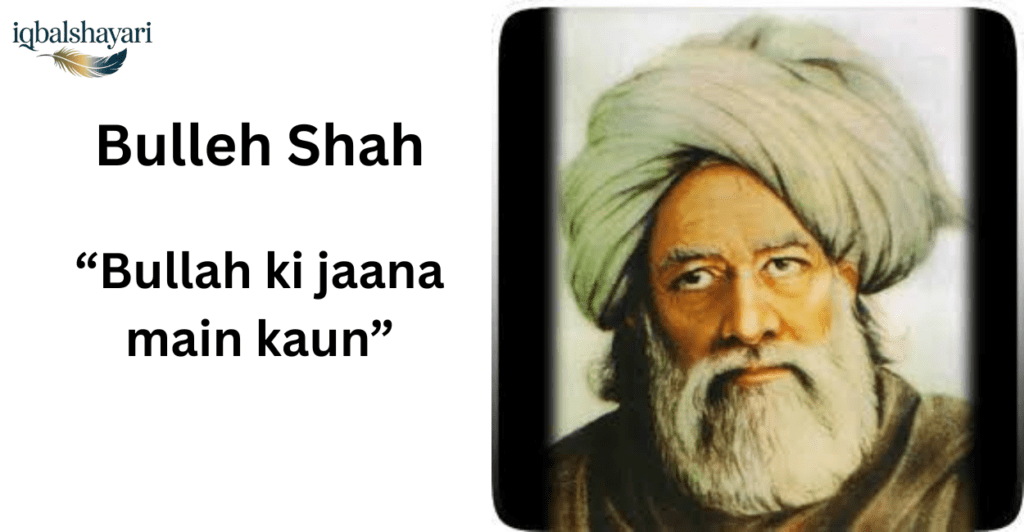
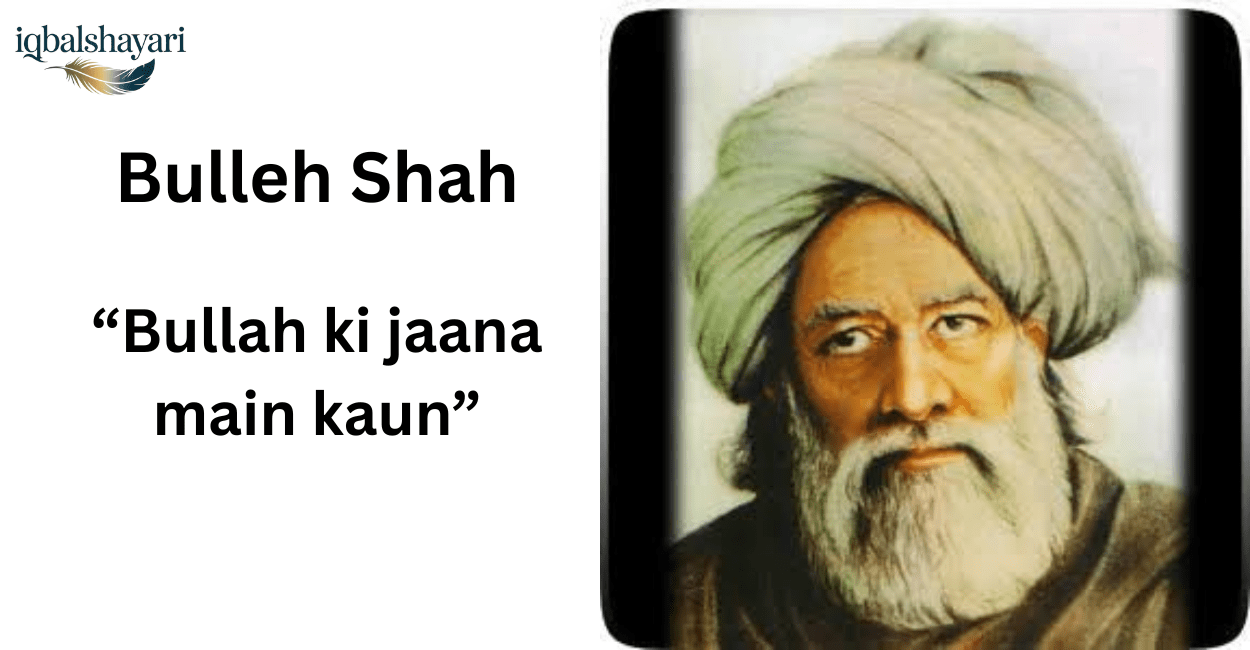
His most famous work, “Bullah ki jaana main kaun” (Bulleh, what do I know who I am?), captures the essence of his spiritual philosophy. In this kafi, he systematically dismantles every identity marker that society uses to define people:

He declares he’s neither Muslim nor Hindu, neither believer nor infidel. He rejects identification with any religious sect, any social class, any fixed category. The poem builds through negations, stripping away layer after layer of socially constructed identity, pointing toward something beyond all labels—the divine essence that is our true nature.
Other celebrated kafis like “Tere Ishq Nachaya” (Your love made me dance) and “Alif Allah Chambey Di Booti” (God is the essence like a flower in the garden) explore themes of divine intoxication, mystical union, and the supremacy of love over religious law.
His poetry employed everyday metaphors that resonated with ordinary people. The spinning wheel represented the cycles of existence. The bride seeking her beloved symbolized the soul’s longing for God. Wine stood for divine intoxication. These symbols came from the lived experience of his audience, making mysticism accessible without diluting its depth.
Core Teachings: Love Beyond Law
At the heart of Bulleh Shah’s philosophy is ishq—divine love. But this isn’t sentimental or emotional love. It’s an all-consuming spiritual passion that destroys the ego and merges the lover with the beloved. This love operates as a spiritual force more powerful than religious law, ritual observance, or scholarly knowledge.
He taught that the fundamental barrier to spiritual realization is the ego, what Sufis call the nafs. All our social identities—our caste, our religious affiliation, our achievements, our status—are constructions of this ego. Spiritual progress requires the complete dissolution of this false self through the process of fana (ego annihilation), leading to baqa (subsistence in God).
Bulleh Shah relentlessly criticized religious orthodoxy. He questioned the value of prayer without sincere devotion, pilgrimage without inner journey, fasting without genuine self-restraint, and religious scholarship without self-knowledge. In his most provocative statement, he suggested it’s better to tear down mosques and temples than to break a single human heart, because God resides in the heart.
His religious pluralism was radical for his time and remains challenging today. He recognized truth in multiple religious traditions, saw Hindu yogis and Muslim Sufis as seeking the same ultimate reality, and rejected sectarian identity as a barrier to spiritual realization. His famous line “I am neither Hindu nor Muslim; my mosque is the tavern, my faith is love” summarizes this inclusive vision.
The Caste Revolution
Perhaps Bulleh Shah’s most revolutionary stance was his attack on caste discrimination. His relationship with Shah Inayat wasn’t just a personal choice—it was a theological statement. He argued that spiritual realization, not birth circumstances, determines human worth.
This teaching struck at the foundation of social order in 18th-century Punjab. The caste system wasn’t just a Hindu institution; it had deeply infiltrated Muslim society as well, with families like Bulleh Shah’s Syeds occupying the top of the hierarchy and groups like Shah Inayat’s Arains relegated to lower status.
Bulleh Shah’s poetry consistently mocked those who took pride in their high birth while lacking spiritual insight. He celebrated the spiritual superiority of the supposedly inferior, turning social hierarchies upside down. This message resonated powerfully with marginalized communities, who found in his verses religious validation for their human dignity.
Death and the Final Controversy
When Bulleh Shah died around 1757 or 1758 in Kasur (historical accounts vary slightly on the exact year), even his death became controversial. The culmination of a lifetime of opposition from religious authorities, orthodox scholars refused to lead his funeral prayers. They declared him outside the fold of Islam due to his heretical teachings.
According to popular tradition, the impasse was only resolved through supernatural intervention—either Shah Inayat’s spirit or another spiritual figure appeared to lead the prayers. Whether this account is historically accurate or legendary, it illustrates how threatening Bulleh Shah’s message was to established religious authority.
He was buried in Kasur, and his tomb quickly became a pilgrimage site. Unlike many saints’ shrines that become exclusive to one religious community, Bulleh Shah’s shrine has always welcomed devotees across religious boundaries—Muslims, Sikhs, Hindus, and others who find inspiration in his universal message.
The Musical Legacy
Bulleh Shah’s poetry found its most powerful contemporary expression through qawwali, the devotional music tradition of South Asian Sufism. In the late 20th century, legendary qawwals like Nusrat Fateh Ali Khan and Abida Parveen brought his kafis to international audiences through electrifying performances that conveyed the ecstatic spiritual states his poetry describes.
The 2006 Bollywood film “Rang De Basanti” introduced Bulleh Shah to a new generation through the hit song “Ranjha Ranjha,” based on his poetry. Contemporary artists from rock bands like Junoon to pop singers like Rabbi Shergill have created modern adaptations, making his 300-year-old verses relevant to youth culture.
This musical revival has made Bulleh Shah one of the most performed Sufi poets globally. His kafis are now standard repertoire for qawwali concerts from Pakistan to California, from wedding celebrations to spiritual gatherings, from traditional sama sessions to contemporary fusion concerts.
Bulleh Shah in America Today
For Punjabi-Americans and South Asian diaspora communities across the United States, Bulleh Shah represents a vital connection to cultural heritage. Major cities with significant Punjabi populations—California’s Bay Area, New York, New Jersey, Chicago, Houston—regularly host events featuring his poetry.
Universities including UC Berkeley, Columbia, and the University of Chicago include Bulleh Shah in their South Asian studies curricula. Cultural centers from Los Angeles to Washington DC organize qawwali nights and poetry readings celebrating his work. These events serve multiple purposes: maintaining linguistic connections for second-generation immigrants, creating interfaith dialogue opportunities, and exploring themes of identity that resonate with diaspora experiences.
The questions Bulleh Shah raised about identity—Who am I beyond my labels? What defines me beyond my community’s expectations?—speak directly to diaspora experiences of navigating multiple cultural identities. His rejection of fixed categories and his emphasis on authentic self-discovery over inherited identity have made him a guide for many negotiating the complexities of bicultural life.
Why He Matters in 2026
Nearly three centuries after his death, Bulleh Shah’s relevance has only intensified. In an era of increasing religious fundamentalism and identity politics, his message of love beyond sectarian boundaries offers an alternative vision. His critique of religious orthodoxy that prioritizes ritual over compassion speaks to modern spiritual seekers frustrated with institutional religion.
His emphasis on questioning fixed identities resonates with contemporary discussions about fluid identity, intersectionality, and the limitations of categorical thinking. His attack on social hierarchies connects to ongoing movements for racial justice, caste equity, and economic equality.
For those interested in interfaith dialogue, Bulleh Shah provides a model of religious pluralism rooted not in relativism but in mystical insight—the recognition that different traditions can point toward the same ultimate reality. His life demonstrates that challenging religious orthodoxy doesn’t require abandoning one’s tradition but rather deepening into its mystical core.
How to Explore Bulleh Shah Today
If you’re new to Bulleh Shah, start with English translations of his most famous kafis. Collections like “The Bullhe Shah” translated by Taufiq Rafat or “A Thousand Petal Lotus” by Puran Singh offer accessible entry points. Read the poems slowly, letting their repetitive refrains create a meditative effect.
Listen to musical performances to experience the emotional power of his poetry. Nusrat Fateh Ali Khan’s renditions capture the ecstatic intensity of mystical love. Abida Parveen’s performances convey profound devotional depth. Rabbi Shergill’s “Bullah ki jaana” offers a contemporary interpretation that has introduced millions to Bulleh Shah.
For those interested in deeper study, academic works by scholars like Christopher Shackle and Farina Mir provide historical and literary context. Online resources including YouTube channels dedicated to Punjabi poetry, podcasts exploring Sufi mysticism, and digital archives of qawwali performances make his work more accessible than ever.
Frequently Asked Questions
When was Bulleh Shah born and when did he die?
Bulleh Shah was born around 1680 in Uch Sharif, Punjab, and died approximately in 1757 or 1758 in Kasur, Punjab. Some historical sources cite slight variations in these dates due to limited written records from that era. He lived during the declining years of the Mughal Empire under Aurangzeb’s rule, a period of religious rigidity and social stratification.
Who was Bulleh Shah’s spiritual teacher and why was this controversial?
Shah Inayat Qadiri Shatari was Bulleh Shah’s spiritual master. The relationship was controversial because Shah Inayat came from an Arain background, an agricultural caste considered socially inferior to Bulleh Shah’s Syed lineage. In 18th-century Punjab’s rigidly hierarchical society, a high-caste religious scholar becoming the disciple of a lower-caste master violated fundamental social norms and scandalized both Bulleh Shah’s family and the religious establishment.
What language did Bulleh Shah write in and why does it matter?
Bulleh Shah primarily wrote in Punjabi, the vernacular language of common people, rather than Persian, which was the language of religious and literary elites. This choice was revolutionary because it democratized access to mystical knowledge, making profound spiritual teachings available to illiterate farmers and artisans rather than limiting them to educated scholars. His decision elevated Punjabi from a spoken vernacular to a vehicle for sophisticated philosophical and mystical expression.
What is Bulleh Shah’s most famous poem?
“Bullah ki jaana main kaun” (Bulleh, what do I know who I am?) is his most celebrated work. This profound kafi systematically dismantles fixed identity through a series of negations—Bulleh Shah declares he is neither Muslim nor Hindu, neither believer nor infidel, rejecting all conventional identity markers. The poem points toward mystical realization beyond conceptual categories. Rabbi Shergill’s contemporary musical version introduced this poem to millions of new listeners globally.
Why was Bulleh Shah so controversial during his lifetime?
Bulleh Shah faced opposition on multiple fronts. His discipleship to a lower-caste master violated social hierarchies. His poetry questioned religious orthodoxy and appeared to place love above Islamic law, leading to accusations of heresy. His inclusive attitude toward other religions was seen as undermining Islamic exclusivity. His criticism of caste discrimination and association with marginalized communities alienated him from power structures. The controversy peaked when orthodox scholars initially refused to perform his funeral prayers, declaring him outside mainstream Islam.
Where is Bulleh Shah’s shrine and can anyone visit?
Bulleh Shah’s tomb is located in Kasur, Punjab, Pakistan, approximately 50 kilometers south of Lahore. The shrine welcomes visitors from all religious backgrounds—Muslims, Sikhs, Hindus, and others. During his annual urs (death anniversary), thousands gather for multi-day celebrations featuring qawwali performances and poetry recitations. The shrine’s inclusive atmosphere reflects Bulleh Shah’s universal message of love transcending sectarian boundaries.
How is Bulleh Shah relevant to modern times?
Bulleh Shah’s teachings address contemporary concerns including religious extremism (his pluralistic approach offers alternatives to fundamentalist interpretations), identity politics (his questioning of fixed identities speaks to modern discussions of fluid identity), social justice (his anti-caste stance supports equality movements), and authentic spirituality (his emphasis on inner truth over external conformity resonates with modern spiritual seekers). His work informs interfaith dialogue initiatives and provides frameworks for religious coexistence in pluralistic societies.
How can I access Bulleh Shah’s poetry and music in the United States?
English translations are available through major online retailers and many public libraries, with prices typically ranging from $15-$35 for poetry collections. Qawwali performances featuring his work are available on streaming platforms like Spotify, Apple Music, and YouTube, with subscription costs around $10-$15 monthly. Major cities with Punjabi populations—including Los Angeles, Bay Area, New York, Chicago, and Houston—regularly host live qawwali concerts and cultural programs featuring his poetry, with ticket prices typically $25-$75. University libraries often maintain South Asian collections including academic works on Bulleh Shah.
Conclusion
Bulleh Shah’s life represents a radical commitment to spiritual authenticity over social conformity. Born into privilege, he chose truth over status, love over law, and universal compassion over sectarian identity. His poetry transformed Punjabi into a language of mystical expression, making profound spiritual insights accessible to everyone regardless of education or social rank.
The controversies he sparked—his relationship with Shah Inayat, his challenge to religious orthodoxy, his attack on caste hierarchies—weren’t side effects of his spiritual path. They were the path itself. He demonstrated that authentic spiritual realization inevitably challenges unjust social structures and religious hypocrisy.
Three centuries later, his voice remains urgent. In a world increasingly divided by religious fundamentalism, ethnic nationalism, and rigid identity politics, Bulleh Shah offers an alternative vision rooted in mystical insight: that our common humanity and shared divine essence matter infinitely more than the labels that separate us. His question “Who am I?” remains the most important question anyone can ask, and his life demonstrates the liberation that comes from releasing all false answers.
For diaspora communities navigating multiple cultural identities, for spiritual seekers frustrated with institutional religion’s empty rituals, for social justice advocates challenging oppressive hierarchies, for anyone questioning who they really are beneath society’s definitions—Bulleh Shah’s poetry and life offer guidance, inspiration, and hope. His message is simple but revolutionary: Love is the only truth that matters, and it transcends every boundary we construct.