Introduction:
There is a moment on Eid morning — just after the prayer, when the congregation turns to embrace one another — where language almost fails. The feeling is too large, too layered, too full of everything that Ramadan built and everything that this day releases. It is precisely in that gap that eid poetry has lived for over a thousand years.
From the literary courts of the Mughal Empire to the WhatsApp groups of Birmingham and Houston, poetry for Eid has always been the way people reach for something bigger than a simple greeting. It names the experience with precision and beauty. It holds the joy, the gratitude, the longing, and the faith all at once — in a handful of carefully chosen lines.
This is the most complete guide to eid poetry you will find — covering every form, every occasion, every relationship, and every platform. Whether you want a two-line verse to send tonight or a deeply felt poem to read at a gathering, everything you need is here.
What Is Eid Poetry — and Why Does It Matter?
Eid poetry is verse composed to honour and express the emotional and spiritual experience of the two major Islamic festivals: Eid ul-Fitr and Eid ul-Adha. It is not a modern trend or a social media invention. The tradition stretches back to the earliest centuries of Islamic civilisation, beginning with Arabic odes, flowing through Persian literary courts, arriving in the magnificent poetry of Eid in Urdu during the Mughal era, and now finding a powerful new voice in contemporary English writing.
What separates eid poetry from a standard greeting is depth. A good Eid poem does not simply say “Happy Eid.” It reaches for what the festival actually feels like — the anticipation the night before, the sound of takbeer at dawn, the embrace of someone you have not seen since last Eid, the particular quiet that settles after the prayer ends. It names the experience precisely and beautifully.
Eid poetry matters because the festival itself demands language equal to it. Eid carries too many emotional layers — relief, gratitude, joy, longing, faith, community — for ordinary prose to hold comfortably. Poetry compresses all of it into lines that people save, memorise, and return to year after year.
Today, eid poetry travels on WhatsApp at midnight on Chaand Raat, appears in Instagram captions, is recited at mosque community events, printed on greeting cards, and published in literary journals. The tradition has grown with the global Muslim community, and the best contemporary Eid verse reflects the full, rich reality of what it means to celebrate this festival in 2025.
The History Behind Eid Poetry — From Ancient Tradition to Modern Verse
The tradition of composing poetry for Eid predates the printed word by many centuries. In the early Islamic world, Arabic poets honoured the festival with formal odes called qasidas — lengthy, elaborate compositions that praised God, celebrated the community, and marked the significance of the occasion.
As Islam spread into Persia, the tradition absorbed the extraordinary richness of Persian literary culture. Poets like Rumi and Hafiz wove themes of divine love and spiritual joy into their Eid-related verse, giving the tradition a mystical depth it has never lost.
The most celebrated chapter in the history of eid poetry belongs to the Urdu literary tradition of the Indian Subcontinent. During the Mughal era, grand mushairas — formal poetry gatherings — were held during Eid, where poets competed to produce the most moving verse before audiences who responded to each couplet with passionate appreciation. This tradition shaped the emotional vocabulary that Muslims across South Asia still reach for every Eid.

The great names of poetry for Eid in Urdu — Mirza Ghalib, Allama Iqbal, Faiz Ahmed Faiz, Ahmad Faraz, Parveen Shakir — were not simply writing greeting card verse. They were engaging with Eid as a philosophical, spiritual, and deeply human occasion. Their work elevated the tradition and set a standard that continues to inspire.
Today, that same tradition is being carried forward in English by a generation of Muslim diaspora writers in the UK, USA, Canada, and Australia — producing eid poetry that holds two cultural identities simultaneously and speaks to experiences that previous generations of poets could not have imagined.
Types of Eid Poetry — Finding the Right Form for the Right Moment
Not all eid poetry serves the same purpose or carries the same tone. Understanding the different types helps you choose — or write — exactly the right verse for the right occasion.
Devotional Eid Poetry focuses on gratitude to God, the spiritual meaning of the festival, and the inner experience of worship. These are the poems read after prayer, shared at religious gatherings, or kept privately as personal reflection. They are quieter and more inward than celebratory verse, and they carry a solemnity that short greeting shayari does not aim for.
Celebratory and Festive Eid Poems focus on the outward joy of the occasion — the food, the family, the new clothes, the children’s excitement, the electric energy of the Eid prayer ground. They are warm, accessible, and built for sharing. Most of the short two-line eid poetry you see on social media falls into this category.
Poetry for Eid Dedicated to Loved Ones is perhaps the most emotionally powerful category. Poems written specifically for a mother, father, sibling, child, or friend carry a personal intimacy that no generic celebration verse can match. These are the poems people screenshot, print, and keep.
Reflective and Philosophical Eid Poetry takes the longer view — meditating on the passage of time, the meaning of sacrifice, the nature of gratitude, or what it means to celebrate faith in a complicated world. This is the tradition that the great poetry of Eid in Urdu masters worked in, and it continues powerfully in contemporary writing.
Diaspora Eid Poetry is a growing and deeply original tradition — verse that holds the experience of celebrating Eid far from one’s homeland, in a country that does not share the festival. This is some of the most compelling eid poetry being written today, by Muslim writers navigating between cultures, languages, and identities.
Eid ul-Fitr Poetry — Verses for the Festival of Breaking the Fast
Eid ul-Fitr follows the holy month of Ramadan and carries a very particular emotional texture. The relief of completion. The joy of reunion. The sweetness of the first meal eaten in daylight after thirty days of fasting. The best Eid ul-Fitr poetry captures this specific mixture of exhaustion, gratitude, and exhilaration.
The central images of eid poetry for Eid ul-Fitr are well established across cultures and languages: the crescent moon that announces the festival, the dawn prayer at the Eidgah, the new clothes, the smell of sweet dishes being prepared before sunrise, the embraces exchanged between worshippers after the prayer ends. These images carry emotional weight that readers across the world recognise instantly.
Here are three original English verses in the spirit of this tradition:
The crescent has been sighted — let the celebration start, A month of patient fasting, now joy fills every heart. We rise before the sunrise and gather side by side, In gratitude to God above, in love and humble pride.
Thirty dawns of hunger and prayer have passed, The soul is lighter, the heart holds more than before. Today we feast not just on bread and sweet, But on the mercy God opened at every door.
The kitchen smells of cardamom and rose, The children dressed in colours bright and new. My mother stirs the sweetness on the stove — This is what home means. This is Eid to me.
The third verse above reflects something important about eid poetry at its most effective: it is not the grand statement but the specific, sensory detail — the smell, the sound, the particular gesture — that makes a poem land.
Eid ul-Adha Poetry — Verses of Sacrifice, Devotion and Generosity
Eid ul-Adha is a festival of a different emotional register entirely. It commemorates the supreme act of devotion by Prophet Ibrahim (peace be upon him) — his willingness to sacrifice what he loved most in complete obedience to God. The poetry of Eid ul-Adha is accordingly more solemn, more philosophical, and more spiritually demanding to write well.
The best eid poetry for this occasion does not shy away from the weight of the festival. It engages honestly with what sacrifice means — not just the ritual, but the deeper human question of what we are willing to surrender for what we believe in. It also honours the social dimension of Eid ul-Adha: the obligation to share the sacrifice with those who have less, which is one of the most beautiful aspects of this festival.
He raised the blade with trembling, faithful hands, Not knowing what the next breath would demand — And God, who sees what human hearts cannot, Replaced the grief with mercy, as He planned.
What is it that we sacrifice today? Not merely flesh and bone upon the stone — But ego, pride, the grip of what we own, The self we clutch and think we call our own.
We share the meat with those whose tables are bare, This is the Eid that teaches us to care — That joy is only joy when it is spread, And God is thanked by giving what we have.
Notice how each of these eid poetry examples approaches the same festival from a different angle: the first meditates on the story of Ibrahim, the second turns inward to ask what personal sacrifice means, and the third looks outward to the communal act of generosity. This range of approach is what gives poetry for Eid its richness.
Short Eid Poetry and Two-Line Verses — Perfect for Sharing
Sometimes two lines are enough. The shortest eid poetry — crisp, warm, and instantly shareable — travels furthest on messaging apps and social media. Here is a curated selection of two-line and short-form Eid Mubarak verses built to carry real feeling in minimal space.
May your Eid be bright as the crescent moon, And your joy as wide as the morning sky.
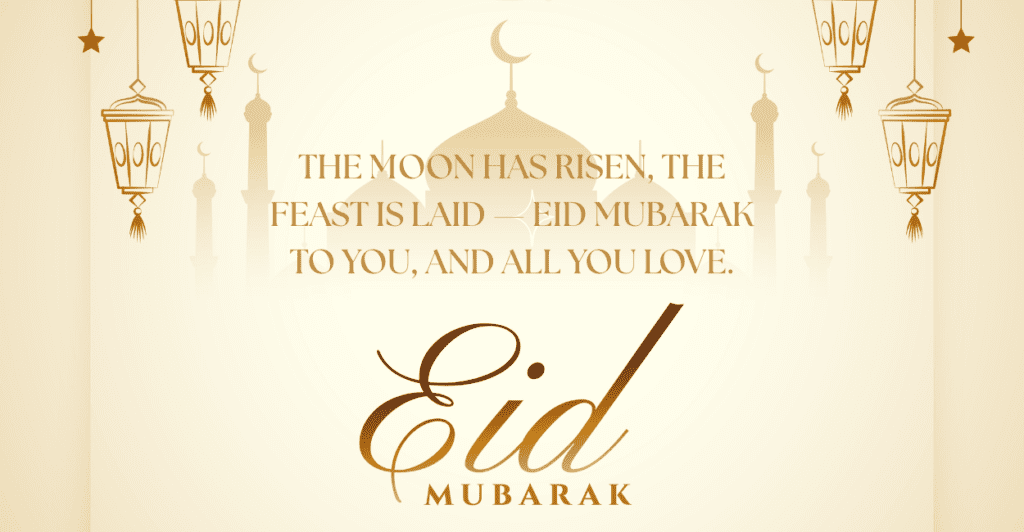
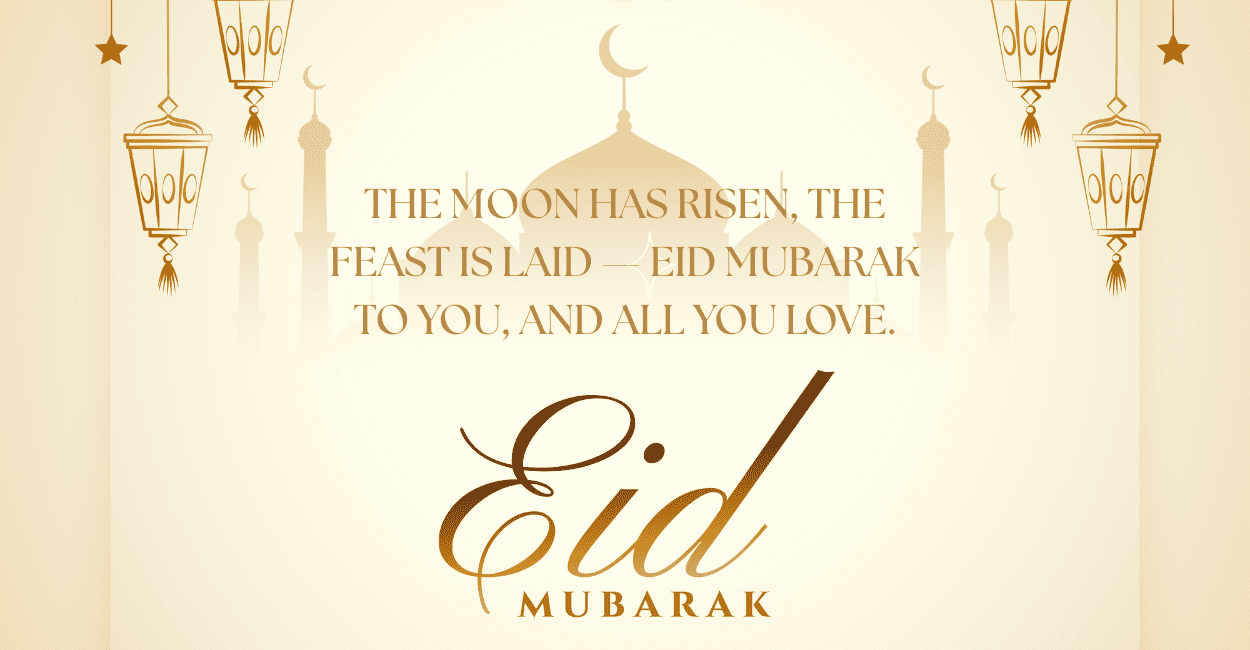
The moon has risen, the feast is laid — Eid Mubarak to you, and all you love.
May every prayer you offered in the dark Be answered in the light of this blessed day.
A thousand Ramadans could not teach What one true Eid morning gives the heart.
Wear joy like new clothes today, And carry it long past Eid is done.
God heard what you whispered in the last ten nights. Today is His answer. Eid Mubarak.
Each of these short eid poetry verses works because it contains one precise, genuine insight rather than a collection of general platitudes. That specificity is the difference between verse that is felt and verse that is scrolled past.
Eid Poetry for Family — Verses for Mothers, Fathers, Children and Friends
The most personally meaningful eid poetry is always that written for someone specific. A poem for your mother on Eid carries a different weight than any general celebration verse. A poem for a child on their first remembered Eid is something they may keep for decades. Here are dedicated verses for the most important relationships in Eid celebrations.
Eid Poetry for a Mother
You rose before the call to prayer each dawn And cooked what love alone could teach your hands. Every Eid I’ve known has lived in you — The sweetness, warmth, the faith you kept for us. May God return to you what you have given, In blessings deeper than you thought to ask.
Eid Poetry for a Child
Today the world is dressed in its finest clothes And every door is open wide for you. Run, small one — the morning is yours to keep, And Eid has saved its brightest light for you.
Eid Poetry for a Friend Far Away
Across whatever distance sits between us now, I send you this: the moon, the prayer, the wish That every Eid finds you well and loved, And no year passes without us sharing this.
The poetry for Eid written for loved ones works best when it uses one specific, truthful detail rather than generalised affection. The mother poem works because of “cooked what love alone could teach your hands” — a line that captures something real about how mothers make festivals possible. Find that specific truth in your own relationship and your poem will write itself.
Poetry for Eid in Urdu — The Classical Tradition
No guide to eid poetry would be complete without acknowledging the classical tradition of poetry for Eid in Urdu that gave the genre much of its depth, sophistication, and emotional vocabulary.
Urdu eid poetry — known as Eid ki Shayari — is one of the richest literary traditions in the Islamic world. It developed during the Mughal era and flourished through the colonial period and into the modern age, producing poets whose work remains recited, memorised, and shared every Eid across Pakistan, India, and the global South Asian diaspora.
Allama Iqbal (1877–1938) gave poetry of Eid in Urdu its most philosophically ambitious dimension. His verses call Muslims not just to celebration but to spiritual self-renewal — to understand Eid not as a reward for thirty days of fasting but as a beginning, a fresh commitment to living fully and faithfully. His collection Bang-e-Dra contains Eid-related verses still recited in Pakistani schoolrooms and London community halls alike.
Mirza Ghalib (1797–1869) brought his characteristic philosophical complexity to eid poetry — joy tinged with irony, celebration shadowed by longing. His influence is visible every time a poet writes about Eid as a moment that holds both presence and absence simultaneously.
Faiz Ahmed Faiz (1911–1984) wrote poetry for Eid in Urdu that celebrated the festival as an occasion for human equality and brotherhood — themes that continue to resonate with readers who see Eid as a moment when social and economic differences dissolve at the Eidgah.
Ahmad Faraz and Parveen Shakir brought the modern sensibility to poetry of Eid in Urdu — Faraz capturing the romantic longing of separation, Shakir bringing a feminine perspective that the classical canon had largely overlooked.
The key forms of poetry for Eid in Urdu include the ghazal (a structured lyrical poem of rhyming couplets), the nazm (a thematic poem with a unified narrative), the qita (a short standalone stanza ideal for greetings), and the sher (a single couplet, the two-line form most widely shared today). Understanding these forms deepens appreciation of eid poetry across all languages.
How to Write Your Own Eid Poetry
Writing eid poetry is more achievable than most people believe. You do not need a literary degree or years of practice. You need one honest feeling and the willingness to find precise words for it.
Start with a single specific emotion. What does Eid mean to you this particular year — not in general, but this year? Gratitude? Relief? Longing for someone who is not here? Pure happiness? The most powerful eid poetry begins from a precise emotional truth, not a vague celebratory impulse.
Use sensory detail. What do you see, hear, smell, taste on Eid morning? The call to prayer at dawn. The smell of food being prepared before sunrise. The sound of children. The feeling of new fabric. Specific sensory details make eid poetry feel real and memorable in a way that abstract statements never do.
Choose a simple structure. A four-line rhyming verse (quatrain) is the most beginner-friendly form. Alternatively, try three-line free verse stanzas — no rhyme required, just strong imagery and honest feeling. The poetry for Eid in Urdu tradition uses the four-line qita as its most accessible form for exactly this reason.
Write a first draft without editing. Get everything down. It will be rough. No good eid poetry starts perfect. The goal of the first draft is simply to find what you actually want to say.
Cut the obvious lines. Any line that just states the obvious — “Eid is a wonderful festival” — should be replaced with something that shows rather than tells. What specific moment captures that feeling? What image makes the emotion visible?
Read it aloud. All eid poetry lives in the ear before it lives on the page. Read your draft aloud and you will immediately hear what works and what does not. Where it stumbles, simplify. Where it flows, trust it.
Where and How to Share Eid Poetry
The platform shapes the poem as much as the words do. Different formats work better in different contexts, and matching your eid poetry to the right channel makes a significant difference.
WhatsApp and Telegram are where most eid poetry sharing happens today. Short two-line verses work best — easy to read in a notification preview, easy to forward. Send on the eve of Eid for maximum emotional resonance. A voice message reading the poem adds a warm personal dimension that text alone cannot replicate.
Instagram and Facebook reward slightly longer verses — four to eight lines — paired with clean visual content. Carousel posts work beautifully for longer poetry for Eid, with one stanza per slide. Use hashtags including #EidMubarak, #EidPoetry, #EidulFitr, and #EidulAdha to reach wider audiences. Reels with a poem read aloud over gentle background music consistently outperform static posts.
Greeting cards and handwritten letters remain the most meaningful channel for eid poetry that truly matters. A handwritten poem is one of the most personal gifts you can give. Choose a devotional or relationship-specific verse rather than a generic celebration one, and keep it to six to ten lines — enough to be meaningful without overwhelming the card.
Community events and gatherings are where longer, reflective eid poetry comes into its own. A poem read aloud at an Eid prayer gathering or community dinner is remembered long after the event. Practise reading slowly — most people rush when they are nervous, and poetry for Eid needs space to breathe.
One important principle applies across all platforms: always credit the poet when sharing work that is not your own. The poetry of Eid in Urdu tradition has always valued attribution deeply, and that principle deserves to carry forward into English sharing culture. If you do not know who wrote a verse, “author unknown” is always more honest than a guess.
Eid Poetry for the Diaspora — Celebrating Far From Home
One of the most emotionally powerful strands of contemporary eid poetry is the writing that emerges from the diaspora experience. For millions of Muslims living in countries where Eid is not a public holiday — where the streets do not transform overnight, where not everyone around them understands what the day means — the festival carries a particular and complex weight.
Celebrating Eid in London, Chicago, Toronto, or Sydney is genuinely different from celebrating it in Karachi, Cairo, or Kuala Lumpur. The joy is real, but so is the negotiation between cultures, the longing for the version of the festival you grew up watching, the effort it takes to mark the day fully when the world around you continues unchanged.
This tradition of diaspora eid poetry produces some of the most original English-language Islamic verse being written today. It is worth seeking out — the poems of Muslim writers published in journals and collections in the UK, USA, Canada, and Australia represent a genuinely new development in the long history of eid poetry, and they speak to experiences that previous generations of poets in any language could not have written about.
Common Mistakes to Avoid in Eid Poetry
Even well-intentioned eid poetry can fall flat when certain mistakes creep in. Here are the most common ones to avoid.
Generic statements without specific feeling are the most frequent problem in eid poetry shared online. Phrases like “Eid is a time of joy and blessings” communicate almost nothing because they apply to every Eid everywhere. The solution is always specificity — one precise image, one genuine emotion, one real moment.
Forced rhyme is the second most common problem. When a word is chosen because it rhymes rather than because it is the right word, the poem collapses. Modern poetry for Eid increasingly works in free verse precisely because forcing rhyme damages emotional honesty. If a line needs to rhyme and the only rhyme available is awkward, choose free verse instead.
Misattribution is a genuine and growing problem in the sharing of poetry of Eid in Urdu specifically. Verses by unknown poets are regularly attributed to Iqbal, Ghalib, or Faiz. Sharing poetry with a false attribution embarrasses the person sharing it and disrespects both the actual author and the named poet. When in doubt, do not attribute.
Confusing Eid ul-Fitr and Eid ul-Adha themes produces verse that feels tonally wrong. Sweet food references and Ramadan completion imagery in an Eid ul-Adha poem, or sacrifice and Ibrahim references in an Eid ul-Fitr poem, both jar. The two festivals are spiritually distinct and the best eid poetry honours that distinction.
FAQs About Eid Poetry
What is eid poetry?
Eid poetry is verse composed to celebrate and express the emotional, spiritual, and communal experience of Eid ul-Fitr and Eid ul-Adha — the two major Islamic festivals. It ranges from short two-line greeting verses to long devotional and philosophical poems, and exists in Arabic, Persian, Urdu, English, and many other languages.
What is the best eid poetry to share on WhatsApp?
The most effective eid poetry for WhatsApp is short — two to four lines — emotionally warm, and specific enough to feel genuine rather than generic. Verses referencing the moon, the morning prayer, or the feeling of reunion travel fastest. Send on Chaand Raat — the night before Eid — for maximum emotional impact.
What is the difference between poetry for Eid ul-Fitr and Eid ul-Adha?
Eid ul-Fitr poetry focuses on the joy of completing Ramadan, the sweetness of reunion, the relief of the first meal, and family warmth. Eid ul-Adha poetry is more solemn — engaging with Prophet Ibrahim’s sacrifice, the meaning of devotion, and the obligation to share with those who have less. The two festivals celebrate different things, and the best eid poetry reflects that distinction.
Who are the greatest poets of poetry for Eid in Urdu?
The most celebrated voices in poetry for Eid in Urdu include Allama Iqbal (spiritual depth and renewal), Mirza Ghalib (philosophical complexity and longing), Faiz Ahmed Faiz (brotherhood and social justice), Ahmad Faraz (romantic longing and separation), and Parveen Shakir (feminine perspective and domestic warmth). Each brought something irreplaceable to the tradition.
How do I write a simple eid poem?
Start with one specific feeling connected to Eid this year. Choose a four-line structure or simple free verse. Use one concrete sensory detail — something you see, hear, or smell on Eid morning. Write a first draft without editing, read it aloud, then cut anything that sounds forced. Sincerity consistently outperforms technical polish in eid poetry.
What is the poetry of Eid in Urdu called?
Poetry of Eid in Urdu is called Eid ki Shayari. It encompasses several distinct forms: the ghazal (structured lyrical poem), the nazm (thematic narrative poem), the qita (short standalone stanza), and the sher (single couplet). The mushaira — a formal poetry gathering — has been the traditional venue for performing and celebrating poetry for Eid in Urdu for centuries.
Can I use eid poetry on YouTube and Instagram without copyright issues?
Classical eid poetry by poets who died before the early twentieth century is generally in the public domain and may be shared with attribution. Contemporary eid poetry is copyright-protected. For personal non-commercial sharing, brief quotations with clear attribution fall within fair use in most jurisdictions. For commercial use on monetised platforms, permission from the poet or their publisher is required.
Conclusion — The Words Are Yours
For as long as there has been an Eid, there has been eid poetry — rising to meet the occasion with language equal to what the day asks of us. The tradition has moved through Arabic, Persian, Urdu, and English, growing richer at every step, absorbing new voices, new geographies, new ways of being Muslim in a world that keeps changing.
The great poets of poetry for Eid in Urdu — Iqbal, Ghalib, Faiz, Faraz — gave this tradition its philosophical depth. The contemporary diaspora writers working in English are giving it new urgency and reach. And somewhere between those two poles, there is space for your voice too.
The best eid poetry is not always the most technically accomplished. It is the most honest. It is the verse that captures what this specific festival means to you — this year, in your city, in your family, with your particular mix of faith and gratitude and love and longing.
Write it down. Send it to someone who needs to hear it. Say it aloud at the table after the prayer. The words matter more than you think.
Eid Mubarak — may this festival bring you peace, joy, and every blessing.