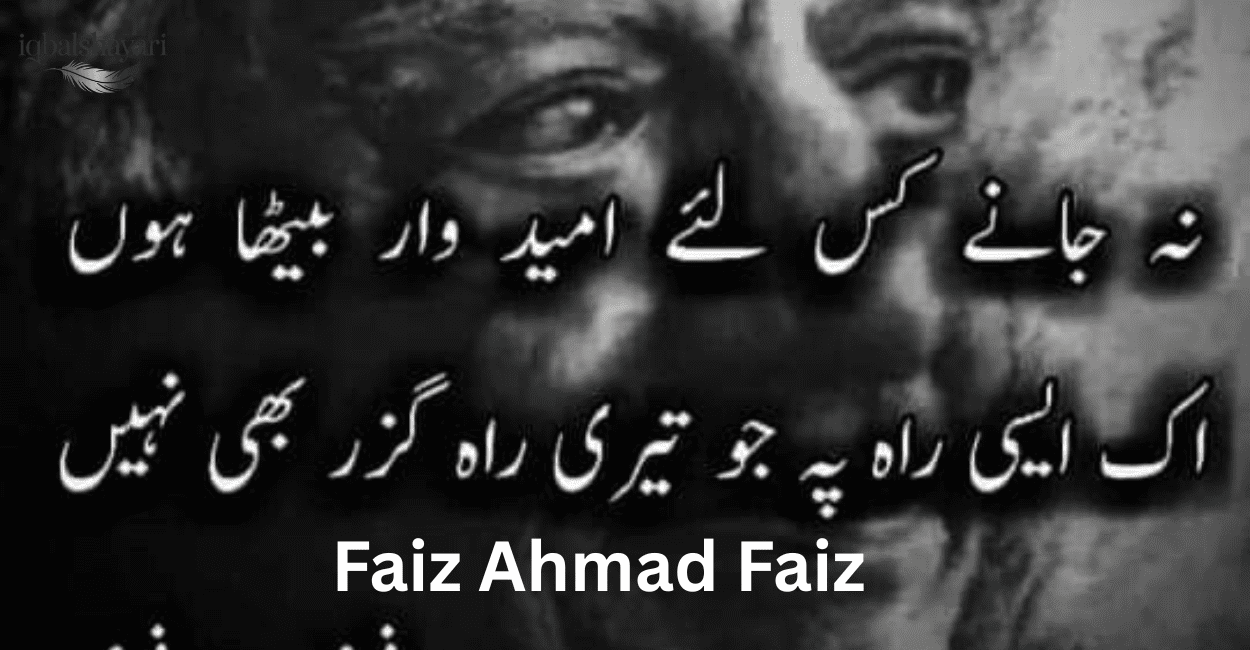
Introduction: Who Made Beauty a Weapon of Resistance
When Faiz Ahmad Faiz was sentenced to death in 1951 for allegedly plotting against the Pakistani government, few could have predicted that his prison cell would become the birthplace of some of the most powerful revolutionary poetry the world has ever known. Today, decades after his death, his verses still echo through protests from Lahore to New Delhi, proving that great poetry transcends both borders and time.
Who Was Faiz Ahmad Faiz?
Faiz Ahmad Faiz (1911-1984) was a Pakistani poet, journalist, and communist activist who revolutionized Urdu poetry by merging classical romantic traditions with progressive political themes. Winner of the Lenin Peace Prize in 1962, he transformed how South Asian literature could speak to both the heart and the barricades.
Born into privilege in Sialkot on February 13, 1911, Faiz rejected the comfortable path laid before him. Instead, he chose to stand with workers, peasants, and the oppressed—a decision that would cost him years in prison but earn him immortality in the hearts of millions.
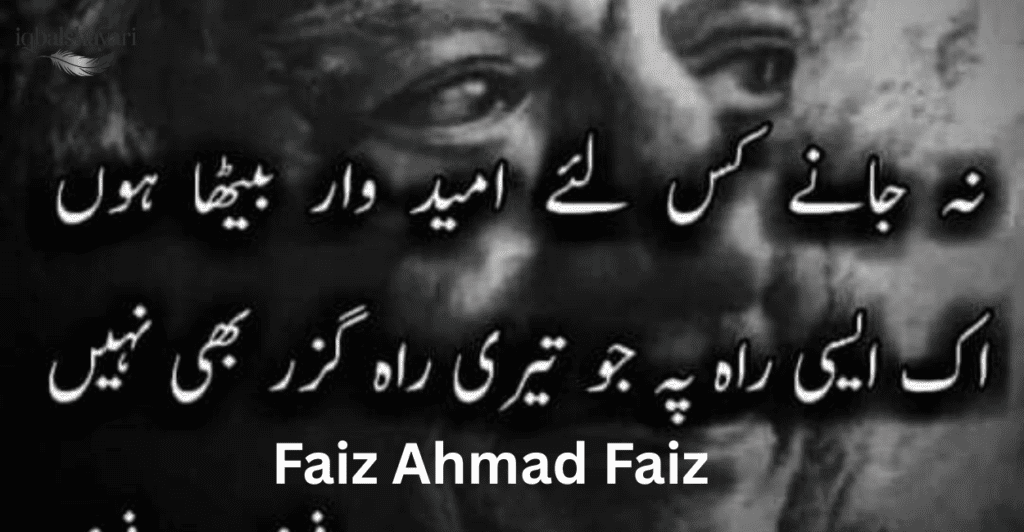
What makes Faiz unique isn’t just his politics or his poetry—it’s how seamlessly he wove them together. His ghazals read like love letters that are simultaneously revolutionary manifestos. A single verse could make you weep for a lost lover while inspiring you to storm the gates of tyranny.
Early Life and the Making of a Revolutionary
Faiz Ahmad Faiz grew up in a prosperous family where education was treasured. His father, Sultan Muhammad Khan, was a successful barrister who ensured his son received the best schooling available in British India.
At Government College Lahore, Faiz immersed himself in both Eastern and Western literary traditions. He earned a Master’s degree in English (1932) and another in Arabic (1934) from Oriental College Lahore. This dual education proved crucial—he could quote Shelley and Keats as easily as Hafiz and Ghalib.
But it was the political ferment of 1930s Lahore that truly shaped him. The Progressive Writers’ Movement, founded in 1936, rejected the idea that literature should merely entertain. Writers, they argued, had a responsibility to illuminate social injustice and imagine better worlds.
Faiz found his calling. He began writing poetry that honored classical Urdu forms while addressing contemporary struggles. His first collection, Naqsh-e-Faryadi (Sketch of Pain), published in 1941, announced the arrival of a major talent.
The Revolutionary Meets His Partner
In 1941, Faiz married Alys George, a British woman who would become far more than just his wife. Alys Faiz converted to Islam, learned Urdu, and became an accomplished translator of her husband’s work. Their cross-cultural partnership symbolized the universality Faiz sought in his poetry.
Alys stood by Faiz through imprisonment, exile, and political persecution. She raised their two daughters—Salima and Moneeza, both of whom became prominent in Pakistan’s cultural scene—while managing the household during his long absences. Her English translations helped introduce Faiz’s poetry to Western audiences.
Military Service and the Birth of Political Consciousness
During World War II, Faiz joined the British Indian Army, eventually reaching the rank of Lieutenant Colonel. He served as a Public Relations Officer, witnessing firsthand the human cost of imperial conflicts.
This experience deepened his communist convictions. He saw how ordinary soldiers—Indian, British, African—were sacrificed for causes that served only the powerful. The contradiction between official rhetoric and bloody reality sharpened his pen.
After Pakistan’s independence in 1947, Faiz became editor-in-chief of the Pakistan Times, using journalism to advocate for democratic governance, workers’ rights, and educational reform. His editorials challenged the new nation’s ruling elite, making him both celebrated and dangerous.
The Rawalpindi Conspiracy Case: From Poet to Political Prisoner
On March 9, 1951, Faiz Ahmad Faiz was arrested along with 14 others in what became known as the Rawalpindi Conspiracy Case. The government accused them of plotting a communist coup against Prime Minister Liaquat Ali Khan.
The charges were serious: overthrowing the state, establishing a socialist government, and collaborating with foreign powers. Faiz was initially sentenced to death.
Whether an actual conspiracy existed remains debated by historians. Some believe military officers genuinely planned a coup. Others argue the government fabricated charges to crush Pakistan’s growing leftist movement. Faiz himself never fully clarified his role, maintaining a dignified silence that only added to his mystique.
After public outcry and international pressure, his death sentence was commuted to life imprisonment. He spent four years (1951-1955) in various Pakistani jails, an experience that paradoxically liberated his poetry.
Prison Poetry: When Chains Produce Freedom
Behind bars, Faiz wrote some of his most enduring work. His prison collection, Zindan-Nama (Prison Notebook), transforms physical confinement into metaphysical meditation on freedom.
“Bol” (Speak), written during this period, became an anthem for free expression:
“Bol ke lab azad hain tere / Bol zabaan ab tak teri hai” (Speak, for your lips are still free / Speak, your tongue is still your own)
The poem doesn’t rage against his captors. Instead, it quietly insists that even in prison, the human spirit remains unconquerable. This restraint made it more powerful than any polemic.
Faiz’s prison poetry demonstrated what he’d long believed: that beauty and resistance aren’t opposites. A perfectly crafted ghazal could be more revolutionary than a thousand manifestos because it moved both heart and mind.
Exile and International Recognition
Released in 1955, Faiz found Pakistan increasingly hostile to dissent. He chose exile over self-censorship, spending significant periods in London, Moscow, and Beirut.
In 1962, the Soviet Union awarded him the Lenin Peace Prize, placing him alongside global icons like Pablo Neruda and Paul Robeson. The recognition was both honor and burden—it confirmed his international stature while marking him as permanently suspect to anti-communist governments.
His years in Beirut (1978-1982) proved particularly influential. As editor of Lotus magazine for the Afro-Asian Writers’ Association, Faiz connected with Palestinian poets and activists. He wrote powerfully about the Palestinian struggle, seeing echoes of his own nation’s unfinished liberation.
The exile years enriched his poetry with new themes—displacement, memory, the ache of distance. Yet he never lost his essential voice, that unique blend of classical elegance and revolutionary fire.
Hum Dekhenge: The Poem That Refused to Die
If one poem captures Faiz’s enduring relevance, it’s “Hum Dekhenge” (We Shall See), written during General Zia-ul-Haq’s martial law in Pakistan.
Using religious imagery from Islamic eschatology, Faiz prophesies the overthrow of tyranny:
“Hum dekhenge / Lazim hai ke hum bhi dekhenge” (We shall see / It is certain that we too shall see)
The poem declares that ordinary people will witness the fall of dictatorships just as believers anticipate the Day of Judgment. By the clothing revolution in spiritual language, Faiz made it both familiar and transcendent.
“Hum Dekhenge” became the most recited protest poem in South Asia. It was sung at demonstrations against military rule in Pakistan during the 1980s. It resurged during India’s anti-CAA protests in 2019-2020. Each generation discovers it anew, finding their struggles reflected in Faiz’s words.
Singer Iqbal Bano’s 1985 performance of “Hum Dekhenge” before 50,000 people in Lahore—defying a government ban on Faiz’s poetry—became legendary. The crowd roared every verse back at her, turning the concert into mass resistance.
Understanding Faiz’s Poetic Innovation
Faiz mastered traditional Urdu poetic forms, particularly the ghazal—a lyric poem consisting of rhyming couplets and a refrain. Classical ghazals typically explore love, wine, or mystical longing.
Faiz took these conventions and subverted them brilliantly. The “beloved” (mahboob) in his ghazals represents both romantic love and freedom itself. “Separation” (hijr) means both personal heartbreak and political oppression. “Union” (visal) signifies both lovers’ meeting and revolutionary victory.
This dual-reading technique was genius. A poem could satisfy traditionalists who heard timeless romance while inspiring radicals who heard revolutionary prophecy. Both interpretations were valid; Faiz intended them to coexist.
His other major form was the nazm—Urdu free verse that allowed more direct statement. Poems like “Bol” use nazm to speak plainly about political realities without sacrificing lyrical beauty.
Major Works and Literary Legacy
Faiz’s complete bibliography spans eight poetry collections published between 1941 and 1981:
- Naqsh-e-Faryadi (1941) – Early romantic-progressive fusion
- Dast-e-Saba (1952) – Hand of the Morning Breeze
- Zindan-Nama (1956) – Prison writings
- Dast-e-Tah-e-Sang (1965) – Hand Under the Stone
- Sar-e-Wadi-e-Sina (1971) – On the Valley of Sinai
- Sham-e-Shahr-e-Yaran (1979) – Evening in the City of Friends
- Mere Dil Mere Musafir (1981) – My Heart, My Traveler
Beyond these collections, individual poems like “Mujh Se Pehli Si Mohabbat Mere Mehboob Na Maang” (Don’t Ask Me for That Love Again) and “Dasht-e-Tanhai” (Desert of Solitude) became standards of Urdu literature.
His work has been translated into over fifteen languages, from Russian to Spanish to Japanese. In the United States, universities with South Asian studies programs regularly teach Faiz in comparative literature courses.
The Communist Who Never Lost His Soul
Faiz’s communism was neither dogmatic nor imported. It grew organically from witnessing inequality in colonial and postcolonial South Asia. He believed workers deserved dignity, that peasants shouldn’t starve while landlords prospered, that imperialism was humanity’s enemy.
But unlike some communist writers who reduced art to propaganda, Faiz never sacrificed aesthetic quality for political messaging. He understood that a beautiful poem moved people more effectively than a crude slogan.
His Marxism was also infused with Sufi mysticism and humanistic warmth. He maintained friendships across political divides, treated even opponents with courtesy, and never claimed certainty where doubt existed.
This non-dogmatic approach explains why Faiz remains beloved even by readers who reject communism. His poetry speaks to universal human longings—for justice, beauty, love, freedom—in language anyone can feel.
Faiz in American Context: Why He Matters Here
For American readers, Faiz Ahmad Faiz offers several points of connection:
Comparative Revolutionary Poetry: Like Langston Hughes, Faiz used poetry to give voice to marginalized communities. Both believed art should serve social justice without becoming mere propaganda.
Translation and World Literature: Faiz exemplifies how great poetry can cross linguistic and cultural boundaries. His work challenges Americans to look beyond English-language literature toward global voices.
Activism and Art: In an era when American artists grapple with political engagement, Faiz provides a model—one that maintained artistic integrity while never flinching from difficult truths.
South Asian American Heritage: For the growing South Asian diaspora in the United States, Faiz connects them to cultural roots while speaking to contemporary American struggles for justice.
His books are available through major US retailers, typically ranging from $15-35 for English translations. University libraries and specialized bookstores in cities like New York, Chicago, and the San Francisco Bay Area carry his works.
Return and Final Years
In 1982, Faiz returned permanently to Pakistan, his health declining. The government remained suspicious, but the literary community welcomed him warmly.
He continued writing until the end, producing verses that meditated on mortality, legacy, and unfinished struggles. On November 20, 1984, Faiz Ahmad Faiz died of a heart attack in Lahore at age 73.
His funeral drew thousands. People from all walks of life—laborers, students, artists, politicians—came to honor the poet who had spoken for them. He was buried in Miani Sahib graveyard in Lahore, where his grave remains a pilgrimage site.
The Living Legacy
Faiz’s influence didn’t end with his death. If anything, it intensified.
His poetry continues as the soundtrack of South Asian resistance. Every major democracy movement, workers’ strike, or student protest features his verses. “Hum Dekhenge” has been sung in languages Faiz never spoke, in countries he never visited.
Contemporary Pakistani and Indian poets cite him as foundational. Singers continue setting his poems to music, finding new melodies for old words. Filmmakers use his verses in soundtracks. Activists quote him in speeches.
Annual Faiz Festivals in Lahore attract international audiences for literary discussions, musical performances, and political dialogues. Faiz Ghar (Faiz House), now a museum, preserves his manuscripts, photographs, and personal belongings.
The Faiz Ahmad Faiz biography isn’t just a historical record—it’s living memory that continues shaping how South Asians think about poetry, politics, and the relationship between beauty and justice.
Frequently Asked Questions
What is Faiz Ahmad Faiz most famous for?
Faiz Ahmad Faiz is most famous for revolutionary Urdu poetry that merged classical romantic forms with progressive political themes. His poem “Hum Dekhenge” became South Asia’s most popular protest anthem. He won the Lenin Peace Prize in 1962 and survived four years of political imprisonment (1951-1955) that produced some of his finest work.
Why was Faiz Ahmad Faiz imprisoned?
Faiz was imprisoned from 1951 to 1955 in connection with the Rawalpindi Conspiracy Case. He was accused of plotting a communist coup against Pakistan’s government along with military officers and other leftist intellectuals. Initially sentenced to death, his sentence was commuted after public pressure. Historians still debate whether the conspiracy was genuine or government fabrication.
What are the main themes in Faiz’s poetry?
Faiz’s poetry explores interconnected themes including revolutionary social change, romantic love as metaphor for freedom, beauty and aesthetics, imprisonment (both physical and metaphorical), exile and belonging, class struggle, anti-imperialism, and hope despite oppression. His unique contribution was showing that political poetry could maintain classical aesthetic sophistication.
Was Faiz Ahmad Faiz a communist?
Yes, Faiz was an open member of the Communist Party of Pakistan and remained committed to Marxist-Leninist ideology throughout his life. However, his communism was non-dogmatic and culturally rooted. He maintained friendships across political divides and never sacrificed artistic quality for propaganda. His progressive politics were integral to his poetry without overwhelming it.
How did Faiz influence Pakistani culture?
Faiz profoundly shaped Pakistani cultural identity through poetry that became protest anthems, influenced multiple generations of writers and artists, established a progressive literary tradition, and provided language for resistance movements. His verses are regularly performed in music, cited in political discourse, taught in schools, and recited at demonstrations. Annual Faiz Festivals continue celebrating his legacy.
Where can I read Faiz’s poetry in English in the United States?
Faiz’s poetry is available in English translation through major US retailers and online bookstores. Look for collections translated by scholars like Victor Kiernan and Agha Shahid Ali, typically priced $15-35. University libraries with South Asian studies programs carry his works. Digital editions are available for $9.99-19.99. Cities with large South Asian populations have specialized bookstores stocking his collections.
What is the meaning of Faiz’s poem “Hum Dekhenge”?
“Hum Dekhenge” (We Shall See) is a revolutionary poem asserting that tyranny will eventually fall and justice will prevail. Written during General Zia-ul-Haq’s martial law, it uses Islamic Day of Judgment imagery to promise the overthrow of dictatorships. The poem declares that ordinary people will witness the downfall of oppressors and establishment of truth. It’s become the most recited protest poem across South Asia.
How does Faiz compare to poets like Pablo Neruda?
Faiz and Pablo Neruda share remarkable parallels—both were communist poets who merged political commitment with lyrical beauty, both won the Lenin Peace Prize, and both remain widely read decades after death. The key difference: Faiz worked within classical Urdu forms (especially ghazals) while Neruda pioneered free verse in Spanish. Both proved that revolutionary poetry needn’t sacrifice aesthetic quality.
Conclusion
Faiz Ahmad Faiz proved that a poet could be simultaneously a revolutionary and a romantic, a political prisoner and a classical master, a communist and a humanist. His life spanned the most turbulent decades of South Asian history, yet his poetry speaks to struggles far beyond any single time or place.
What makes the Faiz Ahmad Faiz biography compelling isn’t just his personal courage or literary genius—it’s how he demonstrated that beauty itself can be a form of resistance. In an age that often separates art from activism, Faiz reminds us they’re inseparable.
His verses continue echoing through protests because they speak truths that remain urgent: that justice delayed is justice denied, that freedom unexpressed atrophies, that hope must be defended even—especially—when darkness seems overwhelming.
For anyone seeking to understand how poetry can matter politically without becoming propaganda, how tradition can serve revolution, or how one voice can inspire millions, Faiz Ahmad Faiz remains the essential study.