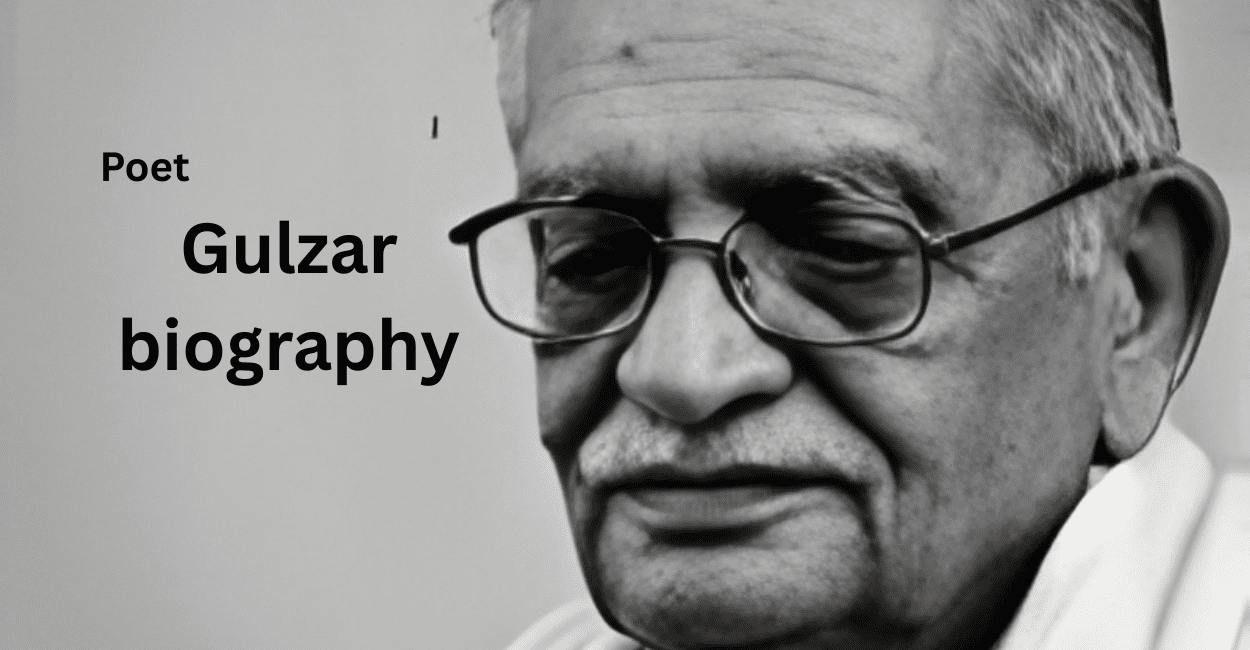
Introduction: Gulzar Biography
Gulzar is one of those rare cultural figures whose work feels both deeply personal and universally relatable. For more than sixty years, his words have lived in poems, film songs, stories, and silences that stay with people long after they are read or heard. To understand Gulzar is to understand how modern South Asian literature and cinema learned to speak softly yet powerfully.
This Gulzar biography traces Gulzar’s life in full context: his origins, the historical forces that shaped him, his creative journey, and the legacy he continues to build.
Who Is Gulzar?
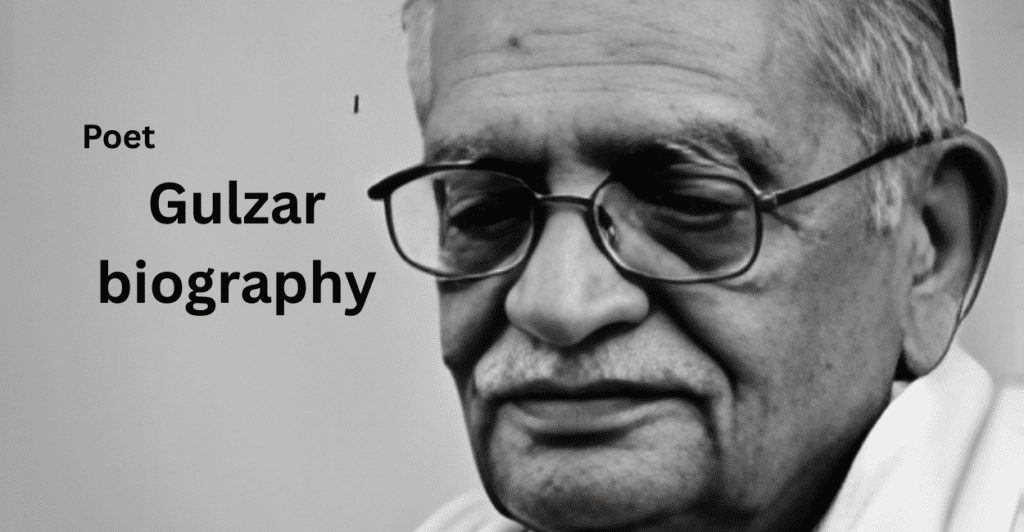
Gulzar is the pen name of Sampooran Singh Kalra, an Indian poet, lyricist, author, screenwriter, and film director. He is best known for modern Urdu poetry and Hindi film lyrics that balance emotional depth with simple, conversational language.
What sets Gulzar apart is his ability to bridge two worlds. He belongs equally to serious literature and popular culture. His poetry is discussed in academic circles, while his lyrics are sung by millions who may never open a poetry book.
Early Life and Roots
Gulzar was born on 18 August 1934 in Dina, a small town in Punjab during British India. Today, Dina is located in Pakistan. He was born into a Sikh family, but his cultural surroundings were diverse, shaped by Punjabi, Urdu, and Hindi traditions.

From a young age, Gullzar felt drawn to words rather than classrooms. His formal education remained limited, but his reading was wide and instinctive. Urdu poetry, in particular, left a lasting impression on him and would later become the core language of his creative expression.
The Partition and Its Deep Influence
The Partition of India in 1947 marked a turning point in Gullzar’s life. Like millions of others, his family was forced to leave their home and migrate to India. This experience of displacement, uncertainty, and loss became a quiet undercurrent in his writing.
Instead of turning to overt political commentary, Gulzar chose a more intimate path. His work reflects:
- The emotional cost of separation
- A sense of longing for places left behind
- Silence as a form of memory
- Personal loss over historical rhetoric
Partition shaped not just his themes, but his tone. It taught him restraint, and that restraint became his signature.
Moving to Mumbai and Finding His Way
After resettling in India, Gullzar eventually moved to Mumbai, the center of the Hindi film industry. Like many young creatives, he struggled at first. He took up small jobs to survive, while quietly observing the world around him.
His life changed when he met Bimal Roy, one of Indian cinema’s most respected filmmakers. Gulzar worked as an assistant under Roy, absorbing lessons in realism, discipline, and humane storytelling. This apprenticeship gave him a foundation that would later define his work, both in cinema and literature.
Entry Into Hindi Cinema
Gullzar began his professional writing career as a lyricist in the early 1960s. At that time, Hindi film songs were often dramatic and heavily stylized. Gullzar introduced something new: emotional honesty wrapped in everyday language.
His lyrics did not shout. They whispered. And that whisper felt closer to how people actually experience love, loss, and memory.
Gulzar as a Lyricist
Over the decades, Gullzar wrote thousands of songs that reshaped Hindi film music. His lyrics often focus on inner emotions rather than grand gestures.
Common themes in his songs include:
- Love as companionship rather than fantasy
- Separation without bitterness
- Time as a living presence
- Unspoken feelings and emotional pauses
He collaborated with some of the most influential figures in Indian cinema, including R.D. Burman, A.R. Rahman, Hrishikesh Mukherjee, Yash Chopra, and Mani Ratnam. Each collaboration brought out a different shade of his writing, yet his voice remained unmistakable.
Gulzar as a Film Director
Gullzar’s creative ambitions were not limited to lyrics. He also emerged as a thoughtful film director, known for realism and psychological depth.
Some of his most respected films include:
- Mere Apne, which explores generational conflict
- Aandhi, a nuanced look at politics and personal relationships
- Kitaab, centered on childhood and imagination
- Ijaazat, a quiet study of emotional closure
- Maachis, dealing with insurgency and the cost of violence
His films often focus on characters rather than plots, and emotions rather than spectacle. Female characters in his cinema are especially notable for their independence and complexity.
Gulzar the Poet and Author
Beyond films, Gullzar is widely regarded as one of the most important voices in modern Urdu poetry. His poetry collections, short stories, and essays are read across India, Pakistan, and the global South Asian diaspora.
He writes in multiple forms:
- Free verse (nazm)
- Short poems
- Reflective prose
- Short stories
- Children’s literature
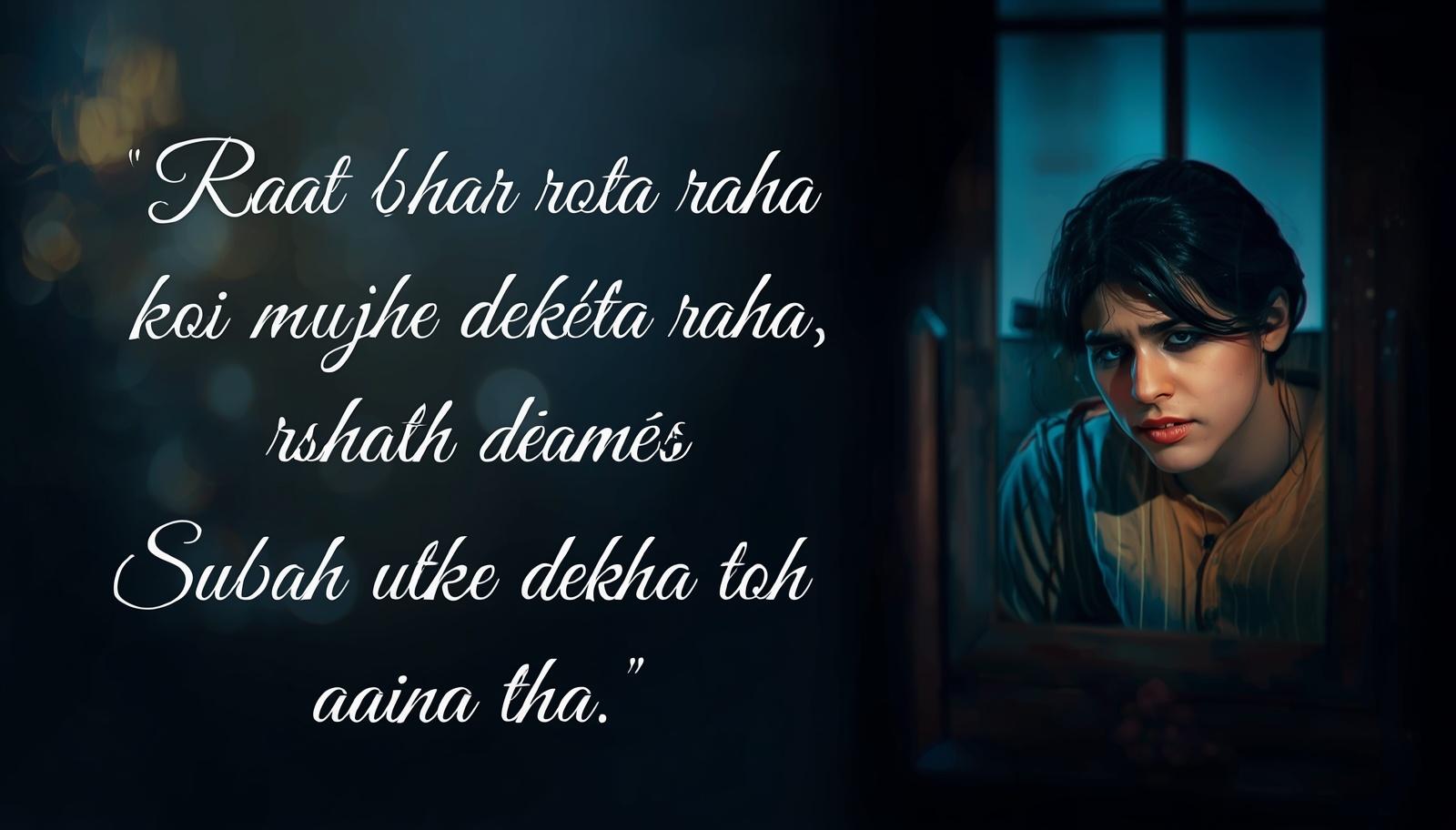
His short poems, sometimes just a few lines long, have found new life online, where readers share them as reflections of their own unspoken thoughts.
Writing Style and Philosophy
Gullzar’s writing style is often described as minimalist, but that simplicity is carefully crafted.
Key elements of his style include:
- Silence used as meaning
- Incomplete sentences that invite reflection
- Metaphors drawn from daily life
- Emotional ambiguity instead of clear conclusions
He does not tell readers what to feel. He creates space for them to feel on their own.
Literary Influences
Gullzar’s work reflects deep respect for classical and progressive Urdu literature.
Notable influences include:
- Mirza Ghalib, for philosophical depth
- Faiz Ahmed Faiz, for humanism and moral clarity
- The Progressive Writers’ Movement, for social awareness
Yet Gullzar never imitates. His voice remains personal, shaped by lived experience rather than literary trends.
Major Contributions Across Fields
Gullzar’s body of work spans multiple creative domains:
- Hindi film lyrics
- Urdu poetry collections
- Screenplays and dialogues
- Film direction
- Children’s books
This range is one reason his relevance has endured for decades.
Awards and Recognition
Golzar has received almost every major cultural and cinematic honor available in India and beyond.
Among his most notable awards are:
- Academy Award (Oscar) for Best Original Song
- Grammy Award
- Dadasaheb Phalke Award
- Padma Bhushan
- Padma Vibhushan
- Multiple National Film Awards
These recognitions reflect both artistic excellence and long-term cultural influence.
Personal Life
Gulzar married renowned actor Raakhee, one of the most respected performers in Indian cinema. They have a daughter, Meghna Gulzar, who is a successful filmmaker known for films such as Talvar and Raazi.
Despite his public stature, Golzar has always maintained a private life, rarely giving interviews and avoiding media attention.
Cultural Impact and Legacy
Golzar’s influence reaches far beyond his own work.
He has:
- Redefined Hindi film songwriting
- Modernized Urdu poetry for contemporary readers
- Inspired generations of poets and lyricists
- Shaped the tone of realistic Indian cinema
His words continue to circulate across classrooms, concerts, and digital platforms.
Why Gulzar Still Matters
In an age of fast content and constant noise, Golzar’s work feels grounding. His themes are timeless, his language remains accessible, and his emotional honesty continues to resonate.
People return to Gulzar not for spectacle, but for understanding.
FAQs
Who is Gulzar?
Gulzar is an Indian poet, lyricist, author, and filmmaker known for modern Urdu poetry and Hindi film lyrics.
What is Gulzar’s real name?
His real name is Sampooran Singh Kalra.
When and where was Gulzar born?
He was born on 18 August 1934 in Dina, Punjab, now in Pakistan.
Which language does Gulzar write in?
He primarily writes in Urdu and Hindi.
Has Gulzar won an Oscar?
Yes, he won an Academy Award for Best Original Song.
Is Gulzar also a film director?
Yes, he has directed several critically acclaimed films.
Who is Gulzar’s daughter?
His daughter is filmmaker Meghna Gulzar.
Conclusion
Gulzar biography is not just the story of a celebrated writer. It is the story of a region, a language, and a way of seeing the world with empathy and restraint. His words remind us that emotions do not need to be loud to be powerful.
Decades after his first lines were written, Golzar continues to speak to new generations. Not by chasing trends, but by staying true to the quiet truths that define human experience.