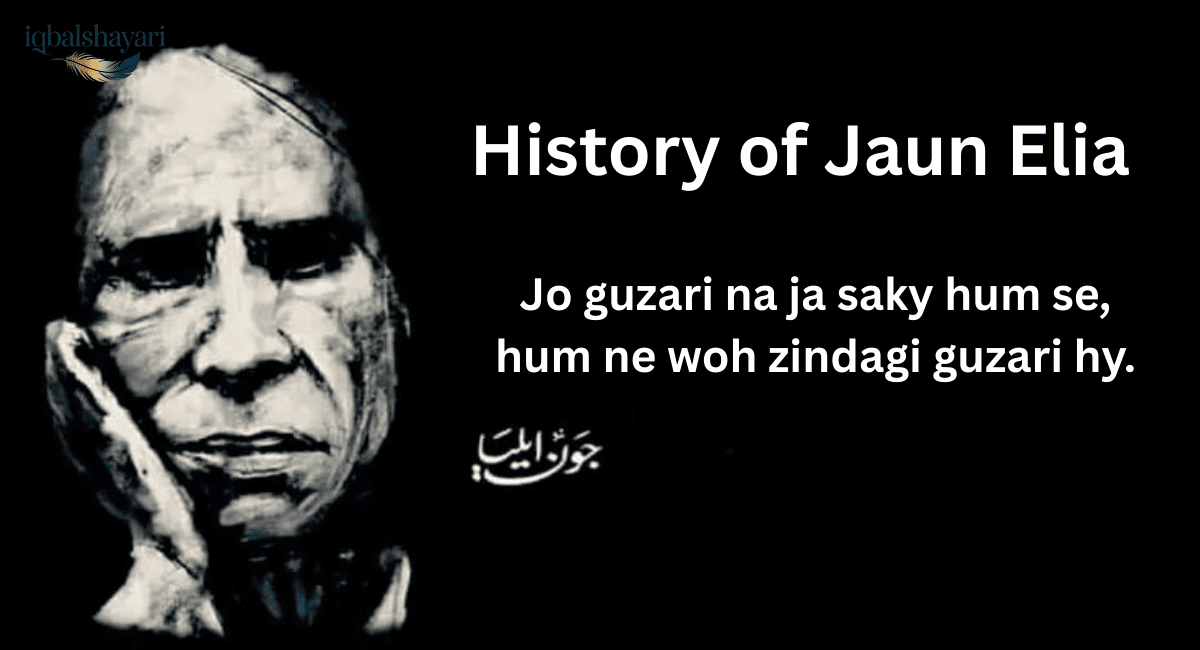
Introduction:
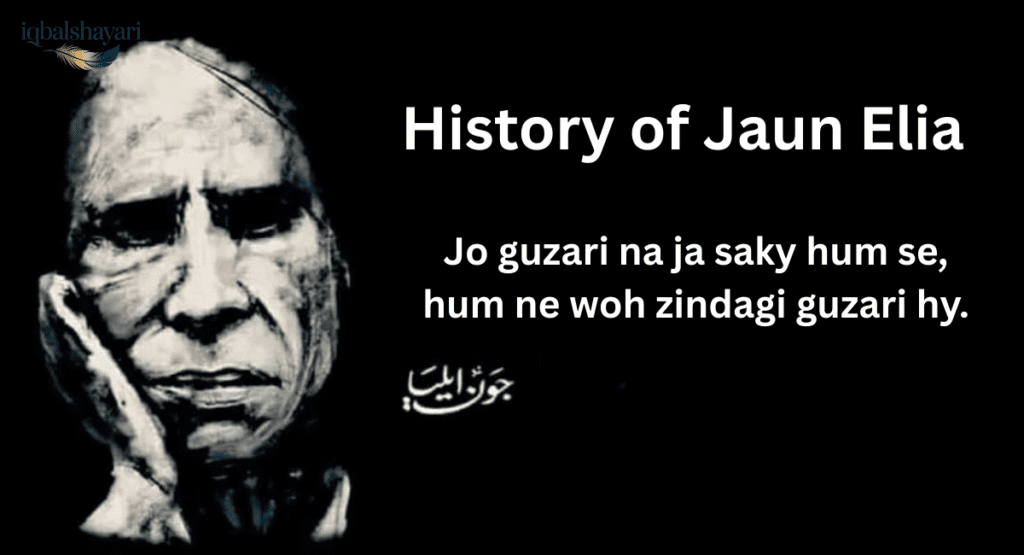
Jaun Elia is a name that continues to intrigue lovers of Urdu poetry. Even decades after his passing his words are quoted across books & social media and literary discussions. Yet many readers only know him for his sharp couplets or melancholic expressions missing the historical & philosophical and personal journey that shaped his poetry.
Understanding the history of Jaun Elia provides insight into why his works still resonate. From a young scholar in Amroha to a literary icon in Pakistan his journey embodies the struggles of intellectual pursuits and philosophical explorations that left an indelible mark on modern Urdu literature.
Jaun Elia biography | Jaun Elia Shayari collection
Early Life and Historical Background
Jaun Elia was born Syed Hussain Sibt e Asghar Naqvi in 1931 in Amroha India & a town known for its scholarly and literary traditions. He grew up in a family that placed a high value on education and debate. From a young age he was drawn to Arabic & Persian & philosophy and history subjects that would later shape the intellectual depth of his poetry.

The Partition of 1947 had a profound effect on him. Like millions his family migrated to Pakistan leaving behind their ancestral home and roots. This forced migration created a sense of displacement and existential questioning that became a recurring theme in his poetry. His early life marked by both rigorous study and historical upheaval provided the foundation for his reflective and often somber literary voice.
Key Points:
- Birth and family influence in Amroha
- Early exposure to classical literature and philosophy
- Partition migration and its impact on identity
- Formation of his existential and skeptical worldview
External links: Wikipedia biography | Rekhta Jaun Elia profile
Entry into Urdu Literature
Jaun Elia’s journey into Urdu literature was unconventional. Despite writing poetry from his youth he published his first works late partly due to his skepticism toward literary circles and fame. When his poetry finally appeared it immediately stood out defying traditional norms of Urdu literature.

Unlike his contemporaries who often celebrated romanticized love or moral ideals, Jaun Elia questioned everything about society & religion & history and human emotions. His approach was bold and introspective & making readers reflect on their own lives. This honesty and intellectual rigor quickly earned him recognition positioning him as a trailblazer in modern Urdu poetry.
Key Points:
- Delayed publishing due to skepticism
- Unique voice questioning societal norms
- Intellectual honesty as his signature style
- Recognition as a distinct figure in Urdu literature
Modern Urdu poets | Jaun Elia biography
Major Poetry Collections and Literary Style
Key Collections
- Shayad (1974) – Explores existential themes and human vulnerability
- Lekin (1991) – Reflects on love, loss, and disillusionment
- Gumaan (1971) – Combines social critique with personal introspection
- Yani (1997) – Highlights intellectual reflections on life and philosophy
Style and Themes
Jaun Elia’s poetic style is characterized by simplicity in language but depth in meaning. His verses often blend sarcasm irony and philosophical pondering. Themes such as loneliness & mortality & love and existential despair recur throughout his work. Unlike traditional poets he rarely indulged in decorative imagery instead he focused on raw & reflective and thought provoking content.
One of his signature qualities was the ability to make personal pain universal, allowing readers to connect deeply with the emotions he expressed. His work challenged conventions and expanded the scope of Urdu poetry making it more reflective and introspective.
Jaun Elia books list | Selected ghazals explanations
Philosophical and Intellectual Impact
Jaun Elia was not only a poet but also a philosopher. His work consistently reflected skepticism toward religion & society and traditional ideologies. Existentialism & personal loss and intellectual rebellion were recurring motifs and his poetry encouraged readers to question the world and themselves.
He introduced concepts such as nihilism & personal freedom and intellectual honesty to Urdu poetry which had previously emphasized ornate romanticism or moral messages. By blending philosophy with verse Jaun Elia made poetry a medium of introspection inviting both critical thinking and emotional resonance.
Key Points:
- Existential and skeptical themes
- Intellectual depth in poetry
- Rejection of superficial optimism
- Inspiration for future poets seeking authenticity
Influence on Modern Urdu Literature
Jaun Elia’s impact on modern Urdu literature is undeniable. Many contemporary poets & especially those engaging in digital platforms like Instagram & Twitter and online poetry blogs draw inspiration from his candid and reflective style.
His poetry inspired the rise of confessional and philosophical poetry focusing on personal struggles and intellectual exploration rather than mere aesthetic beauty. Young poets today admire his honesty & his willingness to confront uncomfortable truths and his rejection of conformity. In this way Jaun Elia bridged classical literary traditions with modern sensibilities ensuring that his influence continues across generations.
Modern Urdu poets influenced by Jaun Elia | Jaun Elia quotes with meanings
Criticism and Controversies
Despite admiration Jahn Elia was also a controversial figure. Critics often called his poetry pessimistic and accused him of excessive nihilism. His personal lifestyle and outspoken nature further fueled debates about his work.
However these controversies reinforced his literary significance. By challenging norms and refusing to conform Jaun Elia provoked discussion and reflection cementing his place as an intellectual rebel in Urdu literature. The debates around his work highlight the enduring relevance of his ideas and the depth of his poetic vision.
Controversial Urdu poets | Literary criticism of Jaun Elia
Conclusion and Call to Action
Jahn Elia’s life and poetry form a crucial chapter in Urdu literature. From his early life in Amroha to his philosophical explorations and literary contributions in Pakistan his legacy continues to inspire readers and poets alike.
Call to Action: Explore Jaun Elia’s poetry beyond quotes. Read his major works reflect on the philosophy behind his words and share your favorite verses. Engage with modern poets influenced by him to experience the full breadth of his literary impact.
Jaun Elia Shayari collection | Jaun Elia biography
FAQs About Jahn Elia
Q1: Why was Jahn Elia considered pessimistic?
A: His poetry explored existential despair & reflecting skepticism and a critical view of society.
Q2: Was Jahn Elia religious or atheist?
A: He questioned traditional beliefs and leaned toward intellectual skepticism influencing his worldview.
Q3: When did Jahn Elia publish his works?
A: Though he wrote from a young age major collections like Shayad and Lekin were published later in life.
Q4: What is Jahn Elia’s lasting impact on Urdu poetry?
A: He reshaped modern Urdu poetry with confessional & honest and philosophical writing inspiring generations of poets.