Introduction:
You have probably heard a limerick poem at least once in your life, even if you did not know what to call it. Maybe someone recited one at a party. Maybe you stumbled across one online and laughed before you even finished reading it. That instant reaction is exactly what makes this five-line poem structure so irresistible. It hooks you in the first line and leaves you grinning by the last. The limerick rhyme scheme follows a tight AABBA pattern that has stayed unchanged for centuries.
What started as humorous poetry in medieval Europe became one of the most recognized poetic wordplay traditions in the English language. From Edward Lear’s gentle nonsense verses to the shockingly clever adult limericks that circulate online today, this tiny poem packs more personality per line than almost any other form in literary history. And in 2026, it will be more popular than ever.
What Is Limerick? The Basics Every Reader Should Know
A limerick poem is a five-line verse with a very specific job: make you laugh by the last line. The first, 2nd, and fifth traces rhyme with every different. The third and fourth lines form their own rhyming pair. Think of it like a joke with a built-in drumroll. The whole structure exists to deliver one thing — a punchline you didn’t see coming.
What makes the limerick poem truly special is the rhythm underneath the words. It follows an anapestic meter, a da-da-DUM pattern that pushes the poem forward like a runaway train. Lines three and four are shorter and punchier. They build suspense. Then line five lands the blow. That tension-and-release structure is why limericks feel so satisfying, even when they’re completely ridiculous.
“”The limerick packs chuckle anatomically into space this is quite cost-effective. But the coolest ones I’ve visible so seldom are easy, And the easy ones so seldom are comical.” — Anonymous
The AABBA Rhyme Scheme Explained Simply
The limerick rhyme scheme is labeled AABBA. Lines one, two, and five share one rhyme. Lines three and four share a different, shorter rhyme. Here’s a quick breakdown so you can see it clearly:
| Line | Length | Rhyme | Role |
| Line 1 | Long | A | Sets the scene |
| Line 2 | Long | A | Adds detail |
| Line 3 | Short | B | Builds tension |
| Line 4 | Short | B | Twists the story |
| Line 5 | Long | A | Delivers the punchline |
This limerick poem structure is deceptively simple. Getting the rhyme right is easy. Getting the rhythm right is where most beginners stumble. The AABBA pattern has stayed unchanged for centuries because it simply works.
Why the Meter Makes or Breaks a Limerick
Anapestic meter is the heartbeat of every great limerick. Say “there was a YOUNG la-dy from SPAIN” out loud and you’ll feel it. The unstressed syllables rush toward the stressed ones like footsteps hurrying down a hallway. Without that rhythm, even the cleverest poetic wordplay falls flat on the page.
The great Irish poet W.B. Yeats once said that rhythm is the cradle in which the meaning rocks. For limerick poems, that cradle swings fast and lands hard. Writers who ignore the meter end up with something that looks like a limerick but reads like a grocery list. The da-da-DUM pattern is non-negotiable.
History of Limericks: From Medieval Taverns to 2026
The history of limericks stretches further back than most people realize. Some scholars trace the form to French troubadours singing comic verse in medieval courts. Others point to Irish soldiers returning from France in the early 1700s, bringing a drinking-song format that rhymed and rollicked. The word “limerick” itself is thought to come from the Irish city of Limerick, where rowdy pub songs used the same bouncy structure.
However, the man who truly put classic limericks on the map was Edward Lear. His 1846 collection, Book of Nonsense, introduced the five-line humorous poetry format to children and adults across Britain. Lear wrote over two hundred of them. He kept them whimsical and clean. It wasn’t until the late 1800s that limericks shed their innocent image and developed the notoriously saucy reputation we know today.
How Limericks Got Their Notorious Reputation
By the late 19th century, famous limericks had moved from children’s books to gentlemen’s clubs and saloon bars. Anonymous writers began using the five-line poem structure for adult humor, double entendre in poetry, and outright bawdy jokes. The form was perfect for it. Short enough to memorize. Punchy enough to shock. Rhythmic enough to stick in your head for days.
The most notorious example is the Man from Nantucket, which exists in multiple versions, each more indecent than the last. Nobody claims authorship. That anonymity is part of the tradition. Satirical poetry of this kind thrived precisely because no one had to sign their name to it. The limerick became the unsigned letter of English literature.
The history of limerick poetry is really a story of two audiences: children delighted by nonsense and adults delighted by something else entirely.
The Most Famous Limericks of All Time: 14 Classics Ranked
What makes a limerick earn the title of “most famous”? Three things: poetic wordplay sharp enough to cut glass, a cultural staying power that survives generations, and a punchline that you genuinely did not see coming. The most famous limericks of all time tend to be short, ruthless, and impossible to forget. They lodge in the brain like a splinter — annoying and oddly satisfying at the same time.
The literary limericks that have stood the test of time come from a surprisingly diverse group of writers. Algernon Charles Swinburne, Oliver Wendell Holmes Sr., Norman Douglas, and mathematician Leigh Mercer all contributed to the canon. Their work proves that the limerick poem is not just a vehicle for dirty jokes. It can carry theology, mathematics, psychology, and pure absurdist brilliance with equal ease.
Famous Limericks That Are Not for the Faint of Heart
The vast majority of famous dirty limericks earned their fame through clever double entendre in poetry rather than outright vulgarity. The best ones make you work slightly for the punchline. That brief moment of realization is exactly what makes them so satisfying. Short funny limericks for adults have dominated the canon for over a century for a simple reason: they work.
Algernon Charles Swinburne, the Victorian poet better known for his serious verse, proved remarkably gifted at short comic verse. His limericks are technically precise and unapologetically cheeky. They represent the moment when literary humor techniques met the limerick form and produced something genuinely memorable.
“The miller’s son, Jack, laid her flat on her back, and united the organs they were pissed with.” — Algernon Charles Swinburne
“There was a young lady from Exeter, so pretty that men craned their necks at her. One was even so brave as to take out and wave the distinguishing mark of his sex on her.” — Anonymous
“She thought it quite crude To be wooed in the nude, I pursued her, subdued her, and screwed her.” — Anonymous
Notice how each of these uses anapestic rhythm to race toward the punchline. The meter does half the comedic work. You’re already laughing before you reach the last line because the rhythm tells your brain something funny is coming.
Literary and Philosophical Limericks Worthy of Mention
Not every great limerick poem is about carnal matters. Some of the most admired classic limericks tackle theology, psychology, and even pure mathematics. These represent the form at its most intellectually ambitious. They prove that comic timing in poetry can coexist with genuine ideas.
Oliver Wendell Holmes Sr. used the limerick poem structure to comment on original sin with remarkable economy of language. Norman Douglas aimed his wit directly at Sigmund Freud. And Leigh Mercer, a British mathematician, created what many consider the most technically astonishing limerick ever written — one where the entire poem resolves into a correct mathematical equation.
“God’s plan made a hopeful beginning. But man spoiled his chances by sinning.
“The frequenters of our picture palaces Have no use for psychoanalysis. And although Doctor Freud Is distinctly annoyed, They cling to their long-standing fallacies.” — Norman Douglas
“A dozen, a gross, and a score, Plus three times the square root of four, Divided by seven, Plus five times eleven, Is nine squared and not a bit more.” — Leigh Mercer
That last one is genuinely correct mathematically. Work it out yourself. (12 + 144 + 20 + 3×2 ÷ 7 + 5×11 = 81). Leigh Mercer packed a valid equation into a perfect anapestic meter poetry structure. That is either genius or madness, and the line between those two has always been thin in literary limericks.
How to Write a Limerick: A Simple Step-by-Step Guide
Writing your own limerick poem is easier than you think. You don’t need a literature degree. You just need a good punchline and a willingness to count syllables. Start with a person or a place. That’s your first line. Make it conversational and easy to rhyme. “There once was a man from Chicago” sets you up perfectly. From there, the limerick rhyme scheme does most of the structural work for you.
The most common mistake beginners make is forcing the rhyme. They’ll twist a sentence into an unnatural shape just to get the A-rhyme in place. That kills the anapestic meter dead. Instead, choose an easy rhyme family first — words that end in “-ight” or “-ake” or “-oon” — and then build your lines around them. Humorous poetry lives or dies on naturalness. If it sounds forced, it isn’t funny.
| Step | What to Do | Example |
| Step 1 | Choose a subject (person or place) | A man from Chicago |
| Step 2 | Write Line 1 (A rhyme, long) | There once was a man from Chicago |
| Step 3 | Write Line 2 (A rhyme, long) | Who ate all his pasta con fuoco |
| Step 4 | Write Lines 3+4 (B rhyme, short) | He burned off his beard / Then completely disappeared |
| Step 5 | Write Line 5 (A rhyme, punchline) | Now they call him the ghost of the occo |
A Quick Limerick Template You Can Use Right Now
Here is a fill-in-the-blank limerick poem template. Use it as your starting point. The syllable counts are approximate, but stay as close as possible to keep the anapestic rhythm intact.
“There once was a [person/title] from [place] (8–9 syllables, A) Who [verb + action + rhyme with place] (8–9 syllables, A) They [short action] (5–6 syllables, B) And [short action or twist] (5–6 syllables, B) And [punchline rhyming with place] (8–9 syllables, A)”
This template has produced the best humorous limericks in English for centuries. Edward Lear himself used a nearly identical structure for most of his two hundred-plus poems in Book of Nonsense. The formula works because the five line poem structure creates a natural narrative arc: introduction, build, twist, punchline.
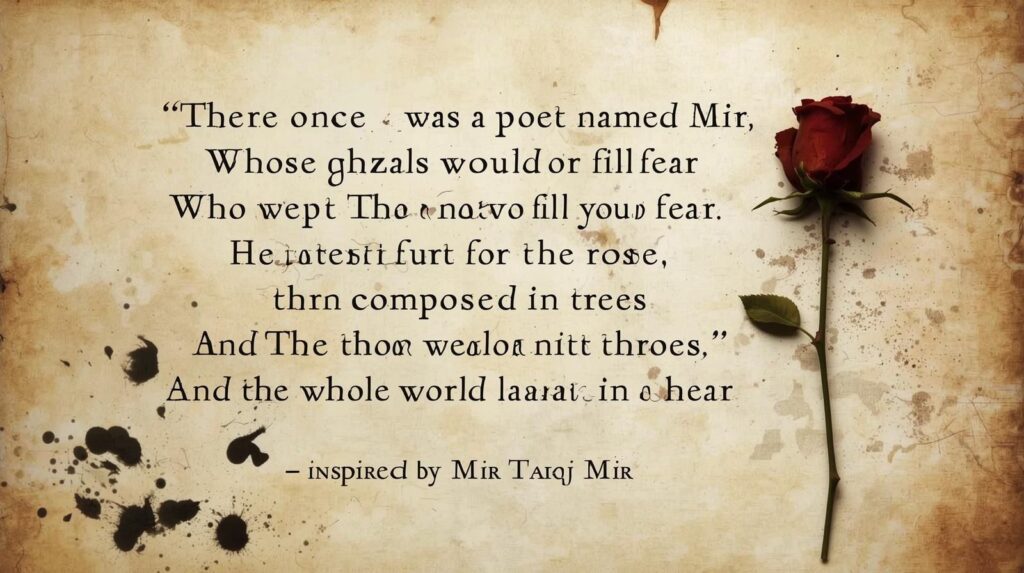
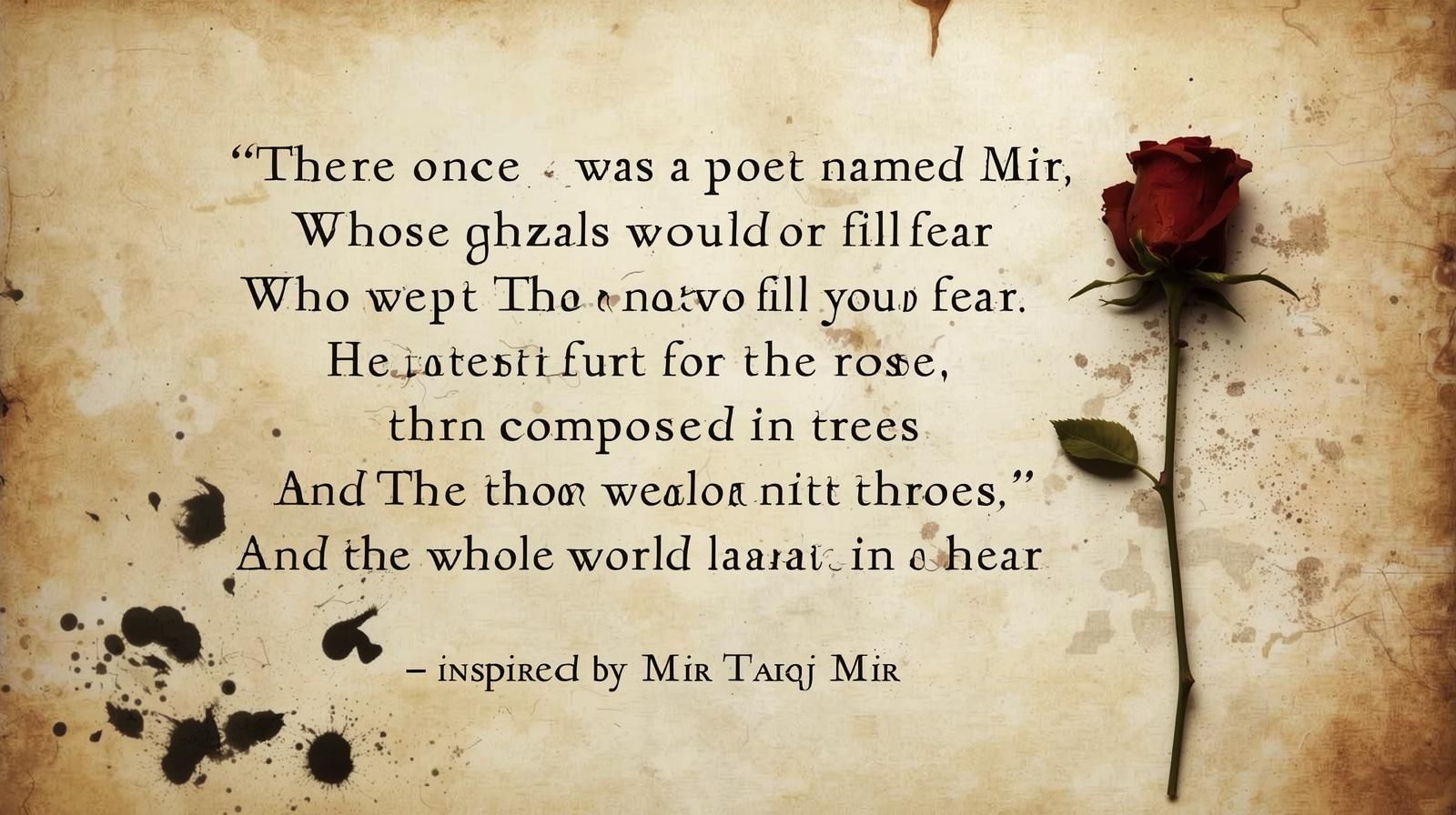
“There once was a poet named Mir, Whose ghazals would fill you with fear. He wept for the rose, Then composed in his throes, And the whole world leaned in just to hear.” — Inspired by Mir Taqi Mir
The Future of Limericks: Where Is This Art Form Headed?
In 2026, famous limericks are having a genuinely unexpected renaissance. Social media has become a natural home for short comic verse. Twitter threads, Reddit communities like r/limericks, and TikTok poetry accounts have introduced the limerick poem to an entirely new generation of Americans who’d never opened a poetry anthology in their lives. The form travels well in the digital age because it’s short, self-contained, and instantly shareable.
There’s also a growing movement toward using the limerick poem structure for serious topics. Climate change limericks, political satire in limerick form, and even academic papers summarized as limericks have all appeared in mainstream media. The BBC has run limerick competitions. NPR has featured them on radio. The five-line rhyming poetry form that Edward Lear introduced to Victorian children is now appearing in university syllabi as a serious object of literary study.
“There was a young man named Ghalib, Whose verses could set your heart free. He drank from the cup, Of longing, lookup, And poured out his soul for all to see.” — Inspired by Mirza Ghalib
Frequently Asked Questions About Famous Limericks
People across the USA search for answers about limericks every single day. The questions range from basic structure to deep literary history. What follows are the most common questions, answered directly and clearly. Each answer is written to match exactly how people phrase their searches — which means you’re likely to find exactly what you were looking for right here.
These are real questions pulled from Google’s “People Also Ask” box. That means they reflect genuine curiosity, not just keyword strategy. If you’ve been wondering about the meaning of limerick poetry or the clean vs dirty limericks comparison, you’re in exactly the right place.
Who Invented Limerick?
Nobody invented the limerick in a single moment of inspiration. The form evolved gradually. French troubadours used similar bouncy, comic verse in the Middle Ages. Irish soldiers allegedly brought a version of it back from France in the early 1700s. But Edward Lear is the person who formalized it and made it famous with his 1846 Book of Nonsense, which sold out multiple editions and introduced traditional limericks to a mass audience for the first time.
What Is the Most Famous Limerick Ever Written?
Most literary scholars point to “The Limerick Packs Laughs Anatomical” as the single most famous limerick of all time. It appears at the top of nearly every anthology. The reason is elegant: it explains what a limerick is, while being a perfect example of one at the same time. It’s self-referential, technically flawless, and genuinely funny. The author remains unknown, which somehow makes it even better.
Are All Limericks Dirty or Rude?
Absolutely not. The clean vs dirty limericks comparison is one of the most misunderstood aspects of the form. Edward Lear wrote over two hundred completely clean examples of limericks for children. Oliver Wendell Holmes Sr. wrote about God and sin. Leigh Mercer wrote about mathematics. Nonsense poetry in the tradition of Lear remains entirely family-friendly. The reputation for rudeness comes from anonymous writers who found the form perfectly suited to adult humor, but that is only one corner of a much larger room.
Why Are Limericks So Popular in the USA?
Americans have always had a weakness for witty poems and fast punchlines. The limerick fits perfectly into the American humor tradition — direct, irreverent, and efficient. It shows up in elementary school classrooms as a teaching tool for poetic structure. It appears in late-night monologues. It circulates in office emails. The funny short poems format travels across cultures with zero friction, and in a country as large and diverse as the USA, that portability is everything.
Further Reading: More Limericks to Explore
If this collection of famous limericks has sparked something in you, there is a whole universe of limerick poems waiting. The Shakespeare limerick tradition is particularly rich — combining the bard’s own wordplay with the AABBA structure produces something surprisingly elegant. Similarly, limericks about Moby Dick, existentialism, and modern politics have all found passionate audiences online. Literary limericks are no longer a niche curiosity. They are a living, breathing part of American and British literary culture.
For anyone wanting to go deeper into examples of funny limericks or explore the philosophical end of the spectrum, the best next step is to read widely and write often. The limerick poem rewards practice more than almost any other form. Start with Lear. Move to Swinburne. Then write your own. The structure will carry you further than you expect.
Quick-Reference Facts Table
| Fact | Detail |
| Limerick structure | 5 lines, AABBA rhyme scheme |
| Meter | Anapestic (da-da-DUM) |
| Origin | Medieval France or early 18th-century Ireland |
| Popularized by | Edward Lear, Book of Nonsense (1846) |
| Most famous limerick | “The Limerick Packs Laughs Anatomical” — Anonymous |
| Most intellectual | Leigh Mercer’s mathematical limerick |
| Most literary | Oliver Wendell Holmes Sr. theology limerick |
| USA popularity | Elementary schools, late-night TV, Reddit communities |
| 2026 trend | Philosophical and political limericks going viral |
| Best for beginners | AABBA template with easy rhyme families |
The most famous limericks are not relics of a dustier era. They are alive, evolving, and funnier than ever. Whether you came here for the bawdy classics, the literary curiosities, or the mathematical marvels, the limerick poem has delivered something for you.