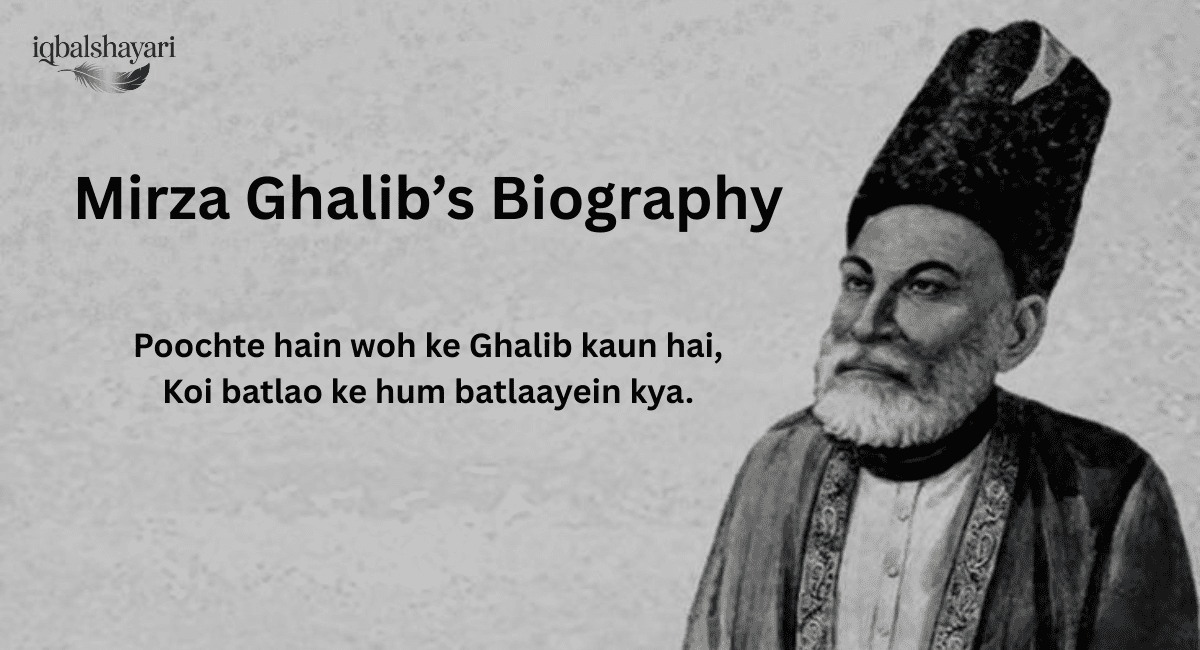
Introduction: The Legacy of Mirza Ghalib’s biography
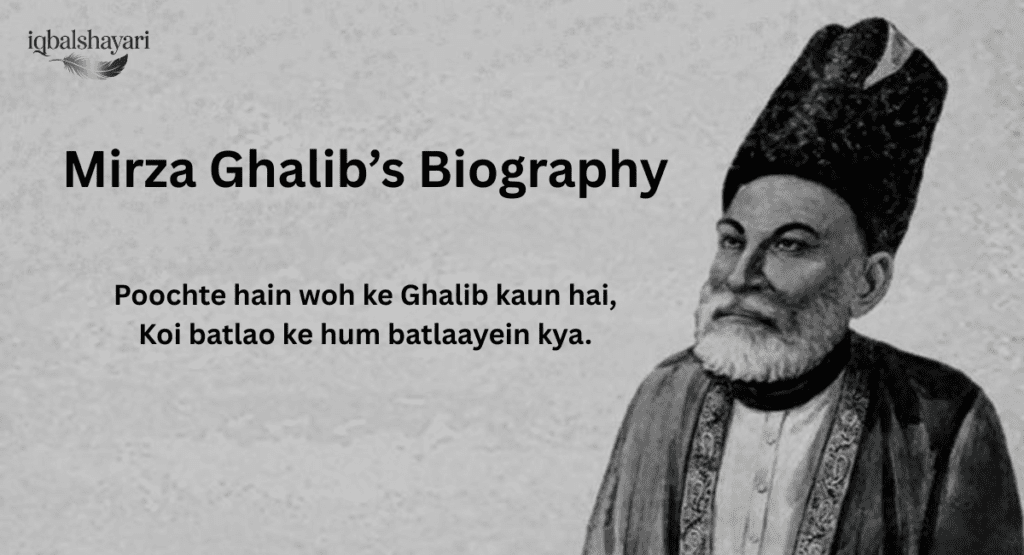
Mirza Ghalib and the name that echoes through the world of Urdu literature remains one of the most beloved poets of all time. While many know Ghalib for his enchanting Shyri & few are familiar with the life behind his words & his struggles and his triumphs and the historical context that shaped his works. Ghalib’s life story is as fascinating and profound as his shayri and offers a window into the turmoil of 19th century India and the complex emotional landscapes he navigated.
In this article we will explore Mirza Ghalib’s biography highlighting the milestones and challenges that shaped his life and delve into his most memorable Shyri collections offering interpretations & insights into the themes he so masterfully expressed. By the end you’ll gain a deeper understanding of not only Ghalib’s life but also the enduring power of his shayari.
Section 1: Early Life & Background
Mirza Ghalib was born as Mirza Asadullah Baig Khan on December 27 / 1797 in Agra India. Raised in a family of noble descent Ghalib’s early years were marked by both privilege and loss. His father Mirza Abdullah Baig was a military officer in the Mughal army but he passed away when Ghalib was just a young child. This early loss had a profound impact on Ghalib who would later express his feelings of abandonment and grief through his shayari.

Growing up in the final years of the Mughal’s Empire Ghalib witnessed the disintegration of the once mighty empire which left an indelible mark on his worldview. The political turmoil and the rise of British colonialism in India shaped much of his perspective both personally and artistically. His childhood thus was defined by an environment in constant flux marked by personal hardship and the loss of political power.
Despite these challenges Ghalib’s intelligence and talent were evident early on. He received his education under the tutelage of various scholars with an emphasis on Persian and Urdu literature. Persian and the language of the Mughal court was Ghalib’s first literary medium. It was only later after the decline of the Mughal Empire that Ghalib turned to writing in Urdu language that was gaining popularity in literary circles. This transition marked a pivotal moment in his career and the rest as they say is history.
Section 2: Ghalib’s Literary Works & Themes
Mirza Ghalib’s literary career spans several decades and is marked by a series of remarkable transformations. Initially Ghalib was well versed in Persian shayri which was the language of the Mughal elite. However the decline of the Mughal Empire and the changing social landscape led him to shift toward writing in Urdu language that was evolving rapidly in the 19th century.
Ghalib’s poetry is often categorized into two main genres: ghazals & quatrains. His ghazals became particularly famous and known for their deep emotional resonance & philosophical underpinnings. In his works Ghalib explored themes of love & heartbreak and existential musings. But what set Ghalib apart from his contemporaries was his ability to blend personal grief with universal themes making his poetry both deeply intimate and globally relevant.
Some of Ghalib’s best known poetry explores the concept of love in its most melancholic form. His famous couplet “Hazaron khwahishen aisi ke har khawahish pe dam nikle” (Thousands of desires & each so intense that it takes my life away) speaks to the insatiable nature of human longing. This poignant exploration of desire & the inevitability of loss can be found in many of his ghazals.

Another central theme in Ghalib’s works is existential reflection. He often questioned the nature of life and the divine as seen in his famous line “Na tha kuch to kuch na tha kuch hai to kuch bhi nahi” (When there was nothing there was nothing; now that something exists there is still nothing). This deep philosophical inquiry into the meaning of life makes his poetry stand out & invites readers to reflect on their own lives and the world around them.
In addition to his poetic style Ghalib’s use of metaphors & imagery was revolutionary for its time. He employed the symbolic use of wine beloved and rose to explore complex themes of selfhood, passion and loss. His work laid the foundation for modern Urdu poetry and inspired generations of poets & writers and thinkers who came after him.
Section 3: The Struggles of Mirza Ghalib urdu poetry
Despite his success as a poet Mirza Ghalib’s life was filled with personal struggles and financial hardships. Throughout his career Ghalib faced severe economic difficulties. He spent an awful lot of his existence in poverty regardless of the truth that his poetry became tremendously acclaimed. Ghalib’s financial demanding situations had been compounded by using the political and social upheavals of the time. The British colonial regime which was steadily gaining control over India, had a profound impact on the society in which Ghalib lived.
The collapse of the Mughal Empire left Ghalib feeling displaced and uncertain about his future. In fact Ghalib’s shyri often reflects the tension he felt between his cultural heritage and the changing political realities of colonial India. His famous couplets express a sense of frustration with the world around him, as he grappled with the loss of the empire he had grown up with and the uncertain future ahead.

Additionally, Ghalib faced devastating personal losses, including the death of his children, which deeply affected him emotionally. These tragic events were reflected in the darker, more melancholic tone of many of his ghazals. His shyri became a form of catharsis, allowing him to process his grief and sorrow through his words. His personal pain, especially the loss of loved ones, made his poetry even more relatable, as it resonated with others who had experienced similar heartache.
Ghalib’s struggles were not only emotional but also social. He often felt alienated from the literary circles of his time, as he believed his work was not truly appreciated by those in power. His letters, which have since become an important part of his legacy, offer a candid look at his frustrations and personal battles. Yet, through all these hardships, Ghalib remained steadfast in his commitment to poetry leaving behind a body of work that continues to inspire generations.
Section 4: Mirza Ghalib’s Best Shyri Collection
Mirza Ghalib’s Shyri is widely regarded as some of the finest poetry in the Urdu language. His ability to express complex emotions ranging from love and loss to deep existential questions makes his work timeless. Below we explore some of his most famous couplets (shers) and their meanings illustrating why his poetry continues to captivate readers today.
- “Hazaron khwahishen asi ky her khwahish pe dam nikly”
Meaning: This line expresses the infinite nature of human desire. No matter how many desires we fulfill they always seem to multiply and they ultimately consume us. - “Dil hi to hy na sang-o-khisht dard se bhar na aye kyu”
Meaning: Ghalib compares the heart to a fragile object, suggesting that if it is filled with pain it will inevitably overflow. The heart unlike stone or brick & is soft and vulnerable. - “Ye na thi hamari qismat, ke visal-e-yaar hota”
Meaning: This line reflects Ghalib’s unfulfilled love and yearning. He speaks of how fate did not allow him to unite with his beloved symbolizing the unattainability of perfect love. - “Nahin hai na ummid-e-istiqlal, kuch be nahe”
Meaning: Here Ghalib addresses the futility of life’s pursuit. The line suggests a sense of hopelessness and resignation expressing how nothing is truly permanent or certain in life. - “Maqta e Ghalib, taqdeer say kaisi ummed, kis baat py raaz ho”
- Meaning: This line reflects Ghalib’s stance on fate and destiny. It speaks to his disillusionment with life’s inherent unpredictability highlighting his deep philosophical view on existence.
These couplets offer just a glimpse into the depth and emotional resonance of Ghalib’s poetry. Whether exploring the intricacies of love & loss or existence, his Shayri transcends time and speaks to the universal human experience.
Section 5: Mirza Ghalib’s Urdu Legacy & Influence
Mirza Ghalib’s legacy extends far beyond his time. His influence on Urdu poetry and literature has been profound and his works continue to be celebrated globally. Ghalib’s ghazals are regularly recited at literary events & poetry recitals and cultural festivals. He has also been widely recognized in popular culture particularly through his influence on Bollywood.
The reverence for Ghalib in modern literature is undeniable. His work has inspired countless poets, songwriters, and artists, both in India and abroad. Ghalib’s poetry remains a cornerstone of Urdu literature and his themes continue to resonate with readers particularly those who are drawn to his deep emotional insights.
The cinematic adaptation of his life such as the Bollywood movie Ghalib introduced his shyri to new generations of readers and viewers further cementing his status as a literary giant. In fact many modern Urdu poets and lyricists credit Ghalib for laying the foundation for the poetic expression that followed.
Ghalib’s influence also transcends language barriers. His works have been translated into numerous languages allowing people from diverse cultures to appreciate his poetic genius. His poetry continues to inspire artists and thinkers worldwide making his legacy timeless.
Conclusion: Celebrating Ghalib’s Timeless Legacy
Mirza Ghalib’s life and poetry are a testament to the enduring power of literature. Through all his struggles and hardships Ghalib crafted works that resonate with readers even today. His exploration of love & loss and existential thought speaks to the human experience & transcending time & culture and geography.
As we continue to celebrate his legacy it’s essential to remember that Ghalib’s shyri is not just about beautiful words it’s about the emotions and wisdom that those words convey. Ghalib’s work has left an indelible mark on both Urdu literature and global culture.
Explore more of Mirza Ghalib’s poetry and dive deeper into the meanings and themes that continue to captivate readers across generations. Ghalib’s words are not just a reflection of his time and they are a reflection of the universal human spirit timeless and ever relevant.