Introduction: Mirza Ghalib Love shayari
Mirza Ghalib stands as one of the greatest poets in Urdu and Persian literature, and his love Shayari continues to captivate hearts more than 150 years after his death. When we speak of love in Urdu poetry, Ghalib’s name emerges inevitably—not because he wrote the most love poetry, but because he wrote it with unmatched depth, complexity, and emotional honesty.
Unlike poets who idealized love or reduced it to simple romance, Ghalib explored love in all its dimensions: the ecstasy and the agony, the fulfillment and the longing, the hope and the despair. His love poetry speaks to the universal human experience, which is why readers across cultures and generations continue to find themselves in his verses.
This collection presents Mirza Ghalib’s top 14 love shayari in English, complete with Urdu text, Roman transliteration, English translation, and detailed explanations. Whether you’re a student discovering Urdu poetry, a lover seeking words for feelings you cannot express, or someone who appreciates timeless art, these verses offer something profound and beautiful.
Understanding Mirza Ghalib’s Love Poetry
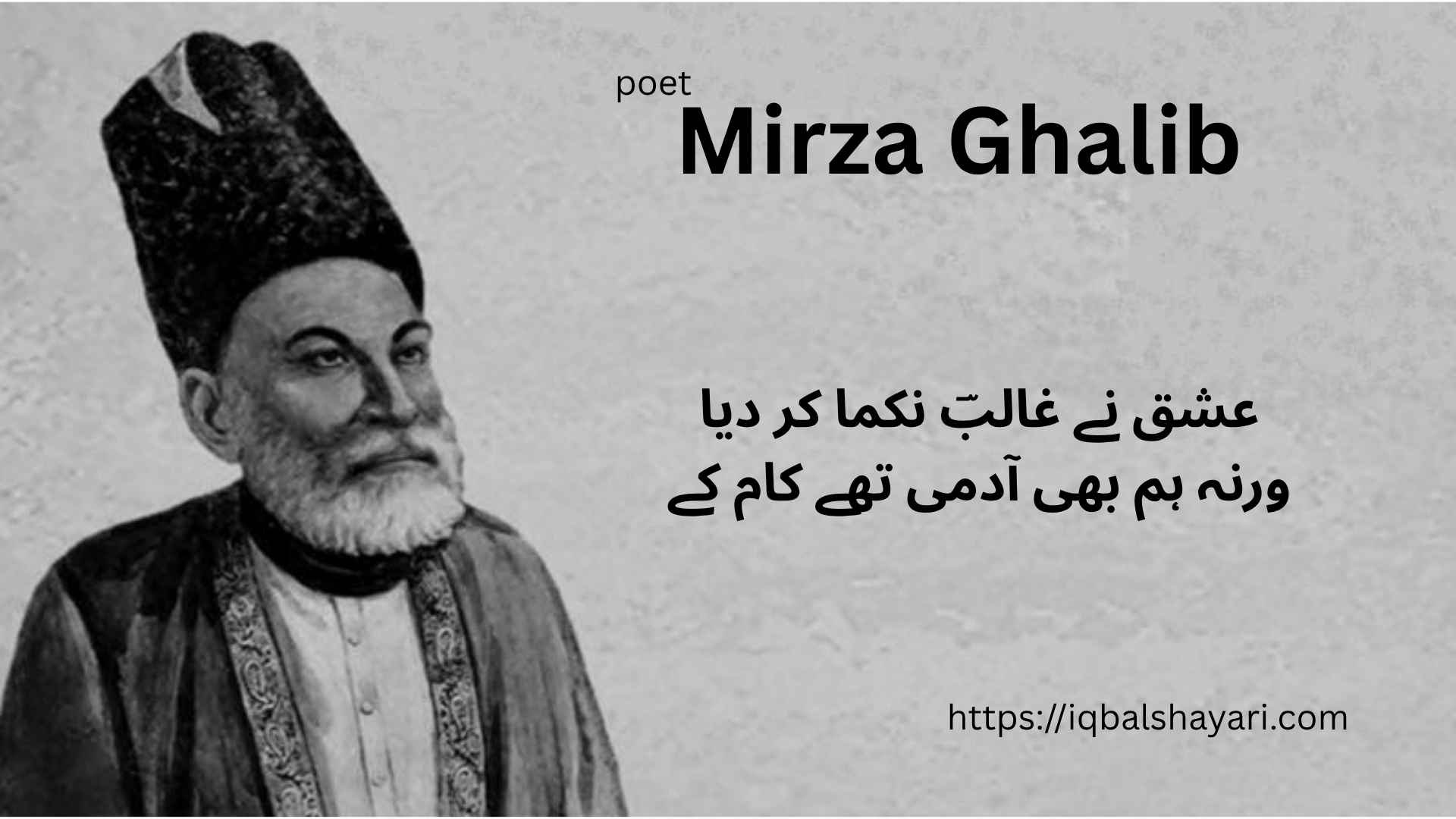
Mirza Asadullah Baig Khan, known as Ghalib, lived in 19th century Delhi during the twilight of the Mughal Empire. He witnessed the transformation of an entire civilization, and this sense of loss, change, and impermanence permeates his poetry. His love poetry is never simple or straightforward; it is layered with philosophical depth and existential questions.
What Makes Ghalib’s Love Poetry Unique
Philosophical Depth – Ghalib didn’t just write about romantic love. He explored love as a fundamental force of existence, as a path to understanding the divine, and as a source of both meaning and suffering in human life.
Paradoxical Beauty – His verses often contain beautiful contradictions. Love brings both pain and pleasure, presence and absence, hope and hopelessness. This paradoxical quality makes his poetry intellectually stimulating while remaining emotionally powerful.
Universal Yet Personal – While Ghalib wrote from personal experience, his expression of love transcends individual experience. Readers from different backgrounds find their own stories in his words.
Language Mastery – Ghalib’s command over language allowed him to express complex emotions with remarkable economy. A single couplet can contain layers of meaning that unfold with repeated reading.
Now, let us explore his most beautiful love shayari, each a masterpiece of emotional and literary excellence.
1. The Pain of Separation
Transliteration:
Yeh na thi hamari qismat ke visal-e-yaar hota
Agar aur jeete rehte yehi intezaar hota
Translation:
It was not my destiny to be united with my beloved
If I had lived longer, this waiting would have continued
Explanation:
This is perhaps Ghalib’s most famous couplet about unfulfilled love. The beauty lies in its profound acceptance of fate combined with the acknowledgment that even an entire lifetime wouldn’t be enough to ease the longing. Ghalib suggests that some loves are meant to remain unfulfilled, and the waiting itself becomes a permanent condition of existence.
The first line establishes the hard reality—destiny denied him union with his beloved. But the second line reveals something deeper: even if he had lived longer (implying forever), nothing would change. The waiting would continue because the beloved’s absence is not a temporary condition but an existential state.
This resonates with anyone who has loved someone they couldn’t have. Ghalib validates the pain while simultaneously showing its permanence, offering no false comfort but a kind of dignified acknowledgment of suffering.
2. Love’s Madness
Transliteration:
Ishq per zor nahi hay yeh woh aatish Ghalib,
Ke lagaaye na lage aur bujhaaye na bane.
Translation:
Love cannot be controlled, it is such a fire, Ghalib
That cannot be kindled at will, nor can it be extinguished at will
Explanation:
In this powerful couplet, Ghalib uses the metaphor of fire to explain love’s uncontrollable nature. Love is not a rational choice that can be turned on or off according to our wishes. It ignites spontaneously and burns regardless of our desire to stop it.
The genius lies in the parallel structure: “lagaye na lage” (cannot be kindled at will) and “bujhaye na bane” (cannot be extinguished at will). This creates perfect balance while emphasizing love’s independence from human control.
This verse speaks to the experience of falling in love when we don’t want to, or desperately trying to stop loving someone but finding it impossible. Ghalib removes the illusion of control, suggesting that love operates according to its own laws, not ours.
3. The Beloved’s Indifference
Transliteration:
Hazaaron khwahishen aisi ky her khwahish pe dam nikly,
Bahut nikle mere armaan lekin phir bhi kam nikle
Translation:
Thousands of desires, each one deserving a lifetime
Many of my wishes came true, yet still they seemed too few
Explanation:
This couplet beautifully captures the insatiable nature of human longing. Ghalib speaks of countless desires, each so intense that fulfilling it could consume an entire lifetime. Despite achieving many of these desires, he still feels they are inadequate.
In the context of love poetry, this can be interpreted as the lover’s endless yearning for the beloved. No matter how much attention or affection is received, it never feels sufficient. Every moment with the beloved creates a desire for another moment, and another, endlessly.
The verse also reflects on human nature more broadly—our capacity for endless wanting, and how fulfillment often leads not to satisfaction but to new desires. Ghalib expresses this universal truth with touching honesty.
4. Love’s Wound
Transliteration:
Na tha kuch to khuda tha kuch na hota to khuda hota
Duboya mujh ko hone me na hota me to kya hota
Translation:
When there was not anything, there has been God; had there been nothing, there might had been God
My existence has drowned me; had I not existed, what would I have been?
Explanation:
This deeply philosophical couplet explores existence itself through the lens of love and suffering. Ghalib suggests that non-existence might have been preferable to the pain of existence, particularly the pain that comes with consciousness and desire.
The first line establishes God’s eternal presence—before creation and in the absence of creation. The second line makes a startling statement: existence itself is the problem. Had the poet never existed, he would have been spared the suffering that comes with being.
In the context of love poetry, this can be read as: loving has brought such pain that non-existence would have been better. But there’s also a mystical dimension—the soul separated from divine unity suffers in individual existence, longing to return to its source.
This verse resonates with anyone who has felt that consciousness itself is a burden, particularly the consciousness of separation from what we love.
5. The Beauty of Pain
Urdu:
دل کی ویرانی کا کیا مذکور ہے
یہ نگر سو مرتبہ لوٹا گیا
Transliteration:
Dil ki veerani ka kya mazkoor hai
Ye nagar sau martaba loota gaya
Translation:
Why speak of my heart’s desolation?
This city has been plundered a hundred times
Explanation:
Ghalib uses the metaphor of a plundered city to describe his devastated heart. But notice the rhetorical strategy: he suggests that his personal heartbreak is so small compared to the larger tragedy (Delhi being repeatedly invaded and destroyed) that it’s not even worth mentioning.
Yet by framing it this way, he actually draws more attention to his pain. It’s a sophisticated literary technique—claiming not to mention something while mentioning it powerfully.
The historical context adds depth: Ghalib lived through Delhi’s decline and witnessed its destruction during the 1857 uprising. His personal romantic losses became intertwined with collective cultural loss, making his love poetry inseparable from his experience of historical tragedy.
For modern readers, this verse speaks to how personal heartbreak can feel both monumentally important and insignificantly small at the same time.
6. Presence in Absence
Transliteration:
Gham-e-hasti ka Asad kis se ho juz marg ilaaj
Shama har rang me jalti hy sehar hony tak
Translation:
The sorrow of existence, Asad, has no cure except death
The candle burns in every color until dawn arrives
Explanation:
Here Ghalib (using his pen name Asad) makes a profound statement about existence and suffering. The only cure for the pain of being is non-being (death). But the second line introduces a beautiful counterpoint through the candle metaphor.
The candle burns in every color (experiencing all kinds of suffering and joy) until dawn (death or enlightenment) arrives. The candle’s purpose is to burn, regardless of the pain. Similarly, our purpose might be to experience life fully, pain included, until our own dawn comes.
In love poetry terms, this can mean: the pain of love is inherent to love itself. To love is to suffer, and the only escape is to stop living or stop loving—but is that really escape? The candle must burn; the lover must love.
This verse offers no comfort except the beauty of the metaphor itself, and perhaps that’s Ghalib’s point—art transforms suffering into beauty without removing the suffering.
7. The Language of Silence
Urdu:
نقش فریادی ہے کس کی شوخی تحریر کا
کاغذی ہے پیرہن ہر پیکر تصویر کا
Transliteration:
Naqsh faryadi hai kis ki shokhi-e-tahrir ka
Kaghazi hai pairahan har paikar-e-tasveer ka
Translation:
The image protests—whose playful writing is this?
Every portrait’s garment is made of paper
Explanation:
This complex verse plays with the relationship between reality and representation. Ghalib suggests that portraits (images) protest being reduced to mere paper and ink. They want to be real, but they’re forever trapped in two-dimensional representation.
As a love poem, this can be read as the beloved’s image in the lover’s mind versus the beloved’s actual reality. The lover creates a mental portrait of the beloved, but this image can never capture the full reality. The portrait “protests” its inadequacy.
There’s also a meta-poetic dimension: Ghalib’s own poetry creates images of love and the beloved, but he’s aware that language, like paper, can only approximate reality. Every attempt to capture experience in words is simultaneously an achievement and a failure.
This verse speaks to anyone who has tried to hold onto someone through memories or representations, only to find that these substitutes highlight rather than ease the absence.
8. Love’s Contradiction
Urdu:
محبت میں نہیں ہے فرق جینے اور مرنے کا
اسی کو دیکھ کر جیتے ہیں جس کافر پہ دم نکلے
Transliteration:
Mohabbat mein nahin hai farq jeene aur marne ka
Usi ko dekh kar jeete hain jis kafir pe dam nikle
Translation:
In love, there is no difference between living and dying
We live by seeing the one for whom we would die
Explanation:
This couplet beautifully captures love’s essential paradox. The beloved is both the source of life and the cause of death. The lover lives only to see the beloved, yet that same sight could kill them.
The word “kafir” (literally “infidel”) is used affectionately to describe the beloved whose beauty and cruelty seem almost divine yet merciless. Classical Urdu poetry often uses religious terminology metaphorically in love poetry.
The genius is in the first line’s philosophical statement: in the realm of love, conventional opposites collapse. Life and death become indistinguishable because both are defined entirely by the beloved’s presence or absence.
This resonates with the experience of intense love where the beloved becomes so central that existence itself is redefined through them. Without them, life feels like death; with them, even dying would feel like living.
9. The Burden of Hope
Transliteration:
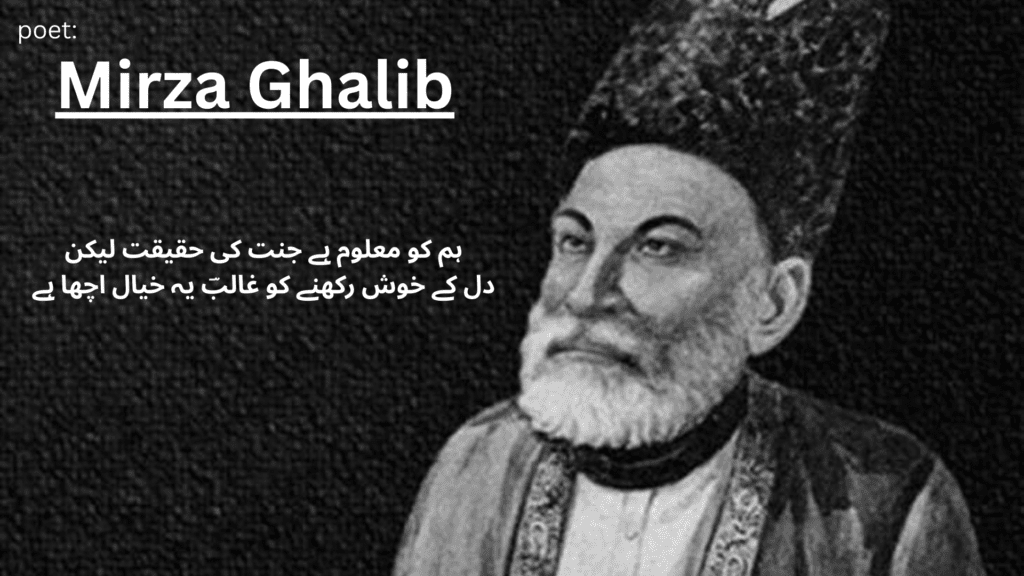
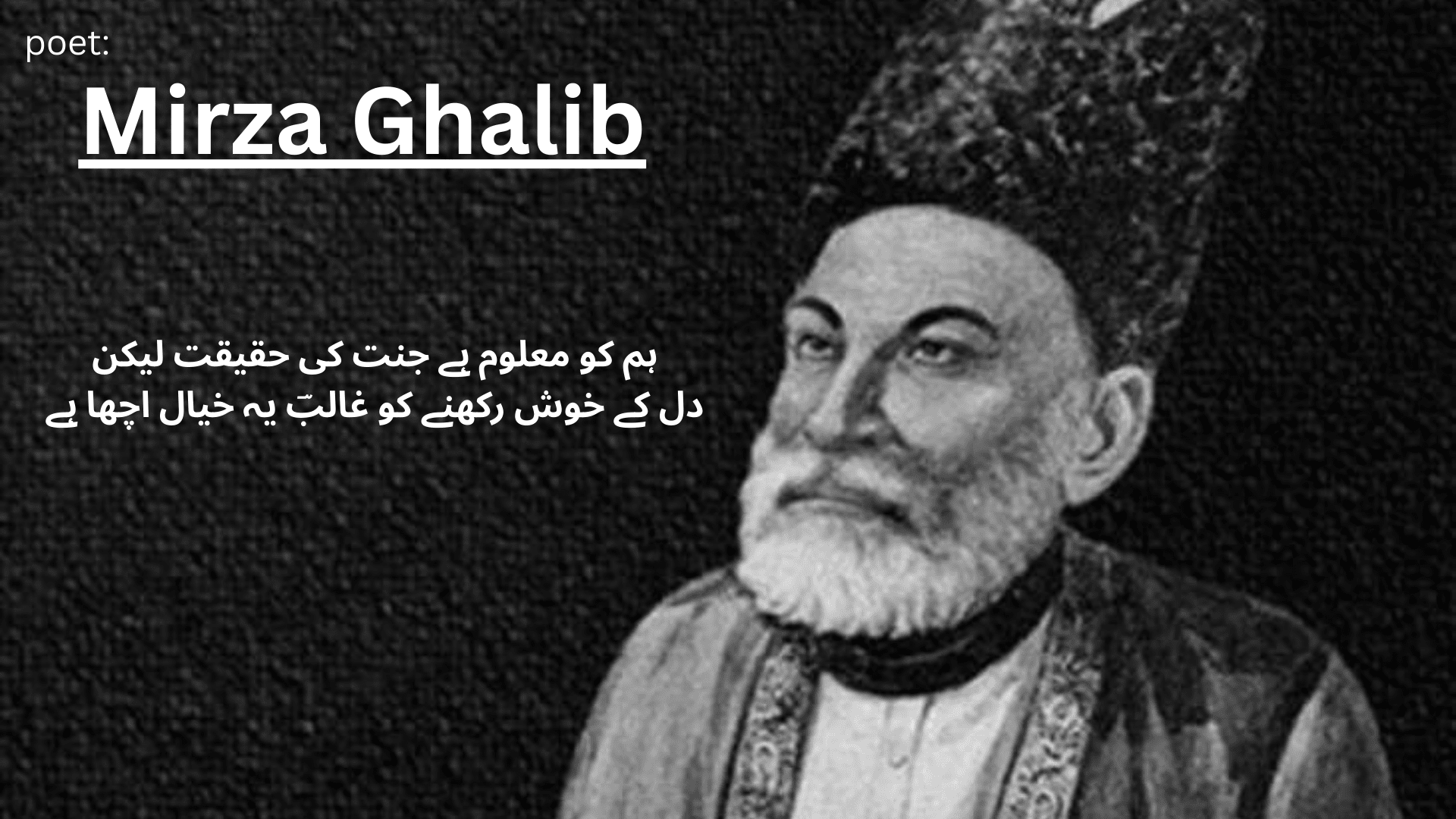
Hum ko maloom hai jannat ki haqeeqat lekin
Dil ky khush rakhny ko Ghalib ye khayaal achha hy
Translation:
We know the reality of paradise, but
To keep the heart content, Ghalib, this thought is good enough
Explanation:
In this famous verse, Ghalib reveals his sophisticated understanding of hope and illusion. He admits knowing that paradise (whether literal afterlife paradise or metaphorical paradise with the beloved) might be an illusion or unattainable. Yet, he chooses to maintain the thought anyway because it provides comfort.
This is remarkably modern in its acknowledgment that we sometimes consciously maintain beliefs or hopes not because we fully believe in them, but because we need them psychologically. The heart requires hope to continue, even if the mind knows better.
In love poetry, this speaks to continuing to hope for the beloved’s affection even when reason suggests it won’t happen. The illusion is necessary for emotional survival. It’s a kind of deliberate self-deception done with full awareness—a very human and touching admission.
This verse comforts anyone who clings to unlikely hopes, validating that sometimes hope matters more than probability.
10. The Gift of Pain
Transliteration:
Bazicha-e-atfal hai duniya mere aage
Hota hai shab-o-roz tamasha mere aage
Translation:
The world is a child’s plaything before me
Day and night, a spectacle unfolds before me
Explanation:
This couplet expresses a state of detachment born from suffering. Having experienced profound pain in love, Ghalib has reached a point where worldly concerns seem trivial, like children’s games. The world’s daily dramas continue to unfold, but they no longer move him as they once did.
There’s a sense of having transcended ordinary experience through suffering. Love’s pain has elevated him to a perspective where everything else appears insignificant. This isn’t happy detachment but rather the weariness of someone who has felt too deeply.
The continuous spectacle (“shab-o-roz tamasha”—day and night show) suggests that life goes on with its events and changes, but for someone devastated by love, these events lose their power to engage or disturb.
This speaks to the transformative power of deep emotional experience. After intense love and loss, ordinary life can seem hollow or distant. It’s simultaneously a statement of superiority and profound loneliness.
11. The Nature of Desire
Urdu:
رگ سنگ سے ٹپکا ہے وہ خون کہ پھر نہیں تھما
جس زخم پہ مرہم رکھا ہو وہ مندمل نہیں ہوتا
Transliteration:
Rag-e-sang sy tapka hy wo khoon ky phir nahi thama
Jis zakham pe marham rakha ho wo mandmal nahin hota
Translation:
Blood that drips from stone veins doesn’t stop flowing
A wound that has been bandaged never heals
Explanation:
This paradoxical verse captures the nature of certain kinds of emotional pain. Ghalib uses two impossible or contradictory images: blood flowing from stone (stones don’t have blood), and bandaged wounds that don’t heal (bandages are supposed to help healing).
The first line suggests a wound so deep it makes even stone bleed—a poetic way of saying that the pain affects even the seemingly impervious. The second line’s paradox is even more striking: the very attempt to heal prevents healing.
In terms of love, this can mean that trying to forget or move on (bandaging the wound) actually keeps the pain alive. Perhaps the constant attention to healing prevents healing. Or perhaps some loves create wounds that are meant to remain open, defining us rather than being overcome.
This verse validates the experience of persistent heartbreak and suggests that some emotional wounds are part of our permanent identity rather than temporary afflictions to be healed.
12. Love’s Revelation
Urdu:
نہ گل نغمہ ہو نہ پردہ ساز ہو میری سخن سنجی
فقط گوئی بیاں میں ذکر مضموں تازہ ہے
Transliteration:
Na gul naghma ho na parda saaz ho meri sukhan sanji
Faqat gooyi bayaan mein zikr mazmoon taaza hai
Translation:
My poetry-making requires neither flowery melody nor musical instruments
Only in plain expression, the subject matter is fresh
Explanation:
This verse shows Ghalib’s literary philosophy and can be read as a statement about authentic expression in love. He claims to need no artificial embellishments (flowery language, musical accompaniment) because the subject itself—love’s experience—is fresh and powerful enough.
This is Ghalib asserting the value of sincere, direct expression over ornamental poetry. Real feeling needs no decoration. The beloved’s impact is so profound that simply describing it truthfully creates powerful poetry.
It’s a remarkably modern poetic stance—prioritizing authentic emotion and original insight over traditional ornamentation. This made Ghalib revolutionary in his time and keeps his poetry feeling contemporary today.
For anyone expressing love, this verse suggests: genuine feeling needs no elaborate expression. Honesty and originality matter more than poetic devices.
13. The Eternal Wait
Urdu:
کوئی امید بر نہیں آتی
کوئی صورت نظر نہیں آتی
Transliteration:
Koi umeed bar nahin aati
Koi soorat nazar nahin aati
Translation:
No hope fulfills
No solution appears
Explanation:
In this simple yet devastating couplet, Ghalib expresses complete hopelessness. The parallel structure (“koi…nahin aati” repeated) creates a rhythmic reinforcement of negation. No hope comes to fruition; no solution becomes visible.
The beauty lies in the understatement. There’s no dramatic declaration or elaborate metaphor—just a quiet, tired acknowledgment that nothing works out and no path forward appears. This makes it even more powerful.
In love poetry, this captures the state of loving someone with no possibility of reciprocation or union. No matter how long one waits or what one tries, nothing changes. The beloved doesn’t respond, circumstances don’t improve, hope remains perpetually unfulfilled.
Yet there’s something almost peaceful in this total resignation. Having accepted that nothing will work out, there’s a kind of rest in giving up struggle. It’s bleak but honest, and that honesty provides its own strange comfort.
14. Love’s Wisdom
Transliteration:
Mat poch ky kya haal hy mera tere peeche
Tu dekh ky kya rang hy tera mere aage
Translation:
Don’t ask what condition I’m in because of you
You see for yourself what your status is before me
Explanation:
This verse brilliantly shifts the perspective from lover to beloved. Instead of the typical pleading or complaint, Ghalib challenges the beloved to observe their own position in the lover’s life.
“Don’t ask what condition I’m in” suggests the suffering is so obvious it doesn’t need explanation. “You see what your status is before me” implies that the beloved should understand their own importance to the lover without needing to be told.
There’s both vulnerability and assertion here. The lover is devastated but also declares that the beloved holds supreme status. It’s a sophisticated move—acknowledging suffering while simultaneously asserting the beloved’s importance, which paradoxically gives the lover dignity.
This verse speaks to anyone who has loved someone who seems oblivious to their devotion. Rather than explaining or begging, sometimes the best response is: look at how I treat you, and you’ll understand everything.
The Timeless Appeal of Urdu Shayari Love
Among all the traditions of romantic expression across world literature, Urdu shayari love holds a uniquely elevated place in the hearts of millions. The Urdu language, with its exquisite blend of Persian, Arabic, and Hindi influences, possesses a natural musicality that makes even the simplest expression of longing feel profound. When lovers turn to Urdu shayari, they are not merely seeking words — they are reaching for centuries of accumulated emotional wisdom, refined through the voices of poets like Ghalib, Mir, and Faiz.
What makes Urdu shayari love so enduring is its remarkable ability to articulate feelings that otherwise remain trapped inside us, unnamed and unexpressed. Whether it is the quiet ache of separation, the intoxicating joy of a first glance, or the bittersweet acceptance of unrequited love, Urdu shayari gives these emotions a home. In today’s fast-paced world, where emotions are often reduced to emojis and fleeting text messages, Urdu shayari love reminds us that some feelings deserve to be honored with beauty, depth, and the kind of language that stays with you long after the moment has passed.
Understanding Ghalib’s Common Themes in Love Poetry
After exploring these fourteen masterpieces, several recurring themes emerge that define Ghalib’s approach to love:
Unfulfilled Longing – Most of Ghalib’s love poetry deals with separation and unfulfilled desire rather than union. He finds more poetic material in longing than in satisfaction.
Philosophical Depth – Love becomes a lens through which to explore existence, consciousness, fate, and the divine. It’s never just about romantic feeling.
Paradox and Contradiction – Love brings life and death, hope and despair, simultaneously. Ghalib excels at capturing these contradictions.
Dignity in Suffering – Even when expressing devastation, Ghalib maintains a certain aristocratic bearing. Suffering doesn’t diminish the lover’s worth.
Acceptance of Fate – While acknowledging pain, Ghalib often expresses acceptance of destiny’s role in love’s outcomes.
The Inadequacy of Language – Despite being a master poet, Ghalib frequently acknowledges that words cannot fully capture the experience of love.
Why Ghalib’s Love Poetry Remains Relevant Today
More than 150 years after his death, Mirza Ghalib’s love poetry continues to resonate with contemporary readers. Why?
Universal Emotions – The feelings Ghalib describes—longing, heartbreak, hope, despair—are timeless human experiences that transcend cultural and temporal boundaries.
Intellectual Honesty – Ghalib doesn’t offer false comfort or simple solutions. His honest portrayal of love’s complexity feels more authentic than idealized romance.
Artistic Excellence – The sheer beauty of his language and the precision of his metaphors provide aesthetic pleasure beyond the emotional content.
Philosophical Depth – His poetry offers not just feeling but also thought, inviting readers to contemplate love’s deeper meanings.
Validation of Pain – In a culture that often tells us to “get over it” or “move on,” Ghalib validates the legitimacy of prolonged heartache.
In our modern world of instant gratification and superficial connections, Ghalib reminds us that some emotions deserve to be felt deeply and expressed beautifully, even—perhaps especially—when they bring pain.
Frequently Asked Questions
Who was Mirza Ghalib?
Mirza Asadullah Baig Khan (1797-1869), known as Ghalib, was one of the greatest poets in Urdu and Persian languages. He lived in Delhi during the Mughal Empire’s decline and is celebrated for his profound philosophical poetry and mastery of the ghazal form.
Why is Ghalib’s love poetry so famous?
Ghalib’s love poetry stands out for its philosophical depth, emotional honesty, and linguistic brilliance. Unlike poets who idealized love, Ghalib explored its complexity, contradictions, and pain with remarkable insight and beauty.
What is a ghazal in Urdu poetry?
A ghazal is a poetic form consisting of couplets (shers) that share a rhyme and refrain. Each couplet is self-contained and can be appreciated independently, though they often explore related themes. Ghalib was a master of this form.
How can I understand Ghalib’s poetry better?
Start by reading translations with explanations (like this article). Learn about the historical context of Mughal Delhi. Understand common metaphors in Urdu poetry (beloved, lover, wine, garden). Most importantly, read repeatedly—Ghalib’s verses reveal new meanings with each reading.
Is Ghalib’s poetry only about romantic love?
While Ghalib wrote many love poems, his poetry also explores philosophy, existence, divine love, social commentary, and personal reflections. Love was often a vehicle for exploring larger questions about human existence.
Where can I read more of Ghalib’s poetry?
Many books and websites offer Ghalib’s complete works with translations. Rekhta.org has an excellent collection with both Urdu text and English translations. Books like “Ghalib: Selected Poems and Letters” offer scholarly translations and commentary.
What makes Ghalib different from other Urdu poets?
Ghalib’s unique blend of emotional depth and intellectual complexity, his innovative use of language, his philosophical approach to traditional themes, and his honest portrayal of life’s contradictions distinguish him from his contemporaries and successors.
Can non-Urdu speakers appreciate Ghalib’s poetry?
Yes, though translations cannot fully capture the original’s nuances, the emotional depth and philosophical insights translate well. Many non-Urdu speakers have found profound meaning in Ghalib’s translated works.
Which of these shayari resonated most with you? Share your favorite Ghalib verses in the comments below.
Conclusion:
Mirza Ghalib’s love poetry represents the pinnacle of Urdu literary achievement. These fourteen shayari demonstrate his unique ability to blend emotional intensity with philosophical depth, traditional form with original insight, and personal experience with universal truth.
Whether you read these verses as romantic poetry, philosophical meditation, or artistic masterpieces, they offer rewards that multiply with each reading. Ghalib’s words have comforted heartbroken lovers, inspired other poets, and enriched the cultural heritage of the Urdu-speaking world for over a century and a half.
If these verses spoke to you, I encourage you to explore more of Ghalib’s work. Each couplet is a world unto itself, and his complete collection contains hundreds of such worlds waiting to be discovered.
Love, as Ghalib knew and expressed so beautifully, is never simple. But in its complexity lies its depth, and in its pain lies its beauty.
Related Reading
Explore more Urdu poetry and learn about the masters:
- Mirza Ghalib Biography: Life and Legacy
- Allama Iqbal’s Best Love Shayari
- Understanding Urdu Ghazal: A Beginner’s Guide
- Parveen Shakir’s Romantic Poetry
- Complete Collection of Ghalib’s Poetry
read more love shayari and Self Motivation Quotes…