Introduction:
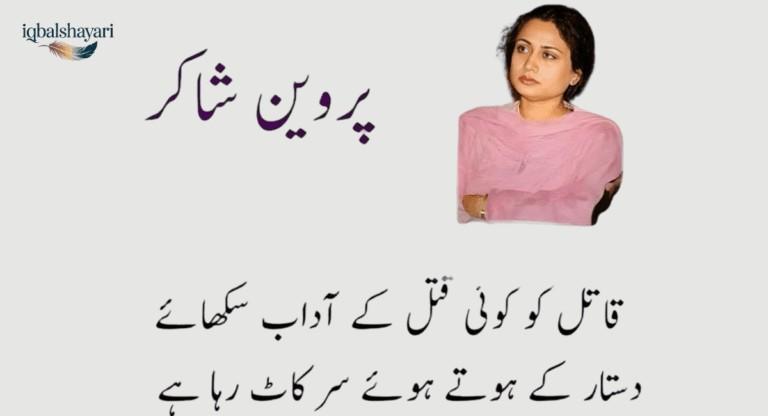
Parveen Shakir is remembered as one of the most powerful and emotionally honest voices in Urdu literature. She did not just write poetry; she reshaped how emotions, especially a woman’s emotions, were expressed in Urdu verse. At a time when poetry largely reflected male experiences, Parveen Shakir introduced a deeply personal feminine perspective that felt authentic and fearless.
Today, readers search not only for Parveen Shakir poetry but also for details about her marriage, love life, son, accident, and death reason. This article presents a complete and balanced Parveen Shakir biography, covering her personal life, literary career, books, and the legacy she left behind.
Early Life and Family Background
Parveen Shakir was born on November 24, 1952, in Karachi, Pakistan, into a middle-class educated family. Her upbringing played a key role in shaping her intellectual curiosity and emotional sensitivity. From an early age, she showed a natural connection with language and expression.

Her father supported her education and encouraged independent thinking, which was uncommon for girls at the time. Growing up in Karachi exposed her to diverse cultural and literary influences. These early experiences laid the emotional foundation that later became the hallmark of her poetry.
The Karachi of her youth was a city of contrasts—traditional values meeting modern aspirations. This cultural tension would later surface in her poetry, where she balanced respect for classical forms with bold personal expression.
Education and Academic Excellence
Education was central to Parveen Shakir’s identity. She earned a Master’s degree in English Literature, followed by a Master’s in Linguistics from Karachi University. Her academic background gave her a strong command over language, structure, and symbolism that distinguished her work from her contemporaries.
She also studied abroad, including time at Harvard University, which expanded her intellectual and cultural outlook. This international exposure helped her blend traditional Urdu poetry with modern themes, making her work both classical and contemporary. She understood the technical mechanics of poetry in multiple languages, which enriched her Urdu verse with fresh perspectives.

Her academic achievements were remarkable for a Pakistani woman in the 1970s. She proved that intellectual excellence and artistic sensitivity could coexist, inspiring countless women who followed in her footsteps.
Career in Civil Services
Parveen Shakir joined Pakistan’s Civil Services, serving in the Customs and Central Excise Group. Working in a male-dominated government environment gave her firsthand experience of authority, independence, and social expectations. She navigated bureaucratic hierarchies while maintaining her creative voice, a balance few could achieve.
Balancing a demanding government career with literary pursuits was not easy. However, this dual life influenced her poetry deeply. Themes like self-respect, identity, emotional conflict, and resilience often reflect her professional struggles and observations. The discipline required in civil service translated into the careful craftsmanship of her verses.
Her colleagues remember her as both professional and personable—someone who commanded respect without losing her warmth. This same quality permeates her poetry, where strength and vulnerability exist side by side.
Literary Career and Rise to Fame
Parveen Shakir began writing poetry at a young age, but her voice stood out immediately. Unlike traditional Urdu poets, she wrote from a woman’s perspective, openly expressing love, vulnerability, and emotional conflict without apology or pretense.
Her poetry gained recognition through literary magazines and mushairas (poetry gatherings), where readers connected with her honesty. Critics praised her for maintaining classical poetic forms while introducing modern emotional depth. She did not reject tradition; she redefined it.
What made her revolutionary was not just what she said, but how she said it. Her verses felt conversational yet profound, intimate yet universal. She proved that poetry could be both accessible and artistically sophisticated.
Parveen Shakir Books and Poetry Collections
Parveen Shakir authored several influential poetry collections that continue to resonate with readers today:
Khushbu (Fragrance) – Her debut collection that established her as a major voice in Urdu literature. The poems explore love, longing, and self-discovery with refreshing honesty.
Sad-barg (Hundred Leaves) – This collection deepened her exploration of emotional complexity, showing maturity in both craft and perspective.
Mah-e-Tamam (Complete Moon) – Perhaps her most celebrated work, where she achieved perfect balance between classical form and contemporary sensibility.
Inkar (Refusal) – A powerful collection that showcases her growing confidence in expressing dissent and independence.
Kaf-e-Aina (Mirror’s Edge) – Her final published work, marked by philosophical depth and reflection on life’s transience.
Her first book, Khushbu, became a landmark in modern Urdu poetry. Later works showed emotional maturity and philosophical depth. Across her books, she explored love, loss, self-awareness, and social realities with clarity and grace.
Poetic Style, Themes and Feminine Voice
Parveen Shakir’s poetic style is known for its simplicity, emotional clarity, and strong imagery. Her language is soft yet impactful, making complex emotions easy to understand. She had the rare gift of expressing profound truths in deceptively simple words.
Common themes in her poetry include:
Love and separation – She explored romantic love in all its phases: anticipation, fulfillment, disappointment, and memory. Her love poetry never felt clichéd because it came from genuine emotional experience.
Loneliness and longing – Even in crowded spaces, her poetry captures the essential solitude of the human experience. She wrote about the longing that persists even after desires are fulfilled.
Identity and self-respect – As a working woman, mother, and artist, she constantly negotiated multiple identities. Her poetry reflects this struggle for wholeness and self-definition.
Feminine strength and independence – She challenged traditional gender roles by expressing women’s emotions without apology. This bold honesty is why her poetry still feels relevant today.
Consider these lines:
تم آئے ہو نہ شب بھر چراغ جلتے رہے “Tum aaye ho na shab bhar chirag jaltay rahay” (You didn’t come, yet the lamps burned all night)
This simple observation becomes a meditation on hope, disappointment, and the rituals we perform while waiting for what may never arrive.
She proved that women’s emotional experiences deserved serious artistic treatment. Her poetry validated feelings that society often dismissed as trivial or overly sentimental.
Parveen Shakir Marriage
Parveen Shakir was married, but her marriage did not last and eventually ended in separation. She remained intensely private about the details, but the emotional impact is evident throughout her poetry. The pain of a failed marriage surfaces in verses that speak of broken promises, misunderstood intentions, and the courage required to walk away.
Her verses reflect disappointment, emotional struggle, and ultimately resilience. Instead of idealizing relationships, she portrayed love realistically, with all its complications and contradictions. This honesty allowed readers to see their own experiences reflected in her work.
She never wrote with bitterness, but with a clarity born from experience. Her poetry about marriage and its dissolution remains some of the most authentic writing on the subject in Urdu literature.
Parveen Shakir Love Life
Parveen Shakir’s love life has been widely discussed because of the emotional depth found in her poetry. While her verses suggest intense emotional experiences, she never publicly sensationalized her personal relationships. She maintained dignity even when writing about vulnerability.
Love in her poetry is complex and layered, filled with hope, longing, pain, and self-awareness. By transforming personal emotions into universal themes, she ensured her poetry remained timeless and relatable. Readers across generations find their own stories in her words.
Her approach to love was neither cynical nor naïve. She understood its power to transform and wound, often simultaneously. This mature perspective makes her love poetry endure beyond changing romantic fashions.
Parveen Shakir Son and Children
Parveen Shakir had one son, Murad Ali, who played a central role in her life. After her separation, she raised him while managing her professional and literary responsibilities. The experience of single motherhood in conservative Pakistani society added another dimension to her strength and determination.
She did not have multiple children. Her bond with her son influenced her later poetry, where themes of motherhood, care, and emotional strength appear with quiet intensity. She wrote about the fierce protectiveness of maternal love and the responsibility of shaping another life.
Friends recall how devoted she was to her son, ensuring his well-being even as she navigated professional demands and personal challenges. This maternal dedication never diminished her artistic output; if anything, it deepened her understanding of love’s many forms.
Parveen Shakir Death Reason
Many readers search for Parveen Shakir death reason due to the sudden nature of her passing. She died at the age of 42, leaving behind unfinished dreams and an irreplaceable literary voice. The Urdu literary world felt her loss profoundly, as she was in her creative prime.
Her death was not caused by illness or natural causes. It was the result of a tragic road accident that shocked the entire nation. The randomness of her death made it even more difficult to accept for those who loved her work.
Parveen Shakir Accident
Parveen Shakir died on December 26, 1994, in Islamabad, due to a car accident. Her vehicle collided with another car on Islamabad Highway, causing severe injuries that proved fatal. She was on her way to work when the accident occurred, making her death all the more tragic.
The news of Parveen Shakir accident spread quickly, leading to widespread grief. Writers, poets, and readers mourned the loss of a poet who had transformed modern Urdu poetry with courage and sincerity. Literary gatherings across Pakistan held memorial sessions, and tributes poured in from around the world.
Her sudden death at such a relatively young age felt like an injustice to literature itself. One can only imagine what she might have written in the years that were taken from her.
Awards and Recognition
Parveen Shakir received several honors during her lifetime, including the prestigious Pride of Performance Award, Pakistan’s highest civilian honor for contributions to the arts. This recognized her contribution to Urdu literature and her role in modernizing poetic expression.
Beyond awards, her greatest recognition came from readers. Her poetry remains part of academic syllabi and literary discussions across Pakistan and beyond. Universities study her work, and new generations continue to discover her voice.
She also received acclaim from literary critics who initially were skeptical of a woman poet writing so openly about personal emotions. Over time, even traditionalists acknowledged her technical skill and emotional authenticity.
Legacy and Cultural Impact
Parveen Shakir’s legacy continues to influence Urdu literature profoundly. She paved the way for women poets to express emotions openly and confidently. After her, it became more acceptable for female poets to write about personal experiences without facing harsh judgment.
Today, her poetry is shared through books and academic courses, social media and literary platforms, and mushairas and cultural discussions. Young poets, especially women, cite her as their inspiration. She proved that authenticity and artistry are not mutually exclusive.
She remains a symbol of emotional honesty and artistic courage. In a literary tradition that often values elaborate metaphor and complex symbolism, she showed that simple language could carry profound meaning.
Why Parveen Shakir Still Matters Today
Parveen Shakir’s poetry remains relevant because it speaks to universal human emotions that transcend time and culture. Her words offer comfort, understanding, and self-reflection in a fast-changing world. In an era of social media and instant communication, her careful, considered verses provide a counterpoint to superficial expression.
New generations continue to discover her work, proving that her voice has not faded. Her poetry still feels personal, sincere, and deeply human. Young readers find that despite decades passing since her death, her words speak directly to their contemporary experiences.
Her courage to write authentically about love, loss, and loneliness inspired not just poets but anyone struggling to articulate their inner lives. She gave permission to feel deeply and express honestly.
Conclusion
Parveen Shakir urdu poetrywas more than a poet. She was a civil servant, a mother, and a woman who expressed her truth with courage. Her experiences of love, marriage, separation, and loss shaped poetry that continues to resonate across generations and borders.
Understanding Parveen Shakir biography allows readers to appreciate her poetry beyond individual verses. Her work remains a lasting source of inspiration, ensuring her place among the most important voices in Urdu literature. She transformed what was possible in Urdu poetry and, in doing so, changed how we understand ourselves.
Related Reading
Explore more about Parveen Shakir and other great Urdu poets:
- Best 2 Lines Sad Urdu Poetry by Parveen Shakir
- Allama Iqbal Biography
- Mirza Ghalib Biography
- Complete Collection of Parveen Shakir Poetry