Introduction: The Poet Who Spoke for Millions — Life, Legacy & Lasting Voice
There are poets who write for the page. Then there are poets who write for the crowd — whose words don’t just sit quietly in books but erupt from stages, travel through generations, and find new life in the most unexpected moments. Rahat Indori was the second kind. Unquestionably.
Born in the heart of Indore, Madhya Pradesh, he grew into one of the most electrifying voices in the Urdu poetry tradition — a man whose shayari could silence a stadium of 50,000 people one second and bring them to their feet the next. For millions across India, Pakistan, and the South Asian diaspora in the United States, his couplets aren’t just memorable lines. They feel like personal truths someone finally found the courage to say out loud.
This is the complete story of Dr. Rahat Indori — the scholar, the performer, the political voice, and the poet whose words refuse to age.
Who Was Rahat Indori? A Quick Portrait
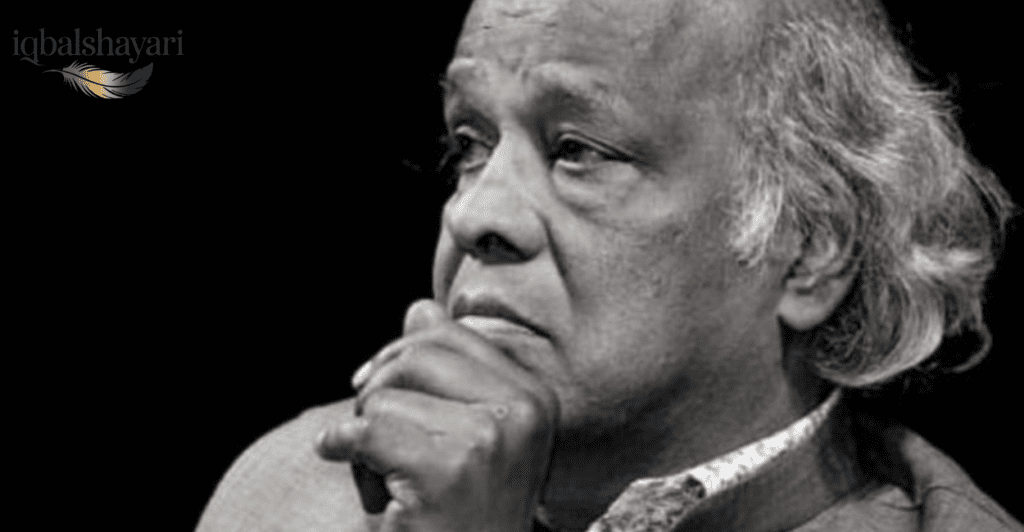
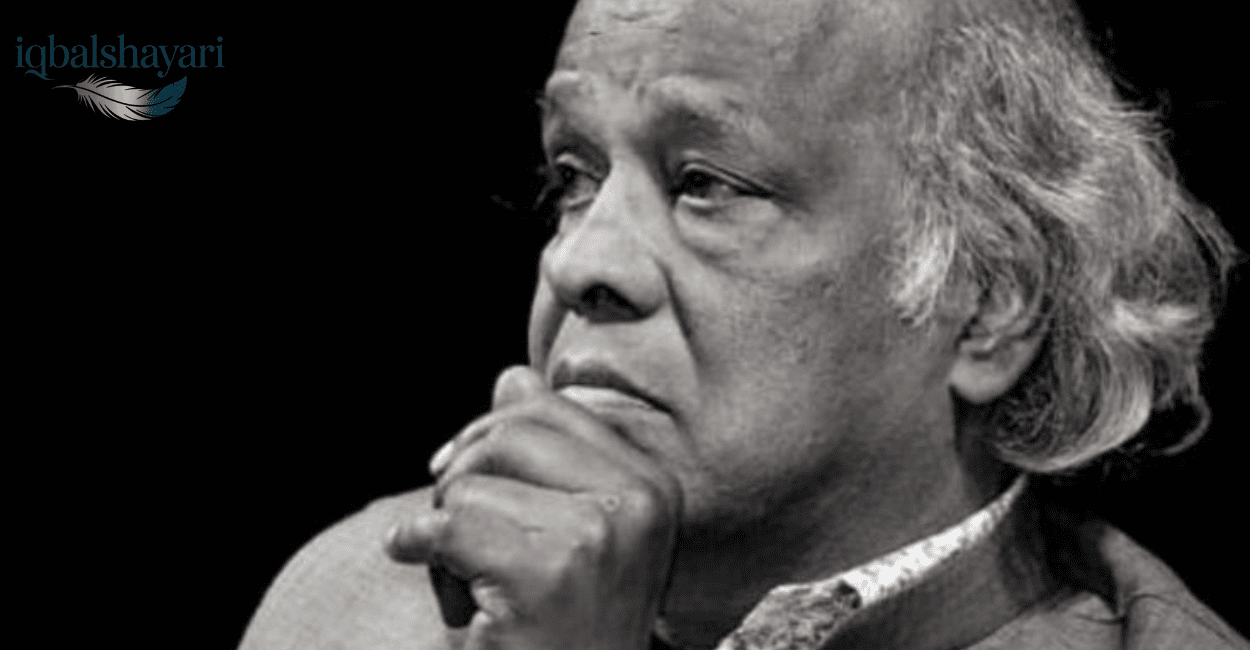
Rahat Indori — born Rahat Qureshi on January 1, 1950 — was an Indian Urdu shayar, academic, and Bollywood lyricist who became one of the defining literary figures of his era. He adopted the pen name Indori as a tribute to his hometown, following the classical tradition of Urdu poets who embed their city into their identity.
He passed away on August 11, 2020, in Indore, after contracting COVID-19. A pre-existing heart condition complicated his treatment, and he died at the age of 70 — leaving behind a body of work that continues to grow in cultural reach with every passing year.
| Quick Facts | Details |
| Full Name | Rahat Qureshi |
| Pen Name | Rahat Indori |
| Born | January 1, 1950, Indore, Madhya Pradesh |
| Died | August 11, 2020 |
| Cause of Death | COVID-19 complications + heart condition |
| Profession | Urdu poet, professor, Bollywood lyricist |
| Education | PhD in Urdu Literature, Barkatullah University, Bhopal |
| University Affiliation | Devi Ahilya Vishwavidyalaya (DAVV), Indore |
| Primary Literary Form | Ghazal, Nazm, Sher |
Early Life: Roots in a Working-Class Indore
Rahat Indori grew up in the Kasai Mohalla neighbourhood of Indore — a working-class area that couldn’t have seemed less likely to produce one of South Asia’s greatest poets. His father, Rafatullah Qureshi, worked in a textile mill. His mother, Maqbool Un Nisa Begum, managed the household.
What the family lacked in financial comfort, the city more than made up for in cultural richness. Indore, historically shaped by the Holkar rulers of the Maratha empire, was a place where Hindu, Muslim, and Maratha traditions mingled freely — a living example of the Ganga-Jamuni tehzeeb (India’s composite syncretic culture) that would later become central to Rahat’s poetic philosophy.
He attended Nutan School in Indore before going on to Islamia Karimia College for his undergraduate studies. Even in those early years, the pull of language was undeniable. He was drawn to the oral culture of Urdu couplets, qawwali, and folk storytelling that surrounded him — absorbing the rhythms that would later define his own voice.
Education and Academic Career: The Scholar Behind the Poet
One of the most overlooked dimensions of Rahat Indori’s life is his rigorous academic career. He wasn’t simply a crowd-pleasing performer — he was a formally trained scholar who brought intellectual depth to everything he wrote.
He completed his Master’s degree in Urdu Literature at Barkatullah University in Bhopal, followed by a PhD at the same institution. His doctoral research engaged directly with classical Urdu literary traditions, giving him a command of the form that informed even his most spontaneous-sounding couplets.
He also pursued a Diploma in Fine Arts, reflecting a broader creative sensibility that extended beyond language alone.
After completing his doctorate, Dr. Rahat Indori joined the Urdu faculty at Devi Ahilya Vishwavidyalaya (DAVV) in Indore, where he taught for decades. Students who sat in his lectures described them with the same words audiences used for his mushaira performances — captivating, alive, impossible to forget.
This dual identity — rigorous academic by day, thunderous stage poet by night — is what gave his work its unusual authority. His ghazals weren’t just emotionally powerful. They were structurally precise, rooted in a deep understanding of Urdu poetic forms like the radif, qafia, and maqta that most contemporary performers only loosely follow.
The Art of the Mushaira: Why Rahat Indori Was Different
For readers encountering Urdu poetry for the first time — particularly those in the US who may be discovering their South Asian heritage — understanding the mushaira is essential.
A mushaira is a formal public gathering of poets and their audience. It’s participatory in a way that few Western literary events are. When a powerful couplet lands, the crowd doesn’t politely applaud — they interject with “wah wah” (bravo), “kya baat hai” (what a thought), and often demand the poet repeat a line before moving on. It’s competitive, electric, and deeply communal.
Rahat Indori didn’t just perform at mushairas — he redefined what they could be. He brought a theatrical physicality to the stage that most literary poets avoided. His baritone voice, timed pauses, and ability to read a crowd of tens of thousands made him the undisputed headline act at every major mushaira in India, Pakistan, the UK, and across the United States.
He performed at stadiums, open grounds, cultural halls, and community centres — from New York to Chicago, from Houston to Edison, New Jersey, where South Asian diaspora communities gathered to stay connected to the language and culture of home.
For second-generation Indian and Pakistani Americans especially, a Rahat Indori performance was often a first encounter with just how alive Urdu shayari could be.
Poetic Style: What Made His Shayari Unforgettable
Rahat Indori’s poetry operated on several levels simultaneously — which is precisely why it reached such diverse audiences.
The Language Was Deliberately Accessible
Unlike many classical Urdu poets who favoured Persian-heavy vocabulary accessible only to the scholarly, Rahat Indori wrote in a register close to everyday spoken language. His words were felt before they were parsed. This was a conscious democratic impulse — poetry as a commons, not a gatekept art form.
The Themes Were Universal but Specific
His shayari covered a wide emotional and political spectrum:
- Romantic longing and love (Ishq) — sensuous, yearning, deeply human
- Resistance and defiance (Bagawat) — challenges to power, injustice, and majoritarian politics
- Homeland and identity (Watan) — belonging, displacement, the idea of India itself
- Communal harmony — a non-sectarian humanism rooted in Ganga-Jamuni tehzeeb
- Mortality and spiritual searching — mortality faced with neither denial nor despair
The Delivery Was Theatrical
Reading Rahat Indori on the page and hearing him perform are two completely different experiences. His mastery of timing — knowing exactly when to pause, when to lower his voice to a near-whisper before the final punch of a couplet — was a performance art in itself. YouTube recordings of his mushaira appearances, many of which have accumulated tens of millions of views, capture something of this quality, but even they fall short of the live experience as described by those who witnessed it.
Famous Shayari: Lines That Became Cultural Touchstones
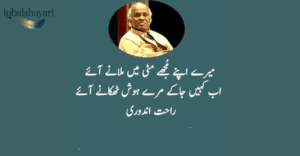
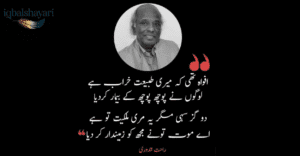
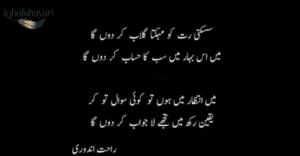
Rahat Indori’s couplets have become part of everyday conversation across South Asia and its diaspora. They appear on WhatsApp forwards, Instagram graphics, protest banners, and university lecture slides. A few of his most celebrated themes, expressed in his own words and paraphrased here for context:
His verse on communal danger and collective responsibility — warning that when fire spreads, no single community’s home is safe — resonated far beyond its original literary context. It became a rallying cry during the CAA (Citizenship Amendment Act) protests of 2019–2020, recited at Shaheen Bagh and protest gatherings across India as an anthem of solidarity.
His romantic poetry captured the particular ache of love that is present but unreachable — a theme that translated effortlessly across cultures and languages.
And his verses on identity and belonging — the idea of existing in the space between two worlds, two cultures, two identities — spoke with striking directness to South Asian diaspora communities in cities like New York, Chicago, and Houston, where the question of where one truly belongs is never fully settled.
Rahat Indori as a Bollywood Lyricist
Beyond the mushaira stage, Rahat Indori contributed meaningfully to Hindi cinema. His film lyrics carried the same emotional intelligence as his literary poetry, bridging the gap between the Urdu literary tradition and the mass reach of Bollywood.
| Film | Notable Song / Contribution | Year |
| Mission Kashmir | Bumbro Bumbro | 2000 |
| Munna Bhai MBBS | Wo Ladki Jo Sabse Alag Hai | 2003 |
| Criminal | Multiple songs | 1995 |
| Mann | Selected lyrics | 1999 |
| Ishq | Song contributions | 1997 |
Bumbro, from Mission Kashmir, remains his most widely recognized popular composition — a song that introduced his name to millions who had never attended a mushaira and might never have encountered Urdu poetry otherwise.
Published Works: Where to Find His Poetry
Rahat Indori authored approximately eight to ten major poetry collections over five decades. His most significant works include titles such as Do Qadam Aur Sahi, Meri Shayari Mere Jazbaat, and his Kulliyaat — the collected works that bring together the breadth of his poetic output in one volume.
Where to Access His Work from the USA
For readers in the United States looking to explore his shayari:
- Amazon.com — Most of his books are available for international shipping; some titles have digital editions
- Rekhta.org — The most comprehensive free online archive of Urdu poetry, including a dedicated Rahat Indori section with original Urdu text and transliterations
- YouTube — Hundreds of his mushaira recordings are freely available; search “Rahat Indori mushaira full” to begin
- Spotify / Apple Music — His Bollywood songs are available on major streaming platforms
- South Asian bookstores — Cities with significant Indian and Pakistani communities, including Edison NJ, Chicago, and Houston, have specialist booksellers who stock Urdu poetry collections
The Political Voice: Poetry as Protest
In his final years, Rahat Indori’s work took on an increasingly political dimension — or perhaps more accurately, the political content that had always been present in his poetry became impossible to ignore as India’s public discourse grew more volatile.
During the CAA protests of 2019–2020, his couplets were recited at demonstrations across India. Crowds at Shaheen Bagh and other sites of peaceful resistance adopted his lines as collective statements of identity, solidarity, and warning. He became, in effect, the unofficial poet laureate of a moment in Indian political history.
He was unambiguous about his own position. He spoke publicly against communal violence, against the targeting of religious minorities, and in favour of the pluralistic constitutional values he believed were the foundation of Indian democracy. His was not a political poetry of party allegiance — it was a humanism rooted in the same Ganga-Jamuni composite culture that had shaped his childhood in Indore.
Death and the Grief That Followed
Rahat Indori was admitted to Aurobindo Hospital in Indore on August 10, 2020, after testing positive for COVID-19. His pre-existing heart condition meant his body had little margin for error. He died the following day, August 11, 2020, at 70.
The reaction was immediate and profound. Social media filled within hours. His couplets trended globally. Bollywood figures, politicians, fellow poets, and millions of ordinary listeners expressed grief that felt genuinely personal — because for many of them, it was.
His funeral was held in Indore, and his grave has since become a place of quiet pilgrimage for admirers who travel from across India and beyond to pay their respects.
Rahat Indori’s Legacy in the USA: How the Diaspora Keeps His Voice Alive
This is the dimension most coverage misses entirely. Rahat Indori was not only beloved in South Asia. He was a defining cultural figure for the South Asian diaspora in the United States — a community of more than five million Indian Americans and Pakistani Americans navigating questions of identity, heritage, and belonging in a country far from the one their parents or grandparents left.
His shayari — particularly his verses on living between worlds and the persistence of love and identity under pressure — spoke directly to that experience. Atmushairas in New York, Chicago, Houston, Dallas, and Edison, New Jersey, his presence (and after his death, his memory) drew audiences who came not just to hear poetry but to feel connected to something larger.
Annual tribute mushairas held in his honour in US cities continue to draw significant crowds. Community organizations and South Asian cultural associations regularly feature his work in programming. On platforms like Instagram and WhatsApp, his couplets circulate in graphic form — shared by second-generation Americans who may not read Urdu but feel his words in translation.
Every January 1 (his birth anniversary) and August 11 (the anniversary of his death), search interest in his name spikes significantly — a digital reflection of the continued emotional hold he has on his audience.
7+ Frequently Asked Questions About Rahat Indori
Q1: What is Rahat Indori’s real name?
His birth name was Rahat Qureshi. He adopted the pen name Indori — a classical Urdu poetic tradition of appending one’s city of origin — as a tribute to his hometown of Indore, Madhya Pradesh.
Q2: When did Rahat Indori die, and what was the cause?
Rahat Indori passed away on August 11, 2020, in Indore. He contracted COVID-19 and had an underlying heart condition that severely complicated his treatment. He was 70 years old.
Q3: Was Rahat Indori a professor?
Yes. He earned a PhD in Urdu Literature from Barkatullah University, Bhopal, and went on to teach at Devi Ahilya Vishwavidyalaya (DAVV) in Indore for decades. His academic career ran parallel to his performing career throughout his life.
Q4: What language did Rahat Indori write in?
He wrote primarily in Urdu, published in Nastaliq script and widely transliterated into Devanagari for Hindi-reading audiences. His vocabulary was deliberately accessible — blending classical Urdu shayari tradition with everyday spoken language.
Q5: Did Rahat Indori write Bollywood songs?
Yes. He contributed lyrics to several Hindi films, most notably Mission Kashmir (2000), where he wrote the iconic song Bumbro Bumbro. He also wrote for films including Munna Bhai MBBS, Criminal, and Mann.
Q6: Why was Rahat Indori’s poetry popular during the CAA protests?
His couplets on communal harmony, collective responsibility, and resistance to injustice aligned powerfully with the mood of the CAA (Citizenship Amendment Act) protests of 2019–2020. Lines originally written years earlier became anthems at Shaheen Bagh and other protest sites, demonstrating the timeless political relevance of his Urdu shayari.
Q7: Where can readers in the USA access Rahat Indori’s work?
His poetry is available on Amazon.com (books, some with international shipping), Rekhta.org (free online archive), and YouTube (mushaira recordings). His Bollywood songs are on Spotify and Apple Music. South Asian bookstores in Edison NJ, New York, Chicago, and Houston often stock his published collections.
Q8: How did Rahat Indori influence modern Urdu poetry?
He democratized Urdu shayari by making it accessible to mass audiences without sacrificing literary depth. His willingness to blend romantic ghazals with sharp political commentary created a template that younger shayars across India, Pakistan, and the diaspora actively follow today.
Q9: What is a mushaira, and why was Rahat Indori famous at them?
A mushaira is a public poetry recitation gathering central to Urdu literary culture — participatory, competitive, and deeply communal. Rahat Indori was considered one of the greatest mushaira performers of his generation, capable of commanding audiences of 10,000 to 100,000 people with theatrical delivery, precise timing, and couplets that landed like physical events.
Conclusion
Rahat Indori defied every category that literary culture tends to impose. He was too popular for the academy and too scholarly for the populists. He was a romantic poet who became a protest voice, a stage performer who was also a serious academic, a man who wrote in Urdu but reached millions who barely knew the language.
What he had — and what no amount of analysis fully captures — was truth. His shayari felt true in the way that the best poetry always does: not because it described the world as it is, but because it described the world as it is felt.
For the South Asian diaspora in the United States, he remains more than a beloved poet. He is a thread of connection — to language, to heritage, to a cultural identity that stubbornly persists across oceans and generations. Every time one of his couplets appears on an Instagram story in New York or is whispered at a mushaira in Chicago, he is still speaking.
And the crowd is still listening.