

Introduction:
A broken heart doesn’t always find its own words; that’s what sad shayari is for. It’s a form of short Urdu poetry built for exactly this kind of feeling: heartbreak, loss, loneliness, the ache that’s hard to explain to another person. On this page, sad poetry in Urdu is grouped by what you’re actually going through: two-line couplets, heartbreak and judai, quiet Ghamgeen verses, and lines about the weight of everyday life.
You’ll find everything in both Urdu script and Roman Urdu, so it works whether you read Urdu comfortably or lean on transliteration. Where a couplet comes from a known poet, Allama Iqbal or Mirza Ghalib, that’s stated clearly. When the source isn’t confirmed, we state that too, instead of guessing at authorship. Whether you’re looking for the saddest Urdu poetry to sit with quietly or the best Urdu sad poetry to send someone tonight, it’s here.
At a glance: Sad shayari, but organized around what someone’s actually going through, not just poet or format. Starts with 2-line shayari since that’s what people search for most, then heartbreak and judai, then ghamgeen, the heavier, more native word for sad that most pages skip. There’s a life/zindagi section too, kept separate from loneliness on purpose so it doesn’t step on a future page.
A WhatsApp status section covers how this poetry actually gets used day to day. Only two named poets show up, Iqbal and Ghalib, and only because both are genuinely, widely credited, not guessed at. Every other couplet on the page says plainly that it was written for this collection, not found somewhere and passed off as unknown. The FAQ at the end covers the real questions: what sad shayari means, what ghamgeen means, and how it differs from sad poetry in general. Closes with a link to the rest of the site.
Best Sad Shayari in Urdu
Every collection on this page is chosen for one reason: it says something real about pain, not just something that sounds sad. Some lines here belong to well-known poets, clearly marked as theirs. Others were written specifically for this page — original work, not lines pulled from somewhere else with the author lost along the way.
A note on sourcing: where a couplet is attributed to a named poet on this page, that attribution reflects wide, consistent literary consensus. Where a couplet has no poet’s name attached, it’s labeled as an original composition written for this page, not presented as an existing quote of unknown origin.
Verified & Attributed Shayari
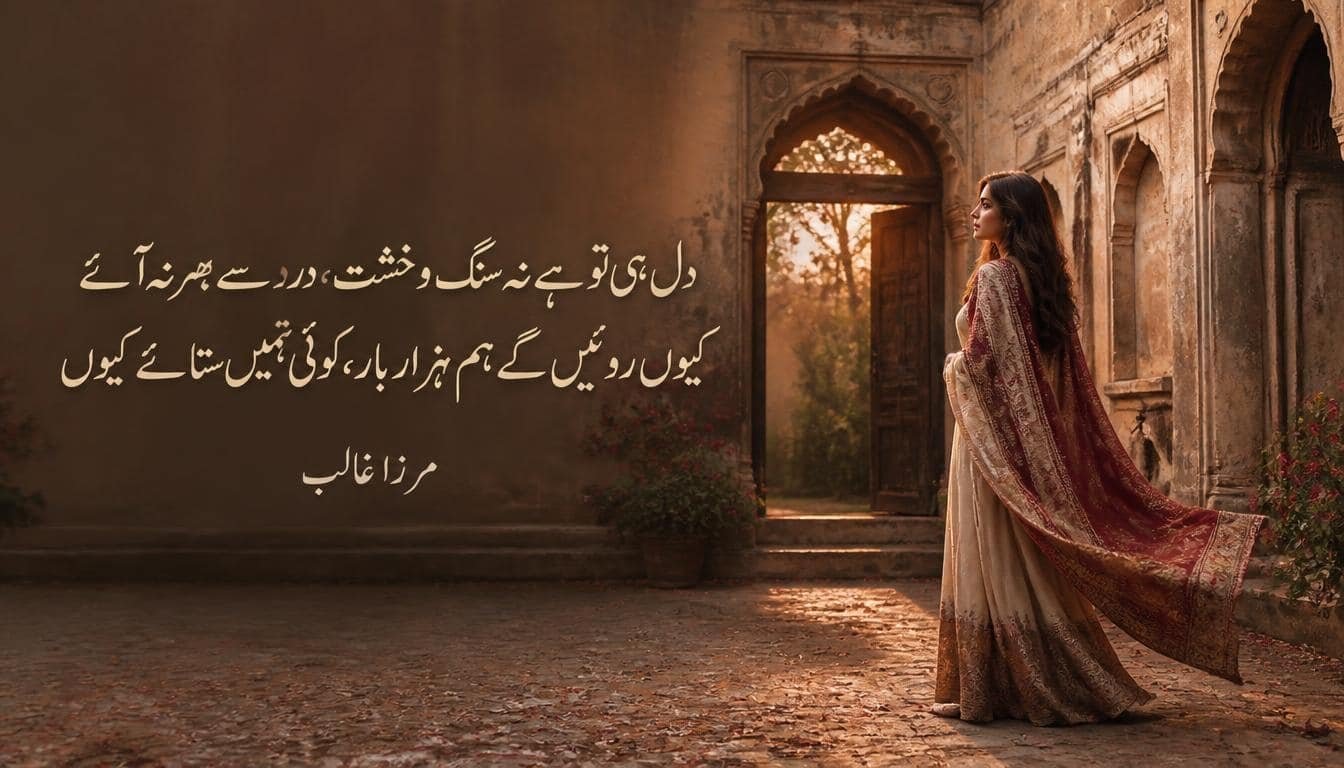
When a couplet on this page carries a poet’s name, it’s because that attribution is widely and consistently recognized — not because it “sounds like” something they’d write. Take this one from Mirza Ghalib:
دل ہی تو ہے نہ سنگ و خشت، درد سے بھر نہ آئے کیوں روئیں گے ہم ہزار بار، کوئی ہمیں ستائے کیوں
Dil hi to hai na sang-o-khisht, dard se bhar na aaye kyun. Royenge hum hazaar baar, koi hamein sataaye kyun?
It’s only a heart, not stone and brick — why shouldn’t it fill with pain? I’ll weep a thousand times over; why should anyone else have to hurt me for it?
Widely attributed to Mirza Ghalib.
This kind of line has survived for over a century because it names something people still recognize in themselves. You’ll find more from Ghalib and Allama Iqbal further down this page, each one credited the same way.
Popular & Original Shayari
A lot of the sad shayari that circulates on WhatsApp and Instagram doesn’t come with a poet’s name at all — sometimes because it was never meant to be famous, just felt. Here’s an original line written for this page, in that same spirit:
کبھی خود سے بھی پوچھا نہیں، درد اتنا کیوں پالا ہے بس جینا ہے اس لیے جی رہے ہیں، یہی سب کچھ بتلا ہے
Kabhi khud se bhi poocha nahin, dard itna kyun paala hai. Bas jeena hai isliye ji rahe hain, yahi sab kuch batlaa hai.
I’ve never even asked myself why I’ve held onto this pain for so long. I’m alive because I have to be — that’s really all there is to say.
Original composition for this page, not attributed to any named poet.
Lines like this are written to be copied straight into a status or a caption, no changes needed. That’s true for most of what’s on this page — copy the Urdu, the Roman Urdu, or the English meaning, whichever fits where you’re sharing it.
2 Line Sad Shayari in Urdu
Two lines are often enough to say what a whole paragraph can’t. This format is the most searched-for style of sad shayari, and it’s easy to see why — it takes seconds to read, needs no explanation, and can be copied exactly as it is without cutting anything down. That’s what makes 2-line sad poetry in Urdu the easiest kind to actually use, not just read.
Sad Shayari 2 Lines in Urdu Script
Reading these in Urdu script carries a weight that transliteration can soften. Here’s one built for that quiet, everyday kind of sadness — not a dramatic heartbreak, just the tiredness that builds up over time:
ہم مسکراتے رہے، درد چھپاتے رہے کسی کو کیا خبر، ہم اندر سے کیا سہتے رہے
Original composition for this page, not attributed to any named poet.
Meaning: We kept smiling, kept hiding the pain. No one ever knew what we were carrying inside.
Two-line shayari like this works because it doesn’t try to explain the sadness — it just names it and stops.
Sad Shayari 2 Lines in Roman Urdu
If Urdu script isn’t comfortable for you to read, Roman Urdu carries the same feeling without the barrier. Here’s the same style of line, written the way it’s most often typed and shared:
Hum muskurate rahe, dard chhupate rahe. Kisi ko kya khabar, hum andar se kya sehte rahe.
Meaning: We kept smiling, kept hiding the pain. No one ever knew what we were carrying inside.
Roman Urdu versions like this are common on WhatsApp and Instagram for exactly this reason — they’re easy to type back out, copy, or read aloud, even for people who grew up speaking Urdu but not reading its script.
Heart Touching Sad Shayari
Some pain doesn’t come from one big event — it builds from small moments that never fully heal. This section covers two forms of that: the ache of a relationship that broke, and the specific pain of judai, or separation, which Urdu poetry treats almost as its own emotion. Both are written to be read slowly, not skimmed.
Broken Heart Shayari
A broken heart rarely announces itself loudly — it shows up in the quiet after everything’s already over. Here’s a line that captures that stillness:
ٹوٹا ہوا دل کسی کو نظر نہیں آتا بس ایک مسکراہٹ کے پیچھے چھپا رہتا ہے
Toota hua dil kisi ko nazar nahin aata. Bas ek muskurahat ke peeche chhupa rehta hai.
Meaning: A broken heart is invisible to everyone else. It just stays hidden behind a smile.
Original composition for this page, not attributed to any named poet.
This is one of the most shared themes in sad shayari because it names something rarely said out loud: that people can look completely fine while carrying something heavy.
Heartbreak & Judai Shayari
Judai isn’t quite the same as heartbreak — it’s the specific ache of distance, whether that distance came from a choice, circumstance, or simply time. Urdu poetry has always treated separation as a subject of its own, distinct from betrayal or loss. Here’s a couplet built around that feeling:
جدائی نے سکھا دیا خاموشی سے جینا نہ شکوہ رہا، نہ آنسو، بس عادت بن گیا رہنا
Judaai ne sikha diya khamoshi se jeena. Na shikwa raha, na aansu, bas aadat ban gaya rehna.
Meaning: Separation taught me to live quietly. No complaints left, no tears — staying like this just became habit.
Original composition for this page, not attributed to any named poet.
Lines about judai tend to resonate less with anger and more with a kind of settled sadness — the pain hasn’t gone away, but it’s become familiar.
Ghamgeen Urdu Shayari
Ghamgeen is the word Urdu speakers actually reach for when English’s “sad” feels too flat. It carries weight — a heaviness that sits in the chest rather than passes through quickly. This section covers two shades of that feeling: raw, unfiltered pain, and the softer, more reflective sorrow that ghamgeen shayari is known for.
Deep Sorrow and Pain Shayari
Some sorrow doesn’t ask to be understood — it just needs to be said. This line sits in that space, without trying to soften what it’s describing:
غم اتنا گہرا ہے کہ لفظ بھی کم پڑ جاتے ہیں بس آنکھیں بولتی ہیں، جہاں زبان خاموش ہو جاتی ہے
Gham itna gehra hai ke lafz bhi kam parr jaate hain. Bas aankhein bolti hain, jahan zubaan khamosh ho jaati hai.
Meaning: This sorrow runs so deep that even words fall short. Only the eyes speak, where the tongue goes quiet.
Original composition for this page, not attributed to any named poet.
This kind of line is common in ghamgeen shayari because it doesn’t try to explain the pain — it just points to the moment where language stops being enough.
Ghamgeen Shayari Lines
Not all ghamgeen shayari is about a single loss. Some of it is quieter than that — a general weight that settles in without a clear cause. Here’s a line built around that kind of feeling:
دل بوجھل ہے، وجہ کوئی خاص نہیں بس ایسے ہی، کبھی کبھی، اداس ہوں
Dil bojhal hai, wajah koi khaas nahin. Bas aise hi, kabhi kabhi, udaas hoon.
Meaning: My heart feels heavy, no particular reason. Just like that, sometimes, I’m sad.
Original composition for this page, not attributed to any named poet.
Not every sadness has a story behind it — sometimes ghamgeen shayari simply gives a name to a mood that would otherwise go unspoken.
Sad Poetry in Urdu About Life
Life itself can feel like the source of sadness, separate from any one person or event. This section stays focused on that — the weight of getting through ordinary days, not heartbreak or separation, which already have their own sections above.
Life Shayari (Zindagi)
Zindagi, or life, shows up constantly in Urdu poetry as something to be endured as much as lived. Here’s a line that captures that tone:
زندگی نے بہت کچھ سکھایا، مسکرا کر جینا بھی ہر زخم کو چھپا کر آگے بڑھنا بھی
Zindagi ne bohot kuch sikhaya, muskura kar jeena bhi. Har zakhm ko chhupa kar aage barhna bhi.
Meaning: Life has taught me a lot — including how to smile and keep living. How to hide every wound and keep moving forward.
Original composition for this page, not attributed to any named poet.
This kind of shayari doesn’t dwell on one specific pain. It speaks more broadly, to the effort it takes just to keep going.
Painful Life Shayari
Some lines go further than tiredness — they speak to life feeling genuinely heavy, day after day. Here’s one written in that register:
زندگی نے ہر بار امتحان لیا پاس ہونے کے بعد بھی، کچھ نہ ملا
Zindagi ne har baar imtihaan liya. Paas hone ke baad bhi, kuch na mila.
Meaning: Life tested me again and again. Even after passing, I was left with nothing.
Original composition for this page, not attributed to any named poet.
This one holds a different kind of sadness — not grief over losing someone, but a quiet frustration with life’s pace and demands.
Sad Shayari for WhatsApp Status
A lot of sad shayari gets read once and shared within minutes — usually as a status, caption, or quiet message to someone who’ll understand it without an explanation. This section is built specifically for that: short, easy to copy, and ready to post as-is.
Short Sad Shayari for Status
A good status line doesn’t need context — it should work on its own, for anyone who reads it. Here’s one built for exactly that:
کچھ باتیں دل میں ہی رہ جاتی ہیں کچھ اسٹیٹس بن کر سامنے آ جاتی ہیں
Kuch baatein dil mein hi reh jaati hain. Kuch status ban kar saamne aa jaati hain.
Meaning: Some things stay locked in the heart. Some become a status instead.
Original composition for this page, not attributed to any named poet.
Short lines like this work well as a status because they say just enough — not so little that it feels empty, not so much that it needs explaining.
Shareable Sad Shayari Lines
Some lines are written less for status updates and more for sending directly to someone — a caption, a reply, or just a message on its own. Here’s one built for that kind of sharing:
یاد آتے ہو تم، پر کہہ نہیں پاتا بس ایک لائن لکھ کر، دل ہلکا کر لیتا ہوں
Yaad aate ho tum, par keh nahin paata. Bas ek line likh kar, dil halka kar leta hoon.
Meaning: I think of you, but I can’t say it out loud. So I write one line, just to feel lighter.
Original composition for this page, not attributed to any named poet.
Lines like this tend to get shared quietly, one-on-one, more than posted publicly — the kind of shayari sent when a full message feels like too much.
Famous Poets’ Sad Shayari
Some sorrow has been written down so well that it’s outlasted the poet who wrote it. This section moves away from original lines to shayari with a real, widely recognized name attached — Allama Iqbal and Mirza Ghalib, two of the most widely read poets in Urdu literature, each represented here by a couplet consistently attributed to their work across literary sources.
Allama Iqbal
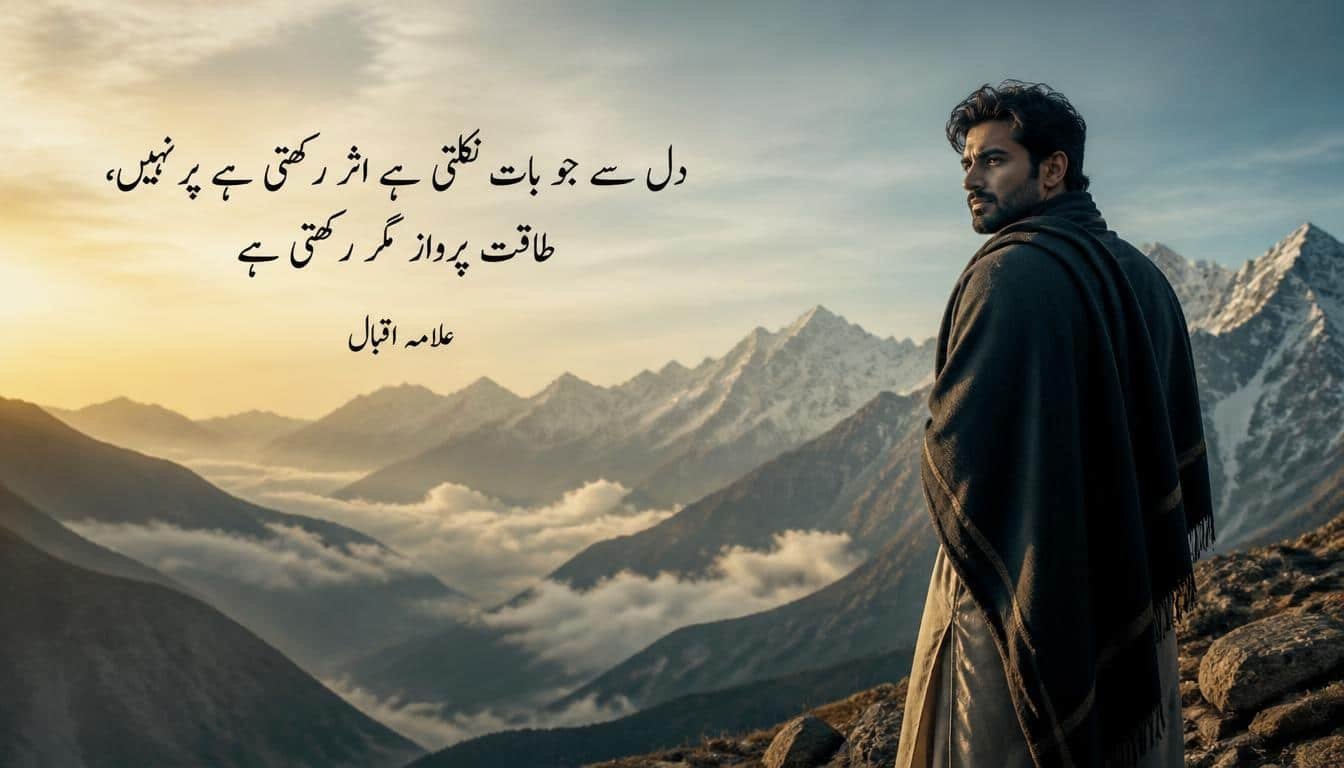
Iqbal’s poetry is often remembered for its philosophy and its call to self-belief, but some of his verses carry a real, quiet heaviness too. This is one of his most widely quoted couplets:
دل سے جو بات نکلتی ہے اثر رکھتی ہے پر نہیں طاقتِ پرواز مگر رکھتی ہے
Dil se jo baat nikalti hai asar rakhti hai, Par nahin taaqat-e-parwaz magar rakhti hai.
Meaning: Whatever comes from the heart carries real weight — but it doesn’t always have the strength to rise and be heard.
Widely attributed to Allama Iqbal.
This verse speaks to a specific kind of sadness: the frustration of feeling something deeply and still not being able to make it heard the way it deserves.
Mirza Ghalib
Ghalib remains one of the most quoted poets in Urdu when it comes to grief, longing, and the exhaustion of wanting something out of reach. This is one of his best-known couplets:
ہزاروں خواہشیں ایسی کہ ہر خواہش پہ دم نکلے بہت نکلے میرے ارمان لیکن پھر بھی کم نکلے
Hazaaron khwahishein aisi ke har khwahish pe dam nikle. Bahut nikle mere armaan, lekin phir bhi kam nikle.
Meaning: So many desires, each one enough to take my breath away. Countless wishes have already left me — and still, it doesn’t feel like enough.
Widely attributed to Mirza Ghalib.
This line is often cited as one of the clearest expressions of longing in Urdu poetry — not sadness over one loss, but the endless, unresolved ache of wanting.
Frequently Asked Questions
What is sad shayari?
Sad shayari is a short form of Urdu poetry, usually one or two lines, written to express grief, heartbreak, loneliness, or loss. It’s built to be read quickly and felt immediately, which is why it’s so often shared as a status or caption rather than read as a longer poem.
What is ghamgeen shayari?
Ghamgeen shayari refers to poetry that carries deep, heavy sorrow — the word “ghamgeen” itself means sorrowful or grief-stricken in Urdu. It’s a more specific, native term than the general word “sad,” and it’s often used for verses about loss, mourning, or a lasting emotional weight rather than a passing bad mood.
What is the difference between sad poetry and sad shayari?
“Sad poetry” is the broader English term, while “shayari” refers specifically to the Urdu literary tradition — short couplets, or sher, often shared and recited on their own. All sad shayari is sad poetry, but not all sad poetry follows shayari’s specific style and structure.
Where can I find sad poetry in Urdu?
Sad poetry in Urdu is available across dedicated poetry sites, literary archives like Rekhta, and collections like this one. Look for pages that clearly separate verified, poet-attributed shayari from original or unattributed lines, since a lot of shayari shared online doesn’t come with a reliable source.
More Urdu Shayari to Explore
Sad shayari is just one part of a much larger tradition. If this collection resonated with you, there is more Urdu poetry across other moods and themes — love, motivation, friendship, and beyond, each with the same standard of honest attribution used throughout this page.
More focused collections on specific themes covered briefly here — like judai, ghamgeen shayari, and Zindagi-focused poetry — are planned as dedicated pages of their own, so this space can go deeper into each one without overloading a single page.
Conclusion
Sad shayari works because it doesn’t try to fix the feeling — it just names it, precisely enough that someone else recognizes their own pain in it. That’s true whether it’s a two-line couplet meant for a WhatsApp status or a century-old verse from Ghalib. What matters isn’t length or fame; it’s whether the words hold something real.
This page brought together sad poetry in Urdu across the moments that call for it — heartbreak, judai, ghamgeen sorrow, the weight of daily life — with every line honestly marked as either attributed or original, so you always know what you’re reading. If one of these couplets said something you couldn’t quite say yourself, it did its job.
For more Urdu shayari across other moods, visit IqbalShayari.com.


2 thoughts on “Sad Shayari in Urdu — Heart Touching Sad Poetry & Shayari Lines”
Pingback: Poetry Explained: Meaning, Types & Urdu Tradition in 2026
Pingback: Love Shayari in Urdu – Romantic & Heart Touching Poetry