Introduction:
There is a moment every person knows. You feel something so vast, so precise, so completely yours — and every word you reach for falls short. That is exactly where love poetry steps in. Not to explain the feeling. To be it. For thousands of years, poets across every culture have used verse to capture what ordinary language cannot hold — the breathless beginning of a new love, the quiet ache of romantic longing, the bittersweet weight of memory.
Urdu shayari takes this further than almost any other tradition on earth. A single couplet of mohabbat poetry can carry an entire relationship inside two lines. Whether you are discovering this world for the first time or returning to it like an old friend, love poetry is not just something you read. It is something you feel in your bones. This guide is your way in — and it starts right now.
What Makes Urdu Love Poetry Unlike Anything Else You Have Read
Urdu love shayari does not explain feelings. It suggests them — and that suggestion hits harder than any explanation ever could. Think of it this way. A photograph shows you exactly what something looks like. A painting makes you feel something about it. English poetry is often the photograph. Urdu shayari hands you the painting and trusts you completely.
The secret is compression. A single shear — just two lines — can carry the weight of an entire relationship. The longing, the silence, the memory of a voice. That is not an accident. It is centuries of craft. Mohabbat in Urdu is not just love. It is love with history inside it.
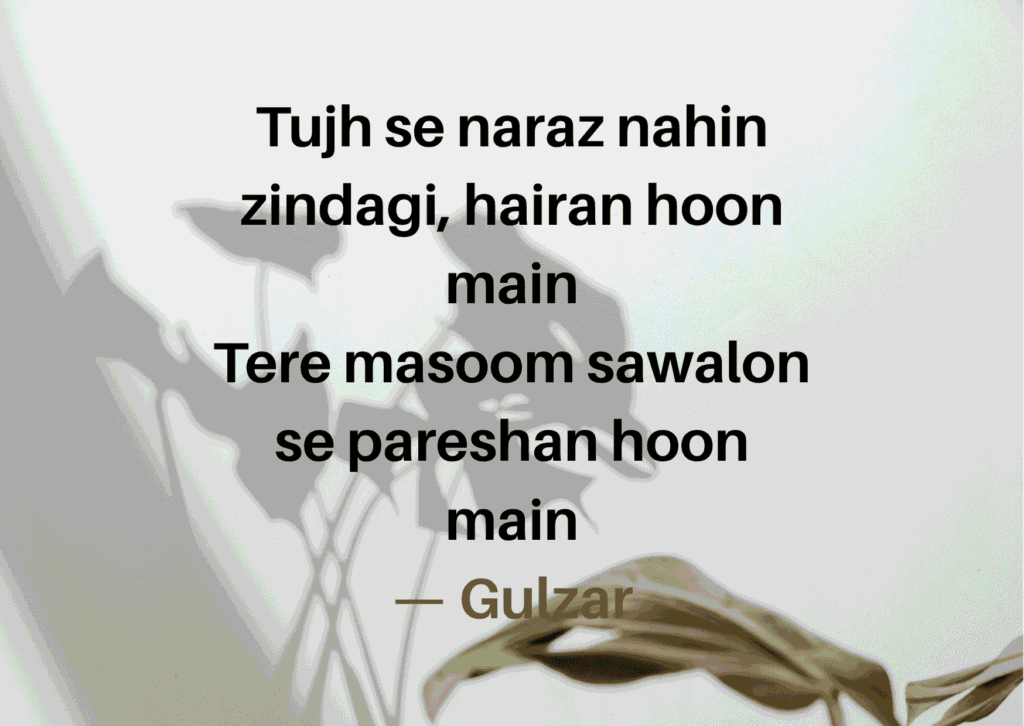
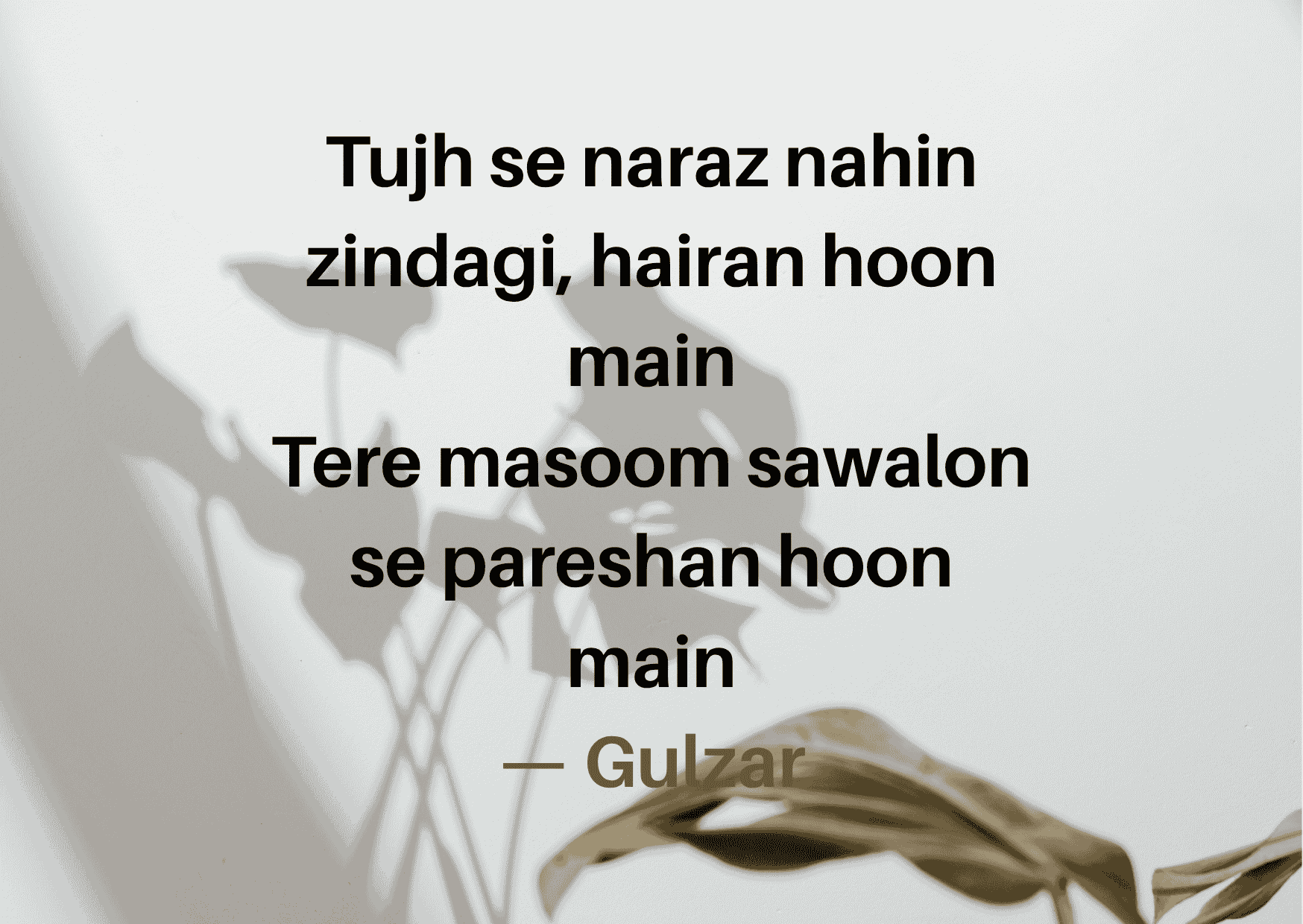
“Tujh se naraz nahin zindagi, hairan hoon main Tere masoom sawalon se pareshan hoon main” — Gulzar
This couplet from Gulzar captures something no direct English translation can fully hold. Life is not the enemy. Life’s innocent questions are the unbearable part. That is the genius of Urdu romantic shayari — the unsaid carries more than the said.
A Brief History of Urdu Love Poetry — From Mughal Courts to Your Instagram Feed
love poetry was not born in a library. It was born in courts, caravanserais, and the conversations of soldiers, saints, and lovers across medieval South Asia. The language itself is a beautiful accident — Persian grammar, Arabic vocabulary, and Hindi soul fused together under the Mughal empire in the 13th and 14th centuries.
The great poets of the Mughal era — Mir Taqi Mir, Mirza Ghalib, and Wali Deccani — turned the ghazal into something sacred. Ghalib alone wrote verses that scholars are still unpacking 200 years later. After Partition in 1947, the tradition did not die. It migrated. It moved with people to Lahore, Karachi, London, and eventually to Houston, Chicago, and New York.
| Era | Key Poets | Dominant Form | Key Theme |
| Mughal Period (13th–18th C) | Mir Taqi Mir, Wali Deccani | Ghazal | Divine and romantic love |
| Colonial Era (19th C) | Mirza Ghalib, Daagh Dehlvi | Ghazal, Qasida | Longing, loss, wine as metaphor |
| Independence Era (20th C) | Faiz Ahmed Faiz, Firaq Gorakhpuri | Nazm, Ghazal | Love + political resistance |
| Post-Partition (1950s–90s) | Jaun Elia, Ahmad Faraz | Ghazal, Sher | Existential heartbreak |
| Contemporary (2000s–now) | Tehzeeb Hafi, Rahat Indori | Sher, Nazm | Modern romance, social media virality |
Today, a 22-year-old in Houston shares a Jaun Elia couplet on Instagram Stories. A college student in Chicago reads Faiz on Rekhta at 2 AM. love poetry did not just survive. It found a whole new generation.
The Three Forms of Urdu Love Poetry Every Reader Should Know
Before you can truly appreciate — or write — Urdu love poetry, you need to understand its architecture. Think of it like music. You can enjoy a song without knowing music theory. But once you understand the structure, every note means more. There are three core forms that shape the entire tradition of romantic shayari in Urdu, and each one does something completely different to the reader.
The ghazal is a string of pearls — each couplet independent yet connected by rhyme and refrain. The nazm is a river — continuous, flowing, building toward something. The shear is a lightning strike — two lines, one truth, no warning. Knowing which form you are reading changes how you receive it entirely.
Ghazal — The Crown Jewel of Romantic Shayari
The ghazal is the most iconic form in all of romantic love poetry. Its structure is precise: each couplet shares a rhyme (qafiya) and a repeating refrain (radif) at the end of the second line. The opening couplet — the matla — sets both. The closing couplet — the maqta — traditionally includes the poet’s name or pen name (takhallus).
What makes ghazal extraordinary is that each couplet stands completely alone. You could rearrange them and the poem would still work. And yet, when read together, they create an emotional atmosphere that is far greater than the sum of its parts. Faiz Ahmed Faiz was the undisputed master of this form — weaving political grief and romantic longing until you could not tell where one ended and the other began.
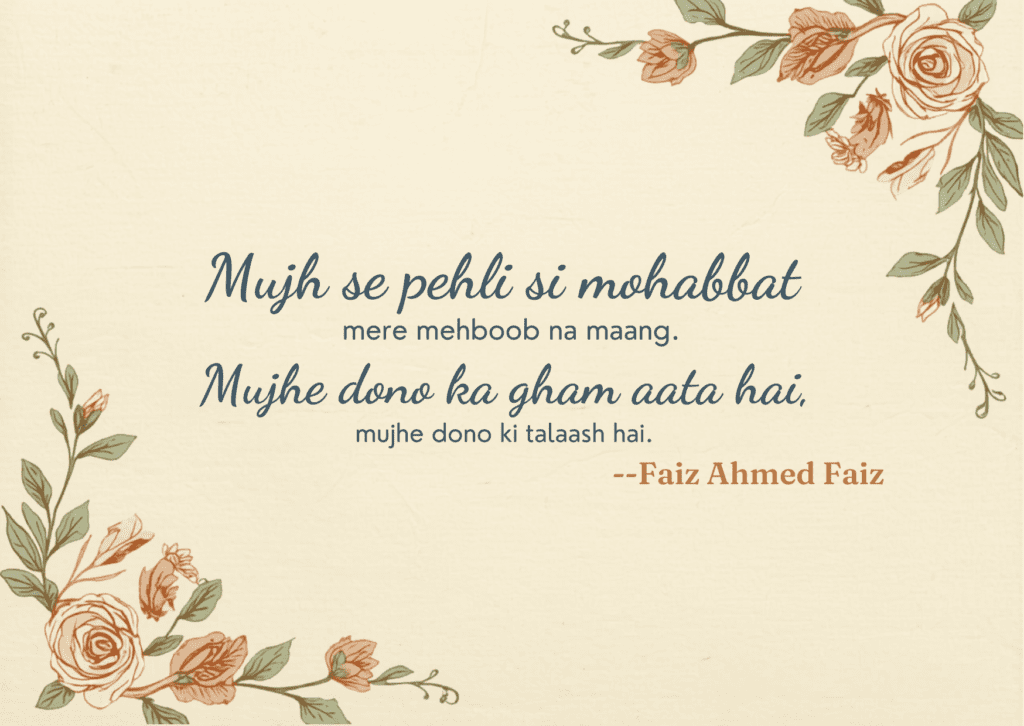
“Mujh se pehli si mohabbat mere mehboob na maang Mujhe dono ka gham aata hai, mujhe dono ki talaash hai”* — Faiz Ahmed Faiz
Nazm — When Love Poetry Tells a Full Story
The nazm gives the poet freedom that the ghazal does not. There is no mandatory rhyme scheme. No refrain. No required length. A nazm can be four lines or forty. It moves like a story — with a beginning, a build, and an emotional destination. This is the form Allama Iqbal used for his philosophical meditations on love, identity, and the soul.
For American readers who are newer to mohabbat shayari, the nazm is often the most accessible entry point. It reads closer to the lyric poetry taught in US schools — Whitman, Plath, Hughes — but with a depth of feeling that is distinctly Urdu. A nazm about waiting for someone can stretch across time and geography in a way a two-line sher simply cannot.
Sher — The Two-Line Verse That Stops You Mid-Scroll
The sher is the most viral form of Urdu love poetry in 2026. There are exactly two lines. The first line sets the scene, the anxiety, or the question. The second line delivers the answer — and that answer should land like a quiet earthquake. There is no buildup. There is no explanation. Just two lines and then silence, which is where the poem actually lives.
“Koi umed bar nahe ati Koi soorat nazar nahin ati”* — Mirza Ghalib
This is why Ghalib’s shares still circulate on Instagram 200 years after he wrote them. The feeling is timeless. The format fits a phone screen perfectly. Dard shayari — poetry of pain — in the sheer form has become the dominant voice of the South Asian diaspora online.
The Poets Who Defined Urdu Love Poetry — And What Made Them Legends
No art form exists without its masters. Urdu love poetry has produced poets whose work is not just literature — it is a lived experience for millions of people across generations and continents. These are not distant historical figures. Their words are texted between friends, quoted at weddings, whispered during heartbreaks, and posted on walls in apartments from Karachi to California. Understanding these poets is understanding the soul of the tradition itself.
Each of these poets brought something the others did not. Ghalib brought philosophical wit. Faiz brought political fire. Jaun Elia brought raw existential grief. Tehzeeb Hafi brought softness back when softness felt revolutionary. Together, they form a lineage — not of imitation, but of emotional inheritance.
Faiz Ahmed Faiz — Love and Resistance Woven Into One Verse
Faiz Ahmed Faiz was born in Sialkot in 1911. He studied at Government College Lahore and later at Oxford. He was a Marxist, a journalist, a soldier, and a poet — and he was imprisoned twice for his political beliefs. None of that stopped him from writing some of the most devastatingly beautiful love shayari ever composed.
What made Faiz singular was his refusal to separate the personal from the political. In his world, loving a person and loving a people were the same act. His beloved was simultaneously a woman, a nation, and an idea of freedom. For the South Asian diaspora in America — people who carry both personal longing and collective grief — Faiz speaks to both at once.
“Aaj bazar me pa-ba-jaulan chalo Chashm-e-nam, jaan-e-shoreeda kafi nahe”* — Faiz Ahmed Faiz
Faiz received the Lenin Peace Prize in 1962 and was nominated for the Nobel Prize in Literature. His collection Nuskhaha-e-Wafa remains one of the most important books in the Urdu literary canon. If you read only one poet, read Faiz first.
Jaun Elia — The Poet Who Made Heartbreak Sound Like Philosophy
Jaun Elia was born in 1931 in Amroha, India. He migrated to Karachi after Partition — a migration he never fully recovered from emotionally. He was a scholar of Arabic, Persian, Hebrew, and Sanskrit. He was also one of the most self-destructive and brilliantly original voices in the history of dard shayari.
Where Faiz looked outward — at society, at justice — Jaun Elia looked inward. His poetry is a relentless excavation of the self. He wrote about abandonment, addiction, and the particular loneliness of feeling like a stranger in your own life. His collection Shayad — meaning “Perhaps” — is a masterpiece of existential mohabbat shayari that reads like a diary written in lightning.
“Main ne chaha tha ke aansu mujhe aate hi nahin Dil ke aansoon ka koi rang nahin hota”* — Jaun Elia
His work dominates diaspora social media in 2026 because it speaks to a specific kind of modern loneliness — the loneliness of people who feel deeply but cannot find words precise enough. Jaun Elia had those words. He still has them.
Tehzeeb Hafi — The Voice of Modern Urdu Romantic Shayari
Tehzeeb Hafi represents something the older masters could not have predicted: the poet as a social media phenomenon. Born in the 1990s in Hafizabad, Punjab, he rose entirely through online sharing — his soft, accessible romantic shayari spreading across WhatsApp, Instagram, and YouTube before he ever had a formal published collection.
What Tehzeeb Hafi does is make tenderness feel powerful. His couplets do not rage or philosophise. They simply observe — a glance, a pause, the way someone says your name. For younger readers in the USA who are discovering Urdu love poetry for the first time, Tehzeeb Hafi is often the gateway. He proves that the tradition is not a museum exhibit. It is alive, today, right now.
“Tum mujh se door jaoge toh mahsoos hoga tumhein Kitni cheezein thi jo main kehta tha aur tum sunte the”* — Tehzeeb Hafi
Why Urdu Love Poetry Is Having a Major Moment in the United States
The South Asian diaspora in the United States numbers over 5.4 million people. That is 5.4 million people who grew up hearing Englissh love poetry at weddings, in films, from grandparents’ radios. Many of them came of age speaking English but feeling in Urdu. For them, finding a platform dedicated to authentic mohabbat shayari is not just entertainment. It is an emotional homecoming.
At the same time, something sudden is going on. Non-South-Asian American readers — drawn in by poets like Rupi Kaur and the general cultural turn toward confessional, emotional poetry — are discovering Urdu verse and finding it speaks to them too. The themes of romantic longing, loss, and resilience are universal. The Urdu language just happens to hold them with uncommon elegance.
| Search Trend | Growth (USA) | Primary Audience |
| “Urdu love poetry” | +340% in 3 years | South Asian diaspora 18–35 |
| “Jaun Elia shayari” | +280% in 2 years | Diaspora + non-South Asian readers |
| “romantic shayari in Urdu” | +190% in 2 years | Bilingual young adults |
| “ghazal poetry English” | +220% in 3 years | English-first poetry readers |
| “#lovepoetry Urdu” (Instagram) | 4.2M+ posts | Global, USA-heavy |
The hashtag #lovepoetry on Instagram now returns millions of posts — a significant portion in Urdu or Roman Urdu. TikTok’s Urdu poetry community has grown faster than almost any other literary niche on the platform. Hindi love poetry is not just surviving in America. It is genuinely thriving.
Urdu Love Poetry in Roman Urdu and English — Bridging Two Worlds
One of the most interesting developments in love poetry is the rise of Roman Urdu — writing the language in the Latin alphabet rather than the Nastaliq script. For many in the diaspora, Roman Urdu is how they text, how they think, and how they feel. It is Urdu without the script barrier, and for millions of American readers, it is the doorway into the tradition.
The platform محبت کی شاعری hosts poetry in all three forms — Urdu script, Roman Urdu, and English translation — which means a reader who knows no Urdu at all can still experience the emotional architecture of a great sher. The meaning travels even when the script does not.
Here is how the same verse looks across three forms:
| Form | Text |
| Urdu Script | دل ڈھونڈتا ہے پھر وہی فرصت کے رات دن |
| Roman Urdu | Dil dhundta hy phir wohi fursat ky raat din |
| English Translation | The heart again seeks those leisured days and nights |
Bilingual poetry — verse that exists comfortably in two languages simultaneously — is one of the most exciting frontiers in contemporary American literary culture. Urdu romantic shayari is perfectly positioned at that frontier.
Best Platforms to Read and Share Urdu Love Poetry in 2026
Finding great Urdu love poetry in 2026 has never been easier. But not all platforms are equal. Some are archives. Some are communities. Some are discovery engines. Knowing which to use for what makes the difference between a shallow browse and a genuine encounter with the tradition.
The best approach is to use multiple platforms for different purposes — classical depth on one, contemporary community on another, social discovery on a third. Think of it as a literary diet. You need different nutrients from different sources.
| Platform | Best For | Content Type | Free? |
| محبت کی شاعری | Contemporary community shayari | User-submitted poetry, poet profiles | Yes |
| Rekhta.org | Classical archive and reference | 600,000+ verses, audio, dictionary | Yes |
| Reddit r/Urdu | Discussion and critique | Community threads, recommendations | Yes |
| Instagram #urdushayari | Discovery and viral content | Short-form shers, reels | Yes |
| YouTube | Audio-visual recitation | Mushaira recordings, poet interviews | Yes |
How to Use These Platforms Together — A Simple Weekly Routine
A simple three-platform weekly routine can build genuine Urdu love poetry literacy faster than any course. On weekday mornings, spend five minutes on Rekhta. Read one classical verse. Read the commentary. Let it sit with you. In the evenings, browse محبت کی شاعری for something contemporary — something written this year, by someone who feels what you feel right now.
On weekends, drop into a Reddit thread or search a hashtag on Instagram. Engage with what you find. Comment on a poem. Ask what a line means. The community around romantic shayari is warm, knowledgeable, and genuinely welcoming to newcomers. This is not an exclusive club. It never was.
How to Start Writing Your Own Urdu Love Poetry — Even If You Are a Complete Beginner
Here is the truth that every great shayar knows but rarely says out loud: you do not start with talent. You start with attention. You notice things — the way light falls, the specific weight of silence after an argument, the particular ache of missing someone in a crowd. That is the raw material. The craft comes later, through reading and practice.
The single best piece of advice for any beginner in Urdu love poetry is to start smaller than you think you should. Do not try to write a ghazal first. Write one sher. Just two lines. Let the first line hold the tension and the second line release it. Read it aloud. If it sounds like something you would actually say — something you would text to someone at midnight — you are on the right track.
“Kuch aisi baat thi us mein jo yaad aati hai Kuch is tarah ki kami hai jo mehsoos hoti hai”* — Parveen Shakir
Writing in Urdu Script vs Roman Urdu — Which Should You Choose?
The honest answer is: both, eventually. But start with whatever feels natural. If you grew up reading Urdu script — Nastaliq, the flowing calligraphic form — write in it. The platform Rekhta has an excellent online keyboard tool that makes typing in Urdu script on any device straightforward.
If Roman Urdu is how you think, write in Roman Urdu. The dard shayari of Jaun Elia resonates just as powerfully in Roman transliteration as it does in Nastaliq script. What matters is that the feeling is real. The script is a vehicle, not the destination. As your practice deepens, you can learn the other form.
The Poets You Must Study Before Writing Another Line
Reading before writing is not optional. It is the entire foundation of the craft. Spend one week each with Faiz Ahmed Faiz, Jaun Elia, Tehzeeb Hafi, and Mir Taqi Mir — in that order. With each poet, ask yourself three questions: What image did they use? What did they leave unsaid? How did the second line of each sher land differently from what you expected?
Craft in love poetry transfers through osmosis, not imitation. You are not trying to write like Faiz. You are trying to develop the instincts that Faiz had — the instinct to compress, to suggest, to trust the reader. One week with each master will do more for your writing than any textbook.
“Hum dekhenge, lazim hy ky hum be dekhenge Woh din ke jis ka waada hai”* — Faiz Ahmed Faiz
Frequently Asked Questions About Urdu Love Poetry
What is the most famous Urdu love poem?
Faiz Ahmed Faiz’s “Mujh Se Pehli Si Mohabbat” is widely considered the most beloved Urdu love poetry composition of the modern era. It asks a lover not to demand the old kind of love because the poet has since learned other sorrows. It is devastating, beautiful, and completely untranslatable in its full emotional depth.
What is the difference between shayari and ghazal?
Shayari is the broad umbrella term for all Urdu poetry. A ghazal is one specific structured form within shayari — defined by its rhyme scheme (qafiya) and repeating refrain (radif). All ghazals are shayari but not all shayari are ghazal. Think of shayari as music and ghazal as one genre within it.
Can I read Urdu love poetry if I do not speak Urdu?
Absolutely. Platforms like محبت کی شاعری and Rekhta offer Roman Urdu transliterations and English translations alongside the original Urdu script. Many of the greatest mohabbat shayari verses are available with full commentary in English. The feeling always travels, even when the language does not.
How do I write love poetry in Urdu as a beginner?
Start with one genuine feeling — not “love” in general but something specific: the exact silence of a missed call, the strange joy of re-reading old texts. Write one sher: two lines, first sets tension, second releases it. Read it aloud. If it sounds human, keep it. If it sounds like a greeting card, rewrite it.
Where can I find Urdu love poetry online in the USA?
محبت کی شاعری is the best community platform for contemporary romantic shayari. Rekhta.org is the gold standard for classical verse. Reddit’s r/Urdu community offers excellent discussion. Instagram’s #urdushayari and #lovepoetry hashtags surface thousands of new verses daily.
Is Urdu love poetry different from Hindi love poetry?
Yes — in important ways. Urdu uses the Nastaliq script and draws heavily from Persian and Arabic vocabulary. Hindi uses the Devanagari script and Sanskrit-based vocabulary. The spoken languages are mutually intelligible but the written forms and poetic traditions are distinct. Urdu love poetry has a particularly strong Persian influence, especially in its use of metaphor and mystical imagery.
Urdu Love Poetry Is Not a Relic — It Is a Living Conversation Waiting for Your Voice
The greatest misconception about Urdu love poetry is that it belongs to the past. To old men in sherwanis reciting at mushairas. To your grandmother’s favourite ghazal on a crackling radio. That version of the tradition is beautiful — and it is still alive. But so is the version being written right now, today, by a 24-year-old in Houston who just went through a breakup and needed two lines to say what 2,000 words could not.
That is the miracle of this tradition. It makes room for everyone. The classical and the contemporary. The Urdu script and the Roman Urdu. The Lahori and the Chicagoan. The heartbroken and the newly in love. If you have not yet found your verse — the one that says exactly what you feel — go looking. It is there. And if you cannot find it, write it. The language is yours now too.
“Ranjish hi sahi dil hi dukhane ke liye aa Aa phir se mujhe chhod ke jaane ke liye aa”* — Ahmad Faraz