

Introduction
Shayari is a form of Urdu and Hindi poetry, usually written as short, emotional couplets called sher. People turn to shayari to express feelings that are hard to say in plain words — love, heartbreak, friendship, motivation, or even quiet pride. Unlike general poetry, shayari has its own distinct literary tradition, built on forms like ghazal and nazm, and a rhythm that feels natural in Urdu, Hindi, and Punjabi alike.
This page brings that tradition together in one place. You’ll find a clear explanation of what shayari actually means, the different forms it takes, and how it changes across languages. Alongside that, you’ll find carefully chosen shayari for love, sadness, friendship, motivation, and everyday life — each with enough context to understand why it resonates, not just words to copy and share.
At a glance: This pillar page explains shayari — Urdu and Hindi poetry built mostly around the sher, a two-line couplet — and why it works differently from poetry in general. It walks through the major forms first, including a real look at how a ghazal is structured (matla, maqta, radif, qafiya, beher), then moves into the emotional side: love, heartbreak, attitude, friendship, and the quieter motivational tone tied to poets like Iqbal.
Language gets its own section too, since Urdu, Hindi, and Punjabi shayari each carry a slightly different rhythm and script. There’s a practical layer as well — how people actually use shayari today, from WhatsApp statuses to birthday captions — plus a poets section that links out to seven verified names rather than guessing at attribution. Every couplet used as an example is labeled honestly as written for the guide, not pulled from somewhere else. A short FAQ closes things out.
What Is Shayari?
Before diving into types and forms, it helps to understand what shayari actually is — and why it holds such a distinct place in Urdu and Hindi literary culture. This section breaks down its core meaning and shows exactly where it stands apart from poetry in the general sense.
Shayari Meaning and Definition
Shiri means poetry, though the word carries a more specific weight than the general term. Traditionally, it refers to a poetic style rooted in Urdu and Hindi literature, most commonly expressed through sher — a couplet made of two connected lines that carry a single complete thought or emotion. In modern, everyday usage, though, “shari” has broadened — people now use it loosely for short, emotional verse in Punjabi, Roman Urdu, or even mixed-language captions, not strictly the classical Urdu-Hindi form. A sher can stand entirely on its own, which is part of why shayari works so well as something people read, remember, and share, rather than just study in a book.
What sets shayari apart is how much meaning it packs into so few words. A good sher doesn’t explain a feeling — it captures it, often through metaphor, contrast, or a quiet twist in the final line. This is why shayari feels personal even when the words are centuries old or written by someone else entirely.
Shayari vs. General Poetry — What’s the Difference?
“Poetry” is a broad term that covers verse in any language, form, or tradition, from English sonnets to free verse. Shayari sits within that larger category, but it follows its own conventions — built on structures like sher, ghazal, and nazm, and shaped by a specific literary history across Urdu, Hindi, and Punjabi.
The difference also shows up in tone. General poetry can explore almost any subject in almost any style. Shairi, by contrast, leans heavily on emotional and relational themes — love, longing, loss, friendship, pride — delivered in a rhythm and vocabulary distinct to the Urdu-Hindi poetic tradition.
Main Forms of Shayari and Urdu Poetry
Not all shayeri looks the same on the page. Some of it is a single sharp couplet; some flows across several lines with one continuous idea. The form matters because it changes how the shayari is meant to be read: fast and complete in two lines, or slower, building toward something bigger.
Sher, Ghazal, and Nazm Explained
The sher is the basic building block of shayari in casual usage. Two lines, known as misras, carry one finished thought between them. No title, no setup needed. Most of what people screenshot and send as a WhatsApp status is a sher, whether they know the term or not.
A ghazal is built from multiple shers, but it isn’t just couplets sharing a theme; it follows a specific structure. The opening sher, called the matla, sets both the rhyme (qafiya) and the repeated refrain (radif) that every following sher’s second line must echo. The whole ghazal keeps one consistent meter, or beher, throughout.
Traditionally, it closes with a maqta, a final sher where the poet works in their pen name, or takhallus, though many modern ghazals skip this. Each sher inside a ghazal can still stand on its own as a complete thought, which is what makes ghazals feel like a collection of couplets rather than one continuous poem. Love and separation are common threads running through them, and they’re the forms most often recited at a mushaira.
A nazm works differently. Instead of independent couplets built on shared rhyme and refrain, it carries a single theme from the first line to the last, closer to what an English reader would simply call a poem. If a ghazal is a set of related but separate thoughts held together by rhyme, a nazm is one continuous thought from start to finish.
| Form | Structure | Best For |
| Sher | 2 lines (misras), one complete thought, no fixed rhyme requirement on its own | Status updates, captions, quick sharing |
| Ghazal | Multiple shers, unified by qafiya, radif, and beher, open with matla, often close with maqta | Love, longing, separation themes; formal recitation |
| Nazm | Continuous lines, single theme throughout, no couplet-by-couplet independence | Narrative or reflective poetry, closer to a Western “poem” |
Two-Line and Short Shayari
This format, often used in everyday, modern usage as another name for a standalone sher, has become the default way people share poetry online. In strict literary terms, “sher” is the correct name for this unit; the two-line phrasing is simply how most casual readers and search queries describe the same thing. It says what it needs to in one breath, which suits a caption or status far better than a longer poem would. Here’s an example written for this guide, in that style:
“Kuch alfaaz kaho, ya khamoshi rakho, dono mein dard chhupa hota hai” (Speak a few words, or keep silence — both carry hidden pain.)
This line was composed specifically for this article to illustrate the two-line format — it isn’t a quote from any existing poet or published source.
Part of why people search specifically for “two line shayari” is practical: they don’t want a whole poem; they want a few words that already say everything.
Types of Shayari by Emotion
This is where most readers actually land — not to study forms, but to find words that match what they’re feeling. Shayari has always worked this way: as a shortcut to saying something you couldn’t quite phrase yourself.
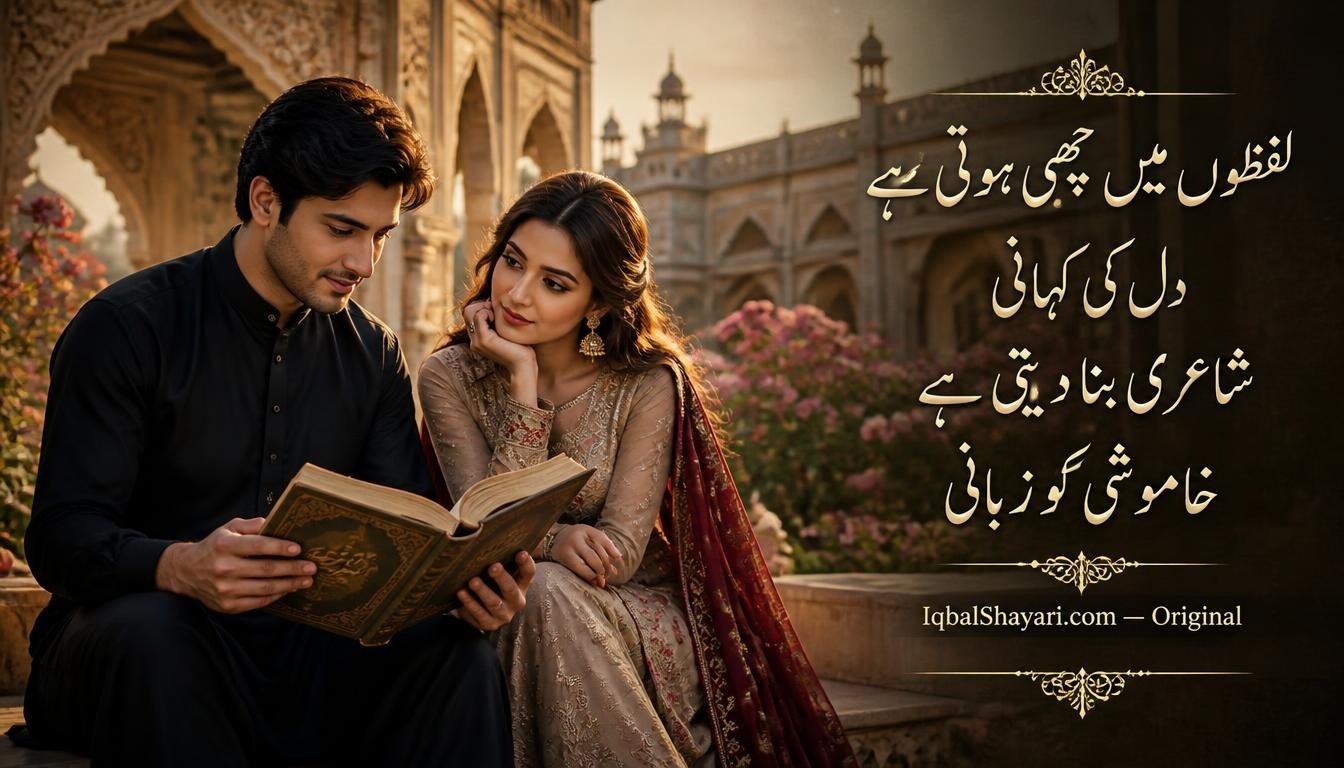
Love, Romantic and Emotional Shayari
Love shayeri rarely says “I love you” outright. It circles the feeling instead — through longing, distance, a glance, a memory that won’t fade. That indirectness is part of the appeal; it leaves room for the reader to fill in their own story.
“Tumhari ek muskurahat mera pura din badal deti hai, bina kuch kahe.” (Your one smile changes my whole day, without saying a word.)
This line was written for this guide to illustrate the romantic-shayar style — it isn’t a quote from any existing poet. What makes it work isn’t complexity — it’s how ordinary the moment is. A smile, nothing more, doing something disproportionate to how small it sounds.
Sad, Heartbreak, and Attitude Shayari
Sad shyari and heartbreak shayari often get grouped, but they carry different weight. Sadness tends to sit quietly, dwelling on loss or distance. Heartbreak is sharper — it names the wound directly, usually tied to someone specific who’s now gone.
Attitude shari takes a different stance entirely. Instead of dwelling on pain, it turns it into confidence, a short, pointed line meant to close a conversation rather than open one. It’s less about grief and more about refusing to explain yourself further. You’ll find more examples in our Attitude Shaari collection.
“Chup rehna bhi ek jawab hota hai, har baat ka spashtikaran zaroori nahi.” (Silence is also an answer; not everything needs an explanation.)
This line was written for this guide, not sourced from any poet. It captures that attitude tone well — measured, unbothered, and final, without a single harsh word in it.
Shayari for Life, Friendship & Motivation
Not all shari is about heartbreak or romance. A large part of it deals with everyday things — pushing through a hard day or the bond you share with people who’ve stuck around. This section covers both.
Life and Motivational Shayari
Life shaari tends to reflect on struggle, patience, and the passage of time rather than any single event. It doesn’t try to fix a problem; it just names what the reader is already going through, which is often enough on its own.
Motivational shari works a bit differently. It’s more direct, built to push someone forward rather than sit with them in a feeling. Allama Iqbal’s work is often associated with this tone, since much of his poetry deals with self-belief and striving, though any specific couplet should be checked against a verified source before it’s attributed to him directly. You can explore his verses on our Allama Iqbal page.
“Manzil unhi ko milti hai, jinke sapno mein jaan hoti hai, sirf dekhna kaafi nahi.” (Only those who reach their destination whose dreams carry real intent — watching them isn’t enough.)
This line was written for this guide as an illustrative example, not attributed to any poet.
Friendship (Dosti) Shayari
Dosti shaayari has a lighter tone than most other categories. It doesn’t need the weight of love or loss behind it — often it’s playful, sometimes teasing, built around the specific comfort of a friendship rather than a grand emotion.
“Dosti wo rishta hai jisme khamoshi bhi bol deti hai, aur jhagda bhi pyar laata hai.” (Friendship is a bond where even silence speaks, and even a fight brings love.)
This line was written for this guide, in the casual, everyday style typical of dosti shayari. What stands out in friendship shayari generally is how casual the language is compared to love or sad shayari — it reads more like something you’d actually say to a friend, not write about one.
Shayari in Urdu, Hindi & Punjabi
Shayaari isn’t locked to one language. The same emotional tradition runs through Urdu, Hindi, and Punjabi poetry, though each carries its own script, rhythm, and slightly different flavor of expression.
Urdu and Hindi Shayari
Urdu shyari is written in the Perso-Arabic script and draws heavily on Persian and Arabic vocabulary, which gives it a particular formality even in casual lines. Hindi shayari covers much of the same emotional ground but is written in Devanagari, often using simpler, more everyday words.
In practice, most people read both in Roman script anyway — on phones, scrolling through captions, script barely matters. What stays constant is the tone: the same words for longing, love, and quiet pain show up across both, sometimes in the same phrasing.
Punjabi Shayari and Punjabi Poetry
Punjabi shayar often leans on rural imagery and directness, shaped by a poetic tradition that grew alongside Punjab’s strong oral and folk-song heritage. This isn’t a strict rule — plenty of Punjabi poetry uses complex metaphor too, but it’s a tendency worth knowing about, distinct from the more Persian-influenced literary conventions found in classical Urdu ghazals. It’s written in Gurmukhi or Shahmukhi depending on the region.
“Dil di gal dil hi samajhda hai, bakiyan nu ta sirf shabad sunaide han.” (Only the heart understands what the heart feels; to others, it’s just words.)
This line was written for this guide to reflect that style — it isn’t a quote from any existing poet or published source. Because of its folk-song roots, a lot of Punjabi shayari carries a rhythm that feels almost meant to be sung, not just read.
How People Use Shayari Today
Shayri used to live mostly in books, recitals, and mushairas. Now most people encounter it on a screen, often without even searching for the word “shayari” itself — they’re just looking for the right few lines to send.
Shayari for WhatsApp Status and Social Media
A WhatsApp status has room for maybe two lines before it gets cut off or ignored, which is exactly why shayri fits so well there. A sher already comes built for that limit — it says one complete thing and stops.
People don’t usually pick shayari for status updates to explain themselves. It’s closer to a mood marker: something posted quietly, meant to be noticed by whoever it’s meant for, without needing a caption of its own.
Shayari for Instagram Captions, Birthdays, and Occasions
Instagram works a little differently. The shayar usually sits under a photo, so it needs to add something the image doesn’t already say — a feeling, a bit of humor, or context the picture alone can’t carry.
Birthday shyri and occasion-based shayari follow their own tone too, usually warmer and more direct than love or sad shayari. The goal isn’t subtlety here; it’s making the moment feel personal, which is why these lines tend to name the person or the occasion outright rather than leaving things open to interpretation.
Not every shayri needs to be heavy, either — funny shayari has its own place here, usually a quick, witty line meant to make someone smile rather than reflect on anything. It works well as a caption when the moment doesn’t call for sentiment.
Famous Poets and Shayari
A lot of shyari read online today has no clear author — it’s folk poetry, passed around without a name attached. But shayari as a tradition was shaped by real poets, and knowing a few of them helps make sense of where the style actually comes from.

Famous Urdu Poets Every Shayari Reader Should Know
Allama Iqbal is one of the most significant names in Urdu poetry, known for work that blends philosophy with poetic form. Mirza Ghalib remains one of the most quoted poets in the ghazal tradition, admired for turning complex ideas into a few tightly written lines.
Faiz Ahmad Faiz and Ahmad Faraz are closely associated with poetry that carries both personal and political weight, while Parveen Shakir is widely known for giving voice to a distinctly modern, feminine perspective within Urdu shayari. Jaun Elia and Mir Taqi Mir, from different eras, are both remembered for an emotional rawness that still feels current. You can explore verses connected to all of these poets in our Poets section.
How to Find Verified and Correctly Attributed Shayari
A huge amount of shayari circulating online is attributed to famous poets without any real verification — a line gets shared enough times that people simply assume it belongs to Ghalib or Faiz, even when it doesn’t. This happens constantly, and it’s one of the biggest quality problems across shayari content on the internet.
On this page, any shayari connected to a named poet is only presented that way when it can be reasonably verified. Where authorship isn’t confirmed, it’s labeled as popular or anonymous shayari instead of being guessed. That distinction matters if you’re trying to actually learn who wrote what, rather than just collecting lines.
Frequently Asked Questions About Shayari
What Is the Difference Between Shayari and Poetry?
Shyari is a specific poetic tradition tied to Urdu and Hindi literature, while poetry is the broader term covering verse in any language or style. Shayari follows its own forms, like sher and ghazal, and leans heavily on emotional themes such as love, longing, and loss — poetry in general has no such fixed direction.
What Is Two-Line Shayari Called?
Two-line shayri is essentially a single sher — the smallest complete unit of shayari, made of two connected lines called misras. It doesn’t have a separate name of its own; a sher already works as a standalone couplet, which is why it fits so naturally into short, two-line form.
Is Shayari the Same in Urdu, Hindi, and Punjabi?
Not exactly. The emotional core stays similar across all three, but each language brings its own script and tone — Urdu leans more formal, Hindi tends to use simpler everyday words, and Punjabi is more direct and grounded. They share the same tradition without being identical.
Conclusion
Shayri isn’t just about finding the right lines to share — it’s a tradition built to say what plain words often can’t. From a single sher to a full ghazal, from Urdu to Hindi to Punjabi, the forms change, but the purpose stays the same: capturing a feeling in as few words as possible.
Whether you came here to understand what shyari actually means or to find something worth sending to someone, hopefully this guide gave you both — real context alongside the words themselves. Explore our Love, Sad, Friendship, and Motivational shayari collections for more, or dive into the poets behind the tradition on our Poets page.