
Introduction:
Mirza Ghalib was an Urdu and Persian poet of Mughal Delhi, best known for his Urdu ghazals. Mirza Ghalib’s poetry in Urdu is easiest to enter one sher at a time, because each couplet holds doubt, desire, humour, or heartbreak in just two lines. In Urdu script the topic is written مرزا غالب کی شاعری.
This page gives you famous Ghalib shayari with Roman Urdu and English meaning, a plain guide to how a ghazal works, why his shers feel hard, a short life sketch, and the books to read first. Each sher is explained in plain words, not just quoted. We checked the couplets against Rekhta, and left out any line we couldn’t confirm. If you only want the couplets, go straight to the first section. Come back to the later sections to see why those lines work.
At a Glance: This guide to Mirza Ghalib poetry in Urdu introduces the Mughal Delhi poet (1797–1869) through his best-known couplets. It presents eleven famous sher in Urdu script and Roman Urdu, each with an English meaning and a short note on how to read it, grouped by love and pain, and by desire, doubt, and wit. It then explains how a ghazal is built, covering matla, maqta, radif, and qafia, and why Ghalib feels hard: Persian vocabulary, his dense early verse, and double meaning.
A short biography covers his court life, debts, and the 1857 uprising, and explains why he wrote in both Urdu and Persian. Readers also get a simple beginner reading path through Diwan-e-Ghalib, his letters and Dastanbu, a note on the 1954 film and 1988 serial, and Iqbal’s tribute to him. A six-question FAQ answers common beginner doubts, and a sourced editorial note explains how the couplets were checked.
Sher on Love, Longing and Pain
Ghalib’s love couplets rarely sound like simple romance. The lover is often tired, teased by his own heart, or half-laughing at his own bad luck. Read these five slowly. The pain usually sits in the second line, where the first line’s promise turns around.
Hazaron khwahishen aisi
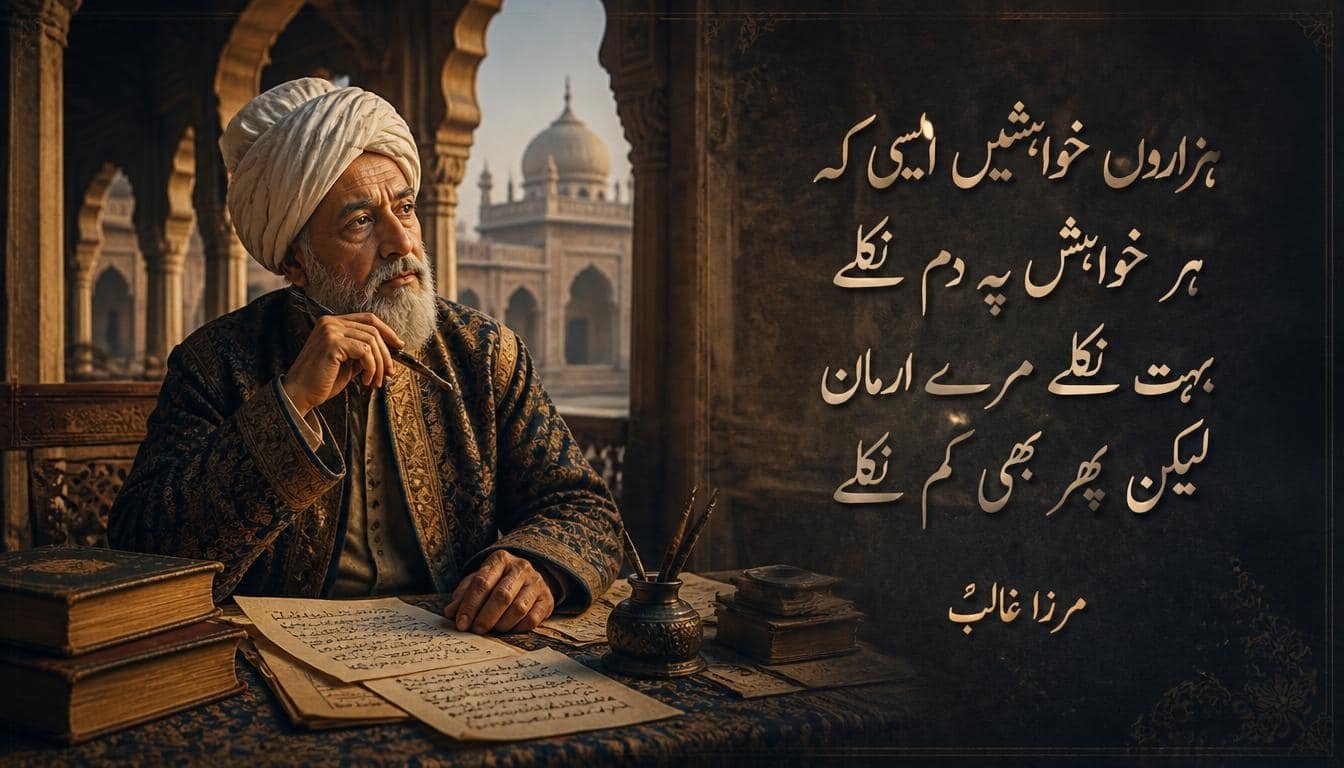
ہزاروں خواہشیں ایسی کہ ہر خواہش پہ دم نکلے بہت نکلے مرے ارمان لیکن پھر بھی کم نکلے
Hazaron khwahishen aisi ke har khwahish pe dam nikle Bohat nikle mere armaan lekin phir bhi kam nikle
Meaning: I have thousands of wishes, each worth dying for. Many of them were fulfilled, and still it felt like too few.
How to read it: Desire here is not a problem that ends once a wish comes true. Even a granted wish leaves the heart asking for more.
Ishq ne Ghalib nikamma kar diya
عشق نے غالبؔ نکما کر دیا ورنہ ہم بھی آدمی تھے کام کے
Ishq ne Ghalib nikamma kar diya Warna hum bhi aadmi the kaam ke
Meaning: Love made Ghalib useless. Otherwise, I was a man of some use too.
What to notice: The joke is on himself. He blames love for his idleness, yet the line also hints at what love costs a person.
Source note: Rekhta lists this sher under Ghalib. Check it against your printed Diwan, because editions differ.
Un ke dekhe se
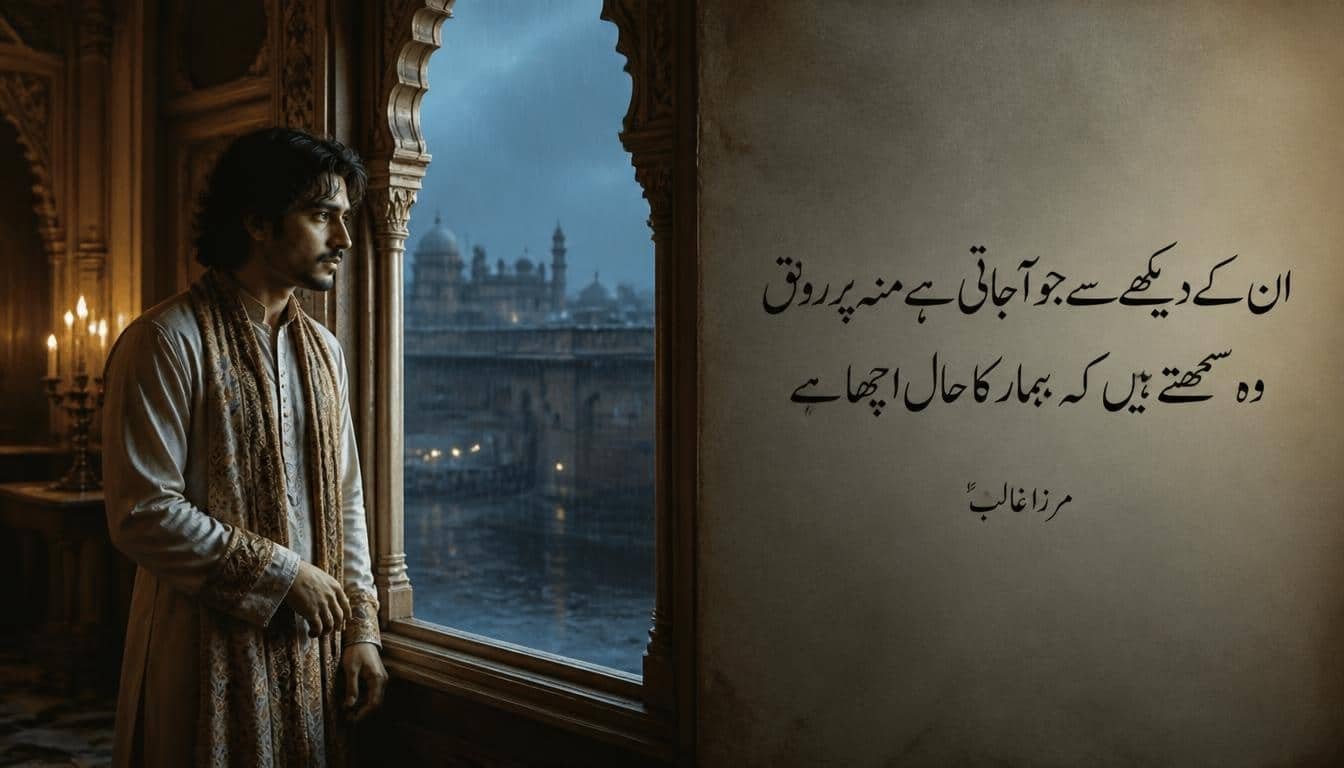
ان کے دیکھے سے جو آ جاتی ہے منہ پر رونق وہ سمجھتے ہیں کہ بیمار کا حال اچھا ہے
Un ke dekhe se jo aa jaati hai munh par raunaq Woh samajhte hain ke beemaar ka haal achha hai
Meaning: When I see her, a glow comes to my face. She takes it to mean the sick man is doing well.
The turn: The “sick man” is the lover. A flash of joy on his face looks like health to the beloved, so she never sees his pain.
Rago mein daudte phirne
رگوں میں دوڑتے پھرنے کے ہم نہیں قائل جب آنکھ ہی سے نہ ٹپکا تو پھر لہو کیا ہے
Rago mein daudte phirne ke hum nahin qaail Jab aankh hi se na tapka to phir lahu kya hai
Meaning: I don’t value blood that only runs through the veins. If it doesn’t drip from the eye, what kind of blood is it?
Why it lands: Real grief should show itself in tears. For Ghalib, tears are the blood of the heart.
Ye na thi hamari qismat
یہ نہ تھی ہماری قسمت کہ وصالِ یار ہوتا اگر اور جیتے رہتے یہی انتظار ہوتا
Ye na thi hamari qismat ke visaal-e-yaar hota Agar aur jeete rehte yahi intezaar hota
Meaning: It was not in our fate to be united with the beloved. Had we lived longer, we would still be waiting.
What to notice: The sher does not blame bad luck for the delay. It says a longer life would only have meant a longer wait.
More in this mood: love shayari in Urdu and sad shayari.
Sher on Desire, Doubt and Wit
This is the side of Ghalib that talks back to God, to critics and to himself. He questions heaven, laughs at his own faults and answers rivals with a smile. These six are easy to quote, and each hides a sharper thought than it first shows.
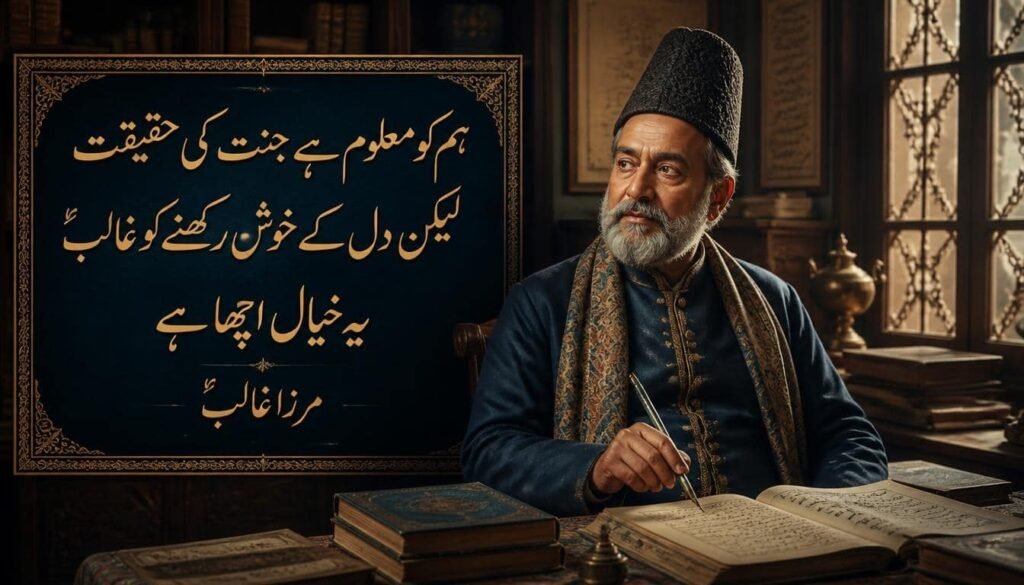
Hum ko maaloom hai jannat
ہم کو معلوم ہے جنت کی حقیقت لیکن دل کے خوش رکھنے کو غالبؔ یہ خیال اچھا ہے
Hum ko maaloom hai jannat ki haqeeqat lekin Dil ke khush rakhne ko Ghalib ye khayal achha hai
Meaning: We know the reality of paradise, but, Ghalib, it is a nice thought to keep the heart happy.
How to read it: He is not simply mocking belief. He admits that some hopes work as comfort, and he says so with a shrug.
Kaaba kis munh se
کعبہ کس منہ سے جاؤ گے غالبؔ شرم تم کو مگر نہیں آتی
Kaaba kis munh se jaoge Ghalib Sharm tum ko magar nahin aati
Meaning: Ghalib, with what face will you go to the Kaaba? You have no shame.
What to notice: He scolds himself by his own pen name. Public self-reproach like this is a Ghalib habit.
Ranj se khugar hua insaan
رنج سے خوگر ہوا انساں تو مٹ جاتا ہے رنج مشکلیں مجھ پر پڑیں اتنی کہ آساں ہو گئیں
Ranj se khugar hua insaan to mit jaata hai ranj Mushkilen mujh par padin itni ke aasaan ho gayin
Meaning: When a person gets used to pain, the pain fades. So many troubles fell on me that they became easy.
Why it lands: The comfort is hard-earned. Troubles pile up until each one feels lighter, which suits anyone worn down by too much at once.
Poochhte hain woh ke Ghalib kaun hai
پوچھتے ہیں وہ کہ غالبؔ کون ہے کوئی بتلاؤ کہ ہم بتلائیں کیا
Poochhte hain woh ke Ghalib kaun hai Koi batlao ke hum batlayen kya
Meaning: They ask who Ghalib is. Will someone tell me what I should say?
The turn: The poet cannot sum himself up in one sentence. That uncertainty is part of the charm.
Hain aur bhi duniya mein sukhanwar
ہیں اور بھی دنیا میں سخن ور بہت اچھے کہتے ہیں کہ غالبؔ کا ہے اندازِ بیاں اور
Hain aur bhi duniya mein sukhanwar bohat achhe Kehte hain ke Ghalib ka hai andaaz-e-bayaan aur
Meaning: There are many fine poets in the world, but they say Ghalib’s way of saying things is different.
What to notice: This is Ghalib praising his own style. “Andaaz-e-bayaan” means his manner of expression.
Rekhte ke tumhi ustaad
ریختے کے تمہیں استاد نہیں ہو غالبؔ کہتے ہیں اگلے زمانے میں کوئی میرؔ بھی تھا
Rekhte ke tumhi ustaad nahin ho Ghalib Kehte hain agle zamaane mein koi Meer bhi tha
Meaning: Ghalib, you are not the only master of Rekhta. They say there was a Meer in earlier times too.
Context: “Rekhta” was an older name for Urdu poetry, and the Meer here is Meer Taqi Meer. Ghalib bows to an earlier master while still sounding proud.
Understanding the Ghazal: Where the Famous Sher Come From
Most of the famous Ghalib lines you have just read are single couplets taken out of longer poems. Those poems are ghazals. Knowing how a ghazal is built helps you see why each sher can stand alone and why it still belongs to a larger piece.
What a Ghazal Is: Matla, Maqta, Radif and Qafia
A ghazal is a poem made of separate couplets that usually share one rhyme pattern and often a repeated ending. Each couplet, or sher, usually finishes its thought in two lines, so it can be read alone. Four terms explain the structure:
- Matla: the opening sher, where both lines carry the rhyme pattern.
- Maqta: the closing sher, which usually includes the poet’s pen name.
- Radif: the refrain, a word or phrase repeated at the end of the line. Some ghazals do not use one.
- Qafia: the rhyming word that comes just before the radif.
You can see the last two in “Ye na thi hamari qismat.” Both lines end in “hota,” which is the radif. The words just before it, “yaar” in visaal-e-yaar and “intezaar,” rhyme with each other. That rhyme is the qafia. For meter and more detail, see beher, qafia and radif explained.
Ghazals to Read First
Reading a single sher can feel like hearing one line of a song. To get the full effect, find the whole ghazal. Search the first line of any couplet from the section above on Rekhta, and the complete poem usually appears with word meanings.
If you want to start fresh, two ghazals are good first reads: “Dil hi to hai” and “Koi din gar zindagani aur hai.” Both are listed among the ghazals in the 1988 television serial on Ghalib, so you can listen after reading. Read a ghazal once for sound, then once more with the word meanings open.
Why Ghalib Feels Hard: Style, Language and Double Meaning
Many readers love a Ghalib sher at first sight and then lose the thread on the next one. That is normal. His difficulty comes from two sources: the language he borrowed and the way he packed ideas into two lines. Once you know both, the verses become easier to enter.
Persian Influence and His Dense Early Style
Ghalib wrote in Persian as well as Urdu, and his Persian Diwan is at least five times longer than his Urdu one. His early Urdu verse followed the Persian poet Bedil, and Rekhta describes that phase as highly Persianized and obscure. That is why some of his lines use heavy Persian words and compressed phrases. Rekhta adds that once he found his own style, he wrote in a much simpler, purer language. If a sher feels stiff, check whether the trouble is one Persian-origin word.
Double Meaning and Wordplay: How to Read a Ghalib Sher
Ghalib often says one thing on the surface and leaves another underneath. Take “Un ke dekhe se.” On the surface, the beloved thinks the sick man looks well. Underneath, the lover is hiding his pain, and she never notices. A few steps help with almost any sher:
- Read the plain meaning first.
- Find the turn, which is usually in the second line.
- Ask who is speaking, and in what tone. He often addresses himself by his own name, as in “Kaaba kis munh se.”
- Look up any unfamiliar word on Rekhta before you decide what the sher means.
Who Was Mirza Ghalib?
Ghalib’s life explains much of his tone. He was a proud man in a fading court, often short of money and never short of wit. A little background makes the sher in the earlier sections easier to feel.
His Life in Delhi: Court, Debt and 1857
Mirza Ghalib was born on 27 December 1797 and died on 15 February 1869. He was born in Agra but spent almost all of his life in Delhi. In 1850, the emperor Bahadur Shah Zafar gave him the title Dabir-ul-Mulk, and that same year he was engaged to write a dynastic history of the Timurid house. Money was a constant worry, though. He lived like an aristocrat and was in debt again and again.
The 1857 uprising hit him hard. He was most pained by the ruin of his beloved Delhi. The British stopped his pension because he visited the court, and he turned to the Nawab of Rampur for his family’s upkeep until it was restored. His tomb stands near Nizamuddin Dargah in Delhi.
Why He Wrote in Both Urdu and Persian
In Ghalib’s time, Persian was the literary language of cultivated circles, and he wrote Persian poetry modelled on the poet Bedil. His Persian Diwan is at least five times longer than his Urdu one, yet his fame rests on his Urdu poetry. He considered his Persian work more important and wanted to be judged by it.
Readers chose differently. His Urdu Diwan was the one that reached a wider audience. Many commentaries were published to make it accessible, and few did the same for his Persian. So the shers you have been reading are the part of his work that the world kept.
Where to Start Reading Ghalib: Diwan and Other Books
Reading a few famous couplets online is a good start, but Ghalib rewards a book. You do not need his whole output. Poetry by Mirza Ghalib reaches most readers through one collection, and a small set of other works covers the rest: the letters and a diary of 1857.
Diwan-e-Ghalib and His Other Works
The Diwan-e-Ghalib is his collection of Urdu verse, and it is the book most people mean when they say “Ghalib.” It was first published in 1841. Ghalib saw it through four more editions, and the fifth and last holds about 1,795 couplets. He was strict about what went in, and he discarded many verses while compiling it. Later editors collected the rest, so editions such as Nuskha-e-Arshi and Nuskha-e-Hamidiya do not match line for line.
His other works are worth knowing too. His letters read like conversation, and he used words and sentences as if he were talking to the reader. Dastanbu is his diary-like account of the 1857 revolt. His Persian collections exist as well, but far fewer readers approach them.
A Simple Reading Path for Beginners
Do not begin at page one of the Diwan. A slower route works better:
- Read ten or twelve famous shers, with word meanings, until the style feels familiar. The first section above is a good place to begin.
- Read a few full ghazals from first line to last, rather than isolated couplets.
- Pick one edition of the Diwan that comes with commentary, and stay with it, so you are not comparing versions.
- Read his letters when you want his voice without the compressed poetry.
- Read Dastanbu last, once you know the man behind the sher.
Mirza Ghalib on Screen: The 1954 Film and the 1988 Serial
Ghalib’s life and verse have reached the screen twice in ways that people still remember. The 1954 Hindi film Mirza Ghalib was produced and directed by Sohrab Modi. Bharat Bhushan played Ghalib, and Suraiya played Moti Begum, with music by Ghulam Mohammed. It was released on 10 December 1954 and won the President’s Gold Medal for the All India Best Feature Film at the 2nd National Film Awards. Suraiya sings “Ye na thi hamari qismat” in it.
The 1988 serial on DD National was written, directed, and produced by Gulzar. Naseeruddin Shah played Ghalib and Tanvi Azmi played Umrao Begum. Jagjit Singh and Chitra Singh sang and composed the ghazals, including “Dil hi to hai” and “Koi din gar zindagani aur hai.” If you read the ghazals first, as suggested earlier, the serial is a good way to hear them.
Ghalib and Iqbal: Where to Read Next
Ghalib and Iqbal each have a field of study named after them: Ghalibiyat and Iqbaliyat. The link between the two goes beyond a shared language. Iqbal wrote a poem called “Mirza Ghalib,” an elegy that pays tribute to Ghalib’s genius, and it appears in his Urdu collection Bang-e-Dara, published in 1924.
Iqbal also pointed readers back to Ghalib’s Persian side. In a message for a Ghalib Day event in February 1937, he reminded Ghalib’s admirers how much his Persian verse deserved attention. If this page has made you curious about how one great poet read another, Iqbal’s poem on Ghalib is a natural next read. To read Iqbal in English, start with Iqbal’s poetry in English translation.
Mirza Ghalib Poetry FAQs
Who was Mirza Ghalib in one line?
Mirza Asadullah Beg Khan, known as Mirza Ghalib (1797–1869), was a poet and letter writer of late Mughal Delhi who wrote in Urdu and Persian. He is best remembered for his Urdu ghazals.
What does the name Ghalib mean?
Ghalib is his pen name, and it means “dominant” or “victor” in Rekhta’s wording. He first used Asad for his Urdu verse and Ghalib for his Persian, and later used Ghalib for both.
Why is Ghalib’s poetry hard to understand?
Three things make it hard: Persian-heavy vocabulary, tightly packed images, and lines that can be read in more than one way. A single unfamiliar word can block a whole sher. Looking up word meanings and finding the turn in the second line usually helps. The section on style above explains this in more detail.
Which Ghalib sher should I read first?
A good first choice is “Hum ko maaloom hai jannat.” Its words are plain, and its mood is clear on a first read. It appears with Roman Urdu and English meaning in the first section of this page.
What is Diwan-e-Ghalib?
It is a collection of his Urdu verse, first published in 1841. Its last edition in his lifetime holds about 1,795 couplets. Several later editions exist, so it helps to stick with one while you read.
Is there a movie or serial on Mirza Ghalib?
Yes, there are two. The 1954 Hindi film Mirza Ghalib was directed by Sohrab Modi, and the 1988 serial on DD National was made by Gulzar, with Naseeruddin Shah as Ghalib.
Final Thoughts: Start With One Sher
Mirza Ghalib’s poetry in Urdu does not ask you to understand everything at once. Pick one sher, say it aloud, and look up the single word that stops you. Then read the ghazal it came from. A few lines in, you start to hear the doubt, the joke, and the ache that have kept readers coming back for two centuries.
Choose one couplet from the first section and read its full ghazal today. Then share the sher that stayed with you with someone who reads Urdu. For more, start with our Urdu shayari guide.