
Introduction:
A good sher doesn’t need many words to land. Two lines, sometimes even less, and it can say what a whole paragraph can’t. That’s the pull behind 2 line love shayari in Urdu: short enough to read in a second, but built to stay with you.
This page brings together short romantic couplets in Urdu, with the Roman Urdu spelling and a plain English meaning next to each one, so it’s easy to read, copy, and send whether or not you can read the script. You’ll also see how a sher is actually built, why the rhythm matters, and a few of the couplets grouped by what they’re really saying, whether that’s longing, distance, or simply missing someone.
At a glance: This page explains what makes a two-line Urdu couplet, the sher, work as a form, then delivers a handwritten collection built around it. It opens by breaking down how a sher is structured: the first misra setting up a thought and the second landing it, then walks through the rhyme and rhythm behind it, qafia and radif, with a short original example to show the pattern and a link out to a deeper explanation on the site’s poetry page.
The core of the page is twenty original two-line love couplets, ten in Urdu script and ten in Roman Urdu, each with a plain English meaning beside it. From there, it groups the couplets by theme, plain declarations of love versus the ache of missing someone, before closing with an FAQ that covers what a sher is called, whether it’s appropriate to send one to someone, its use as a WhatsApp status, and how to spot shayari online that’s been falsely credited to a famous poet. It ends by pointing readers toward the fuller love shayari collection and the sad shayari and poetry pages for related reading.
What Makes a 2 Line Shayari (Sher) Work
A sher is the smallest complete unit of Urdu poetry. Two lines, and nothing more, but within that space a poet has to say something whole. That limit is what makes the form work. There’s no room to explain, so every word has to earn its place.
The Sher Format Explained
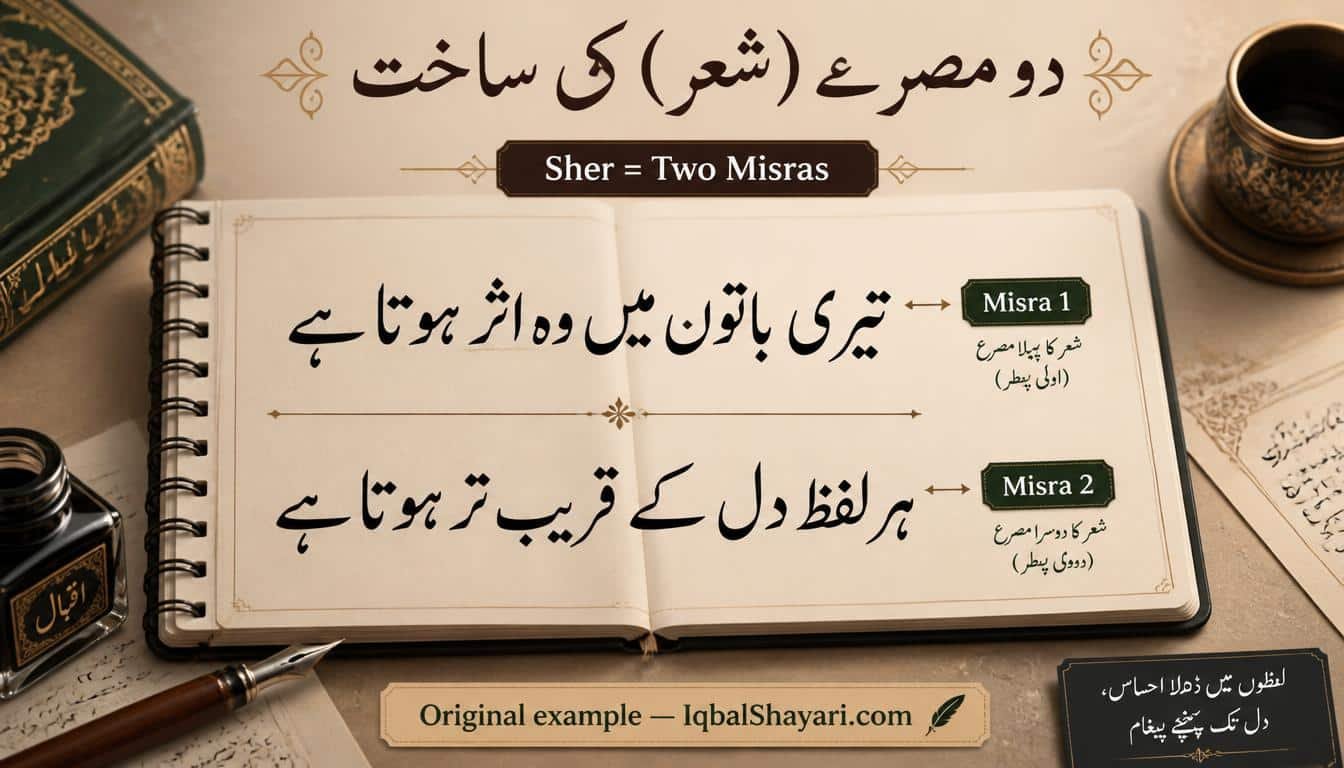
Two lines, called misras, make up a sher, sometimes referred to as do-misre shayari for exactly that reason. The first misra sets up the thought, and the second one lands it, often with a twist or a deeper layer the first line didn’t give away. Read alone, the first line can feel incomplete. Read together, the two lines close the loop. That’s the whole design: tension, then release, in the space of a breath.
Rhyme and Rhythm in a Sher
Most shers follow a rhyme pattern called qafia, the matching sound at the end of each line, and sometimes a radif, a word or phrase that repeats exactly after the qafia. Together they give the sher its musical pull, the reason it sounds right even before you’ve fully understood it. This rhythm isn’t decoration. It’s part of why a two-line shayari sticks in memory long after longer poems fade. For a deeper look at how beher, qafia, and radif work together across Urdu poetry, our poetry page covers that in more detail.
Here’s a short original example, written only to show the pattern and not attributed to any poet: “teri baaton mein woh asar hota hai / har lafz dil ke qareeb tar hota hai.” “Hota hai” is the radif, repeating exactly at the end of both lines, while “asar” and “qareeb tar” carry the qafia just before it.
The Collection: Short Couplets to Read and Share
This is the heart of the page: a set of two-line love shayari written for this collection, not pulled from anywhere else. Each one appears below in its own script style, with a plain English meaning beside it, so it’s easy to copy, paste, and send, whether you read Urdu script or prefer Roman Urdu.

Urdu Script
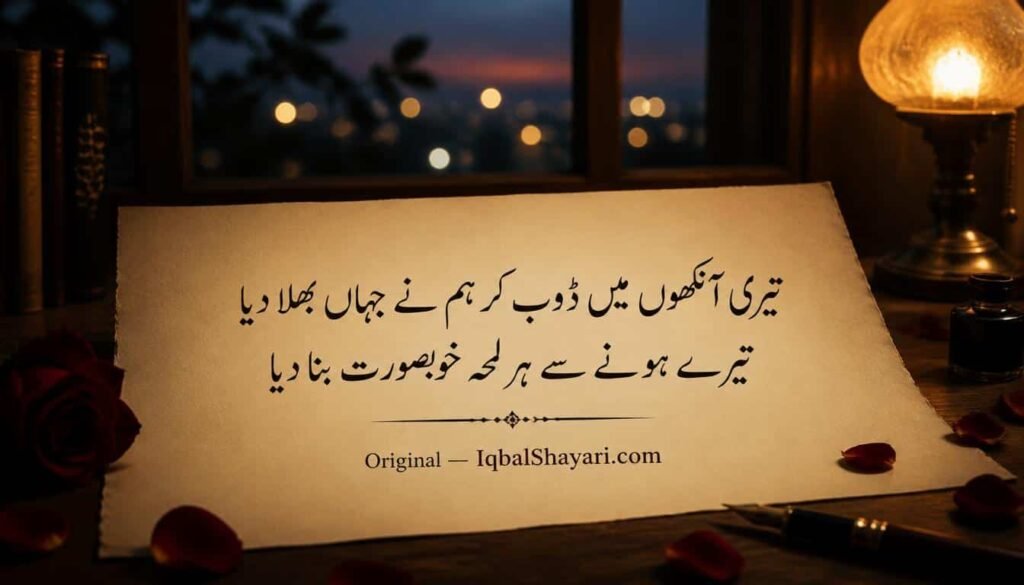
تیری آنکھوں میں ڈوب کر ہم نے جہاں بھلا دیا تیرے ہونے سے ہر لمحہ خوبصورت بنا دیا Teri aankhon mein doob kar hum ne jahaan bhula diya, tere hone se har lamha khoobsurat bana diya. (We lost ourselves in your eyes and forgot the world; just you being there made every moment beautiful.)
دل نے تجھے چاہا تو کچھ اور چاہا ہی نہیں تیرے بعد کسی اور کا خیال آیا ہی نہیں Dil ne tujhe chaha to kuch aur chaha hi nahi, tere baad kisi aur ka khayal aaya hi nahi. (Once the heart loved you, it wanted nothing else; after you, no one else ever crossed my mind.)
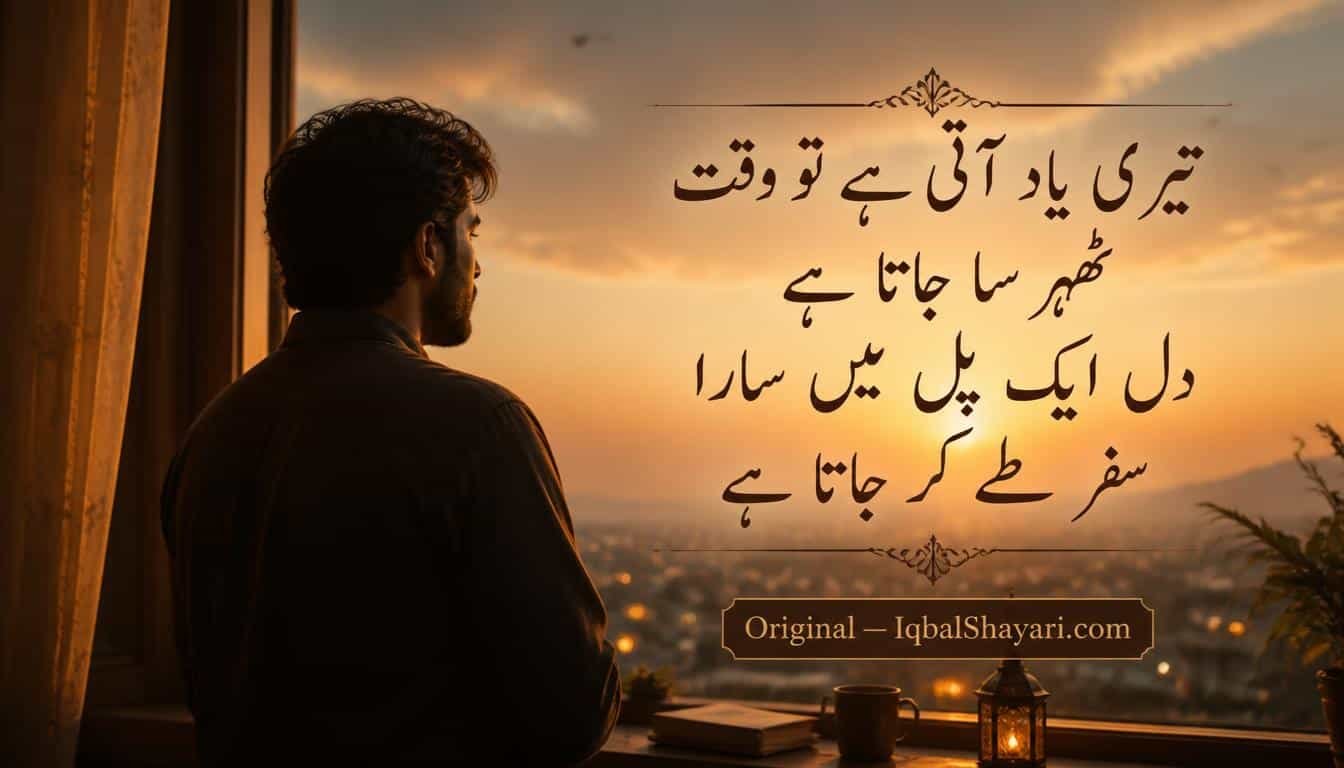
تیری یاد آتی ہے تو وقت ٹھہر سا جاتا ہے دل ایک پل میں سارا سفر طے کر جاتا ہے Teri yaad aati hai to waqt thehar sa jata hai, dil ek pal mein sara safar tay kar jata hai. (When your memory comes, time seems to pause; the heart covers the whole distance in just one moment.)
تجھ سے مل کر لگا جیسے کچھ ادھورا پورا ہوا دل جو برسوں سے خاموش تھا آج بولا ہوا Tujh se mil kar laga jaise kuch adhoora poora hua, dil jo barson se khamosh tha aaj bola hua. (Meeting you felt like something incomplete had finally been finished; the heart that stayed silent for years finally spoke.)
تیرے بغیر یہ زندگی ادھوری سی لگتی ہے ہر خوشی میں بھی کوئی کمی سی لگتی ہے Tere baghair yeh zindagi adhoori si lagti hai, har khushi mein bhi koi kami si lagti hai. (Without you this life feels incomplete; even happiness feels like something’s missing.)
محبت میں تجھے پا کر یہ یقین آیا کہ دل کی ہر دعا کا کوئی مطلب ہوتا ہے Mohabbat mein tujhe pa kar yeh yaqeen aaya, ke dil ki har dua ka koi matlab hota hai. (Finding you in love brought this certainty, that every prayer of the heart truly means something.)
تیری مسکراہٹ میں وہ سکون ملتا ہے جو برسوں کی تھکن میں بھی نہیں ملتا Teri muskurahat mein woh sukoon milta hai, jo barson ki thakan mein bhi nahi milta. (In your smile I find a peace that years of exhaustion never gave me.)
تیرا ساتھ ملا تو خوابوں کو زبان ملی ہر ادھوری بات کو اک پہچان ملی Tera saath mila to khwabon ko zabaan mili, har adhoora baat ko ek pehchaan mili. (When I found you, my dreams found a voice; every unfinished thought finally found its meaning.)
دل نے جب بھی راستہ ڈھونڈا محبت کا تیرے نام پر ہی جا کے ٹھہر گیا Dil ne jab bhi raasta dhoonda mohabbat ka, tere naam par hi ja ke thehar gaya. (Whenever my heart searched for the path of love, it always stopped right at your name.)
تیری باتوں میں ایسی مٹھاس ہے جاناں کہ ہر الجھن بھی آسان لگنے لگتی ہے Teri baaton mein aisi mithaas hai jaanan, ke har uljhan bhi aasaan lagne lagti hai. (There’s such sweetness in your words, my love, that even every trouble starts to feel simple.)
Roman Urdu
Tere naam se din shuru hota hai mera, tere khayal pe hi shaam dhalti hai mera. (My day begins with your name; even my evening settles around thinking of you.)
Faasle chahe kitne bhi ho jayein darmiyan, dil ka rasta tujh tak hamesha khula rahega. (No matter how much distance comes between us, the heart’s path to you will always stay open.)
Tu jo hasta hai to lagta hai duniya theher gayi, teri khushi mein hi meri har khushi bikher gayi. (When you smile, it feels like the world has paused; all my happiness scattered into yours.)
Ishq mein itna sukoon mila tujh se, ke har uljhan bhi aasaan lagne lagi. (Loving you brought so much peace that even every difficulty began to feel simple.)
Teri yaad jab bhi aati hai, hont khud hi muskura dete hain. (Whenever your memory comes, my lips smile on their own.)
Zindagi ne mujhe bahut kuch sikhaya, magar mohabbat sirf tune sikhayi. (Life taught me many things, but love, only you taught me that.)
Tere hone se lagta hai har mushkil aasaan ho jayegi. (With you here, it feels like every difficulty will become easy.)
Dil chahta hai bas tera naam liya jaye, baaki sab baatein khud hi ho jati hain. (The heart just wants your name spoken; everything else takes care of itself.)
Tujhse mil kar lagta hai jaise kismat ne kuch achha socha tha. (Meeting you feels like fate had planned something good.)
Har lafz mein bas tera zikr hai, aur kuch likhne ki zaroorat hi nahi. (Every word carries only your mention; there’s nothing else left to write.)
Common Themes in 2 Line Love Shayari
Even in two lines, love shayari tends to move in a few recognizable directions. Some couplets are about saying it plainly: admiration, devotion, the simple fact of being in love. Others sit closer to absence, the ache of someone not being there. Knowing these patterns makes it easier to find the couplet that actually matches what you’re feeling, instead of scrolling through lines that don’t fit the moment.
Expressing Love and Longing
This is the most common theme in the collection above: love stated directly, without hiding behind metaphor. Lines like “tere naam se din shuru hota hai mera” fall here, plain devotion, said in a way that still carries weight. Longing sits close to this theme too, a mix of wanting someone near and being grateful they exist at all.
Missing Someone You Love
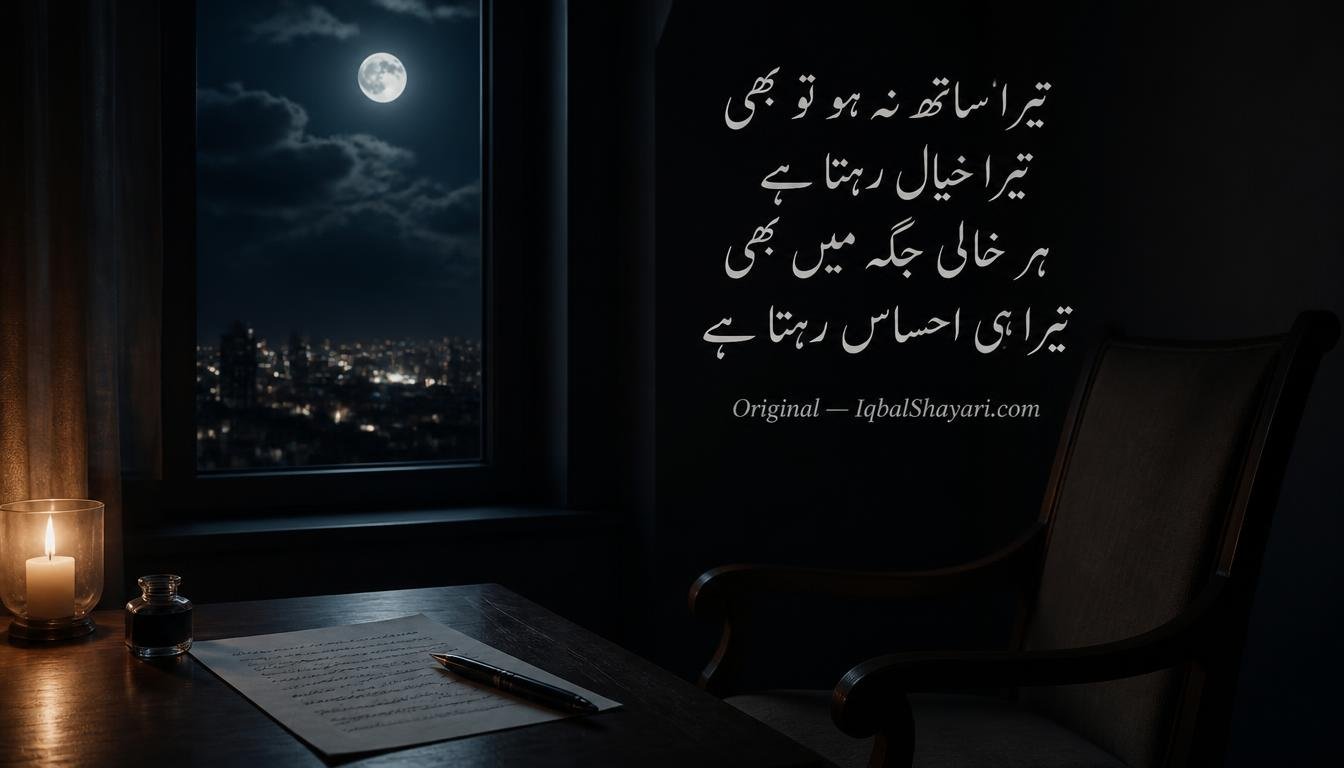
A slightly different feeling comes through here: the couplet isn’t celebrating love so much as sitting with its absence. A short original example fits this well: “tera saath na ho to bhi tera khayal rehta hai / har khali jagah mein bhi tera hi ehsaas rehta hai” (even without you here, the thought of you stays; even in every empty space, only the feeling of you remains). These lines work well for anyone missing someone far away, not necessarily lost, just apart.
Frequently Asked Questions
What is a 2-line shayari called?
A 2-line shayari is called a sher. It’s the basic unit of Urdu poetry, made up of two lines, or misras, that work together to complete one thought. A full ghazal is really just a series of these couplets connected by rhyme, but a single one can stand on its own too, which is exactly what makes it so easy to share.
Is it okay to send a 2-line shayari to someone?
Yes, and it’s actually one of the most common ways shayari gets used today. A well-chosen sher can say something you might not want to spell out in plain words, whether that’s affection, longing, or just letting someone know they’re on your mind. Just make sure the tone matches how well you know the person.
Can these lines be used as WhatsApp status?
Yes, most 2-line shayari works well as a status, since the format is already short and easy to read at a glance. If you’re looking for lines built specifically for status use, with more variety around captions and short quotes, our wider love shayari collection covers that in more depth.
How can you tell if an online shayari is genuinely from a famous poet?
It’s harder than it looks. A lot of collections online credit lines to well-known poets like Ghalib or Iqbal without any real verification, sometimes crediting a poet’s actual verse to a random name, or the reverse. If a site doesn’t clearly say whether a couplet is verified or original, treat the attribution with some caution. On this page, every couplet is either written specifically for this collection or clearly labeled as such; nothing here is presented as a named poet’s work unless it’s genuinely confirmed.
More Love Shayari to Explore
Two lines are a good starting point, but they’re not the only way love shayari shows up. If you’re after more variety, whether that’s status-ready lines, quotes, or verses written for someone specific, the wider love shayari in Urdu collection covers all of that.
If it’s the harder side of love you’re looking for instead — the ache of loss or heartbreak rather than the warmth of it — our sad shayari page goes deep into that mood. And if you want to understand the tradition behind all of this, how sher, ghazal, and the rest of Urdu poetry actually fit together, that’s covered on our poetry page.
Conclusion
Two lines aren’t a limitation in Urdu poetry; they’re the point. A sher forces a poet to say only what matters, and that’s exactly why 2-line love shayari in Urdu travels so well: easy to read, easy to remember, easy to send when your own words aren’t quite ready.
What you’ve seen here covers the basics: how a sher is built, a set of original couplets in Urdu and Roman Urdu, the themes they tend to fall into, and a few honest answers about how this kind of writing gets used and how to spot attribution you shouldn’t trust. If you want to go further, from status lines to verses for someone specific, the full love shayari in Urdu collection is the next place to look.