Introduction:
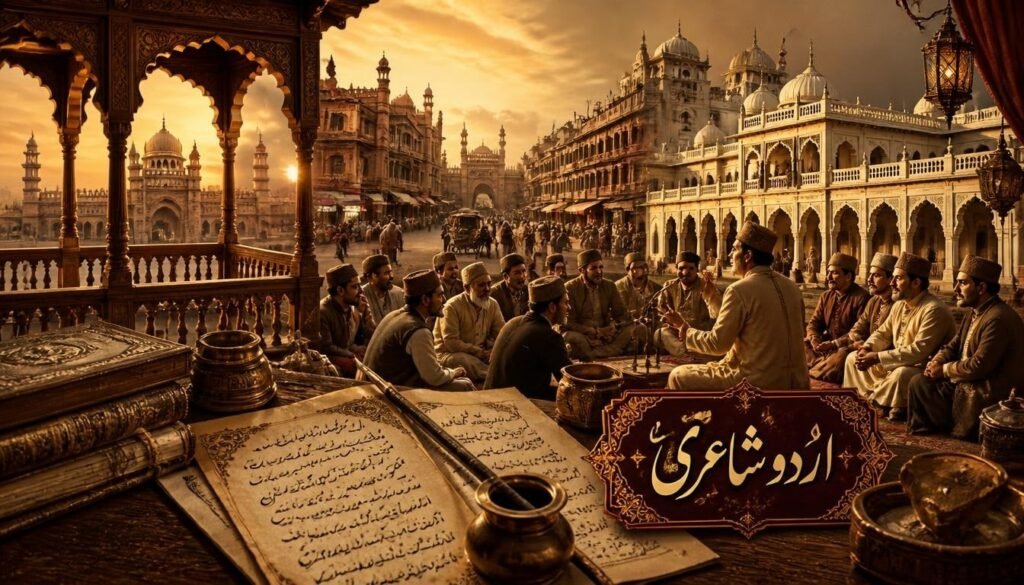
Poetry in Urdu is the verse tradition of the Urdu language, and most people simply call it shayari. It includes the ghazal, the nazm, the rubai, and other forms, and it has been written and recited in South Asia for centuries. Readers meet it today in books, on phones, and at mushairas held in cities around the world.
Read on to learn what Urdu poetry is, how its main forms work, and who the major poets are, from Mir and Ghalib to Allama Iqbal. You will also find classic couplets with their meaning, a step-by-step way to read one, and advice on reading Urdu verse in English translation or Roman Urdu. Couplets by named poets are matched against Rekhta, the Urdu poetry archive. Lines written for this page are labelled, and anything we could not confirm is marked.
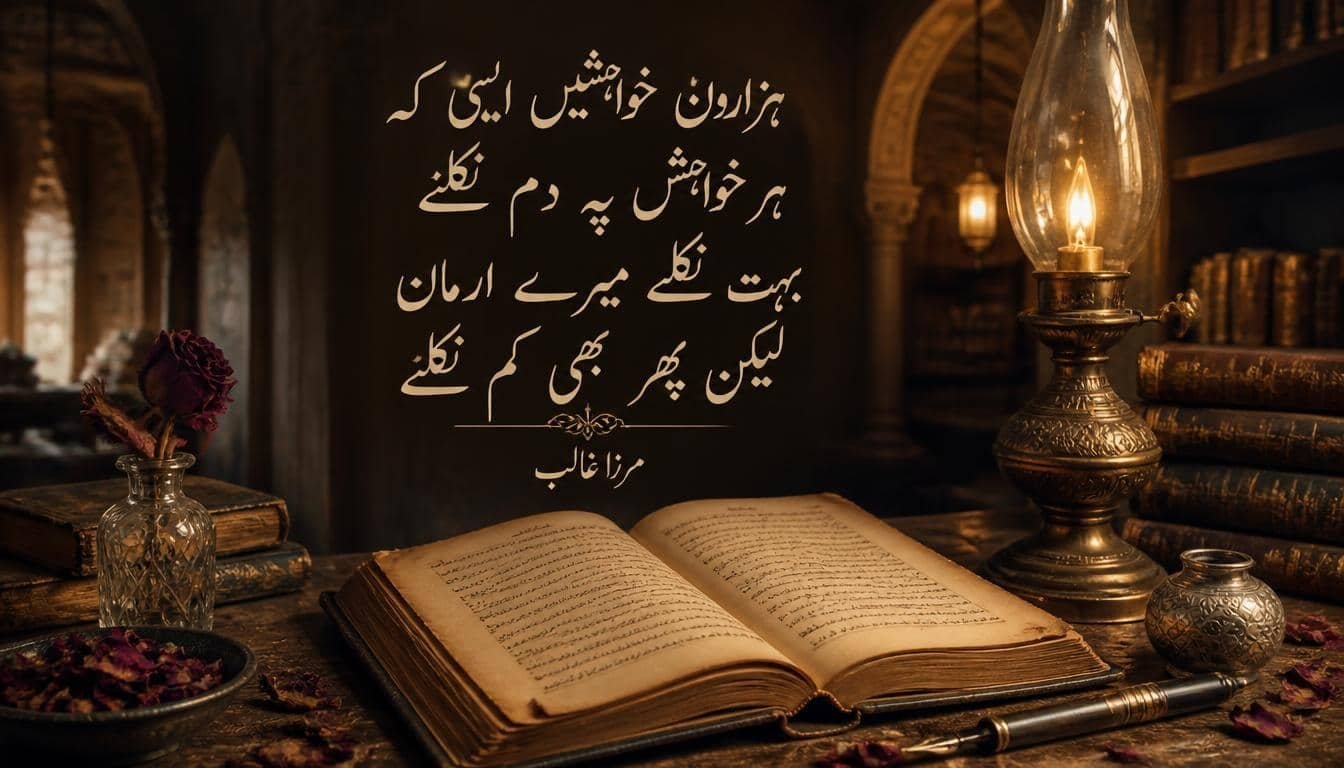
Our English meaning: A thousand desires, each one strong enough to take my breath away. Many of my hopes came true, and still there were too few.
Ghalib is writing about wanting itself. A wish that comes true does not end the wanting.
What Is Urdu Poetry?
Urdu poetry has no single shape. Some forms are two-line couplets that stand alone, and others are long poems that tell a story or mourn a loss. Many forms came into Urdu through Persian and Arabic and then grew into a tradition of their own. The key terms come first, then the history.
Meaning of Urdu Poetry: Shayari, Sher and Nazm
Shayari is the Urdu word for poetry, and in daily use it usually means couplet poetry such as the ghazal. The basic unit is the sher, a couplet of two lines, and each line is called a misra. In a ghazal, every sher can stand on its own. A nazm works differently. It builds one central idea and usually carries a title.
One couplet from Mir and two written for this page show how a sher stands alone. Each holds one finished thought.
Mir Taqi Mir
Meaning: Take even your breath gently. This world is a glassblower’s workshop, and everything in it is fragile.
Written for this page:
دو مصرعوں میں سمیٹ لی میں نے عمر بھر کی بات
جو کہنی تھی بس وہی کہی، باقی سب چھوڑ دی
Do misron mein samet li maine umr bhar ki baat
Jo kehni thi bas wahi kahi, baqi sab chhor di
Meaning: In two lines I gathered the talk of a lifetime. I said only what needed saying and left the rest.
Written for this page:
آئینہ بھی اب سچ بولنے سے کتراتا ہے
جب سے دیکھا ہے سچ کہنے والوں کا کیا ہوتا ہے
Aaina bhi ab sach bolne se katrata hai
Jab se dekha hai sach kehne walon ka kya hota hai
Meaning: Even the mirror now hesitates to speak the truth, since it has seen what happens to those who do.
Online, the same poems often appear in Roman letters or Hindi script. The language does not change. Only the script does.
A Short History of Urdu Poetry
Urdu grew out of local dialects around Delhi in the 13th and 14th centuries and took in words from Turkish, Arabic and Persian. For a long time it went by other names, including Hindavi, Dakhni and Rekhta. Mushafi is credited as the first to use the word “Urdu” for the language, in his first divan.
Who is the father of Urdu poetry? Scholars do not agree, because the answer depends on what you count as the start.
- Wali Muhammad Wali, who died in 1707, is the usual scholarly choice. He was the first established poet to compose ghazals in Urdu, and his visit to Delhi helped Urdu poetry take hold in the north.
- Muhammad Quli Qutb Shah (1565–1611), the Golconda ruler, is named by others because he was the first Urdu poet to put together a diwan of his own.
- Amir Khusrau (1253–1325) is the popular answer. But Frances Pritchett, a scholar of Urdu literature, points out that none of his Hindvi verse survives and that Urdu literature in the north did not really begin before the 17th century.
Written Urdu poetry took shape in three centres. The first was the Deccan in southern India. Quli Qutb Shah wrote in Deccani, an early form of Urdu, as well as in Persian and Telugu, and Rekhta notes that he wrote poems for twelve beloveds. Wali carried the ghazal from the Deccan to Delhi, and his lover, Rekhta says, stands for both the sensual and the non-sensual worlds.
The second centre was Delhi, home to Mir Taqi Mir and Mirza Ghalib. Ghalib himself nods to Mir in one of his best-known closing couplets.
Mirza Ghalib
Meaning: You are not the only master of Rekhta, Ghalib. They say there was once a Mir too.
After repeated attacks on Delhi, Lucknow became the third centre. After 1947, Urdu poetry stayed loved in both Pakistan and India, and today mushairas are held in cities around the world because of the South Asian diaspora.
Forms of Urdu Poetry
Poetry in Urdu comes in many forms, and each has its own shape. The two best known are the ghazal and the nazm. A ghazal is a chain of separate couplets that share a rhyme and a refrain. A nazm builds one idea from start to finish and usually has a title. Rekhta has preserved 33 types of Urdu poetry.
Ghazal: Structure and Key Terms
A ghazal is made of separate couplets that share a rhyme pattern and one meter. Each couplet, or sher, can be read alone, so a single ghazal can move from love to loss to faith without changing form. The word ghazal comes from Arabic and is often explained as “conversing with the beloved”. Love is its most common subject.
A ghazal needs at least five couplets, and most have around seven. In the opening couplet, both lines carry the rhyme and the refrain. In every later couplet, only the second line does. The last couplet often includes the poet’s pen name.
| Term | Meaning |
| Sher | A couplet of two lines |
| Misra | A single line of a sher |
| Matla | The opening couplet of a ghazal |
| Maqta | The closing couplet, often with the poet’s pen name |
| Qafiya | The rhyming word or sound |
| Radif | The refrain that repeats after the rhyme |
| Bahr | The meter that every line follows |
| Takhallus | The poet’s pen name |
A poet’s ghazals are gathered in a diwan. A kulliyat is a complete collection of one author’s poems. Mir’s Kulliyat, for example, holds six diwans.
Here is a short ghazal written for this page to show every part. The pen name “Raahi” is only an example, not a real poet.
تیری یاد اک پرانی کہانی ہے
جو ہر شام نئے لفظوں میں سنانی ہے
وقت نے ہر زخم کو دھندلا ضرور کیا
دل کی دھڑکن مگر اب بھی دیوانی ہے
محفلوں میں تیرا نام نہیں لیتا میں
میری خاموشی ہی تیری نشانی ہے
سمجھانے والوں سے کہنا ہے بس اتنا
محبت تو بس دل کی مہربانی ہے
کم ہی سہی پر ‘راہی’ نے سچ کہا ہر بار
اس لیے لفظوں میں اب بھی وہی روانی ہے
Teri yaad ik purani kahani hai
Jo har sham naye lafzon mein sunani hai
Waqt ne har zakhm ko dhundla zaroor kiya
Dil ki dhadkan magar ab bhi deewani hai
Mehfilon mein tera naam nahin leta main
Meri khamoshi hi teri nishani hai
Samjhane walon se kehna hai bas itna
Mohabbat to bas dil ki mehrbani hai
Kam hi sahi par ‘Raahi’ ne sach kaha har bar
Is liye lafzon mein ab bhi wohi rawani hai
Meaning: Your memory is an old story, and I must retell it every evening in new words. Time blurred every wound, but the heartbeat is still mad. I do not say your name in gatherings, and my silence is your sign. To those who advise me I say only this: love is just the heart’s kindness. Raahi has told the truth every time, though rarely, and that is why his words still flow.
Now find each part:
- Matla: the first couplet. Both lines end with “hai”, the refrain.
- Radif: “hai”, which repeats at the end of the second line in every couplet.
- Qafiya: the words just before the refrain: kahani, sunani, deewani, nishani, mehrbani and rawani.
- Middle couplets: only the second line carries the refrain.
- Maqta: the last couplet, which holds the pen name “Raahi”.
Nazm and Other Forms of Urdu Poetry
A nazm is a poem that builds one idea from start to finish. Unlike a ghazal, its verses connect, and it usually has a title. Poets can write it in rhymed verse, unrhymed verse or free verse. In the 20th century, poets of the Progressive Writers’ Association, including Sahir Ludhianvi and Ali Sardar Jafri, used the nazm to carry messages of freedom and equality. Iqbal wrote some of the best-known nazms in Urdu, including one for children, “Bachche Ki Dua”.
Allama Iqbal, “Bachche Ki Dua”
Meaning: A child’s prayer: may my life be like a candle, may the world’s darkness fade because of me, and may I love the poor and the weak.
Wikipedia dates the poem to 1902 and says it is recited in school assemblies across the region.
Other forms each have their own job:
- Rubai: a four-line poem that rhymes a-a-b-a and holds one idea.
- Qita: two or more connected couplets that develop a single thought.
- Qasida: a poem of praise for a king, noble, or patron. It opens with a rhyming couplet like a ghazal and can run to around 50 lines.
- Marsiya: an elegy for the dead, closely tied to the tragedy of Karbala and written in six-line units. Mir Anis and Mirza Dabeer took the form to its peak in the 19th century.
- Masnavi: a long story poem in rhyming couplets, where each couplet has its own rhyme.
- Hamd: poetry that praises Allah alone.
- Naat: in Urdu, poetry in praise of Prophet Muhammad (PBUH).
- Manqabat: a Sufi devotional poem in praise of Ali ibn Abi Talib or of a Sufi saint.
This rubai was written for this page. Notice the rhyme: the first, second and fourth lines rhyme, and the third does not.
دل نے جو کہا، وہی سچ مانا میں نے
درد کو بھی اپنا گھر جانا میں نے
دنیا نے کہا “یہ غلط راستہ ہے”
پھر بھی اپنا راستہ پہچانا میں نے
Dil ne jo kaha wahi sach maana maine
Dard ko bhi apna ghar jaana maine
Duniya ne kaha “ye ghalat rasta hai”
Phir bhi apna rasta pehchana maine
Meaning: I trusted what my heart said, and I made a home even of pain. The world said this was the wrong road, but I knew my own road.
Famous Poets of Urdu Poetry
A few names come up again and again in Urdu poetry. Mir and Ghalib set the standard for the ghazal in Delhi. Allama Iqbal gave Urdu verse a philosophical voice in the 20th century, and several later poets built on both. This section introduces them so you know whose work to look for first.
Classical Poets: Mir Taqi Mir and Mirza Ghalib
Mir Taqi Mir, who died in 1810, was one of the principal poets of the Delhi school and is often counted among the best poets in Urdu. His ghazals speak of love and grief, and he mourned the plundering of Delhi in his couplets. He later moved to the court of Asaf-ud-Daulah in Lucknow and spent the rest of his life there. His Kulliyat holds six diwans.
Mir Taqi Mir
Meaning: Every leaf and every bud knows how I am. The flower alone, the beloved, does not.
Mirza Ghalib (1797–1869) lived through the end of Mughal rule. He wrote in both Urdu and Persian, and his Persian work is far larger in volume. Ghalib himself valued his Persian more, yet his fame rests on his Urdu poetry. Sauda, Khwaja Mir Dard and Dagh are other Delhi poets worth knowing.
Allama Iqbal and Later Poets
Muhammad Iqbal (1877–1938), known as Allama Iqbal, is the national poet of Pakistan. He was also a philosopher, and his poetry is known for the idea of khudi, or selfhood. One point is easy to miss: he wrote most of his poetry in Persian. His Urdu poetry sits in four books.
| Book | Year | Note |
| Bang-i-Dara | 1924 | His first Urdu collection, written across three phases of his life |
| Bal-i-Jibril | 1935 | His second book of Urdu poems |
| Zarb-i-Kalim | 1936 | Followed soon after Bal-i-Jibril |
| Armaghan-i-Hijaz | 1938 | Published the year he died, part Persian and part Urdu |
Not every Iqbal verse sits in these four books. Dr Sabir Kalorvi, quoted in Dawn, found that about 55 per cent of the Urdu poetry Iqbal had published in periodicals before 1924 was left out of Bang-i-Dara, and later anthologies gathered those verses. That is one reason to check each verse against a collection.
Allama Iqbal
Meaning: You are a falcon, and flight is your work. There are more skies ahead of you.
After Iqbal, other poets shaped the 20th century:
- Faiz Ahmed Faiz (1911–1984) began with ghazals and moved steadily toward the nazm, and he is counted among the progressive poets who mastered both. He was the first Asian poet to receive the Lenin Peace Prize, in 1962.
- Ahmad Faraz (1931–2008) became the founding director general, later chairman, of the Pakistan Academy of Letters.
- Parveen Shakir (1952–1994) is known for bringing a distinct woman’s voice into Urdu poetry. Her first collection, Khushbu, won her wide recognition in the 1970s. She died in a car accident at 42.
- Jaun Elia (1931–2002) moved from India to Karachi in 1957. He began writing poetry as a child but published his first collection, Shayad, when he was about 60.
This page does not quote verses by these four poets. Their published collections are the best place to read them.
Famous Urdu Couplets with Meaning
A couplet is the quickest way into poetry in Urdu, because one sher holds a whole thought in two lines. The couplets below mix well-known verses by Mir and Iqbal with lines written for this page, and each one is labelled. They are grouped by theme, with a plain English meaning for each.
Love and Separation in Urdu Couplets
Romantic poetry in Urdu usually casts the speaker as a lover who waits, suffers or loses. The beloved is often out of reach. For centuries, the ghazal grew around this picture, and in most of these poems the romance fails. The charm lies in how the poet says it.
Mir Taqi Mir
Meaning: Are you crying already, on the long road of love? Wait and see what lies ahead.
Mir gives a lover a stern kind of comfort. Rekhta notes that the first line of this couplet is often misquoted online, and its own text is the authentic version.
Two more, written for this page, show the quieter side of waiting.
انتظار نے مجھے اتنا سکھا دیا ہے
اب دستک سے پہلے ہی دروازہ کھول دیتا ہوں
Intezaar ne mujhe itna sikha diya hai
Ab dastak se pehle hi darwaza khol deta hoon
Meaning: Waiting has taught me so much that I now open the door before the knock.
تم گئے تو گھر کا ہر کونا وہیں تھا
بس ایک خالی کرسی تھی جو بولتی رہتی تھی
Tum gaye to ghar ka har kona wahin tha
Bas ek khali kursi thi jo bolti rehti thi
Meaning: When you left, every corner of the house stayed where it was. Only one empty chair kept speaking.
Faith, Life and Society in Urdu Couplets
Urdu poets also wrote about faith, about how to live, and about the world around them. Islamic poetry in Urdu includes the praise forms hamd and naat described above, and almost every Urdu poet has written at least a few couplets in praise of God. Iqbal often spoke to the Muslim community directly and called for self-realisation.
Allama Iqbal
Meaning: Make yourself so strong that before fate writes its decree, God himself asks you what it is you want.
This is khudi, the idea Iqbal is best known for. Rekhta places this ghazal in Bal-i-Jibril.
Two more, written for this page, put similar ideas in plain words.
جو ملا اس پر شکر، جو نہ ملا اس پر صبر
یہی دو پنکھ ہیں جن سے روح اڑان بھرتی ہے
Jo mila us par shukr, jo na mila us par sabr
Yahi do pankh hain jin se rooh udaan bharti hai
Meaning: Gratitude for what came, patience for what did not. These are the two wings on which the soul flies.
زندگی نے سکھایا جلدی میں کچھ نہیں پاتا
جو دیر سے ملتا ہے وہی دیر تک چلتا ہے
Zindagi ne sikhaya jaldi mein kuch nahi paata
Jo der se milta hai wahi der tak chalta hai
Meaning: Life taught me that nothing is gained in a hurry. What comes late is what lasts.
The Ghalib couplet at the top of this page belongs here too: getting what you wanted does not end wanting.
How to Read Urdu Poetry
Urdu poetry can feel hard at first, mostly because of unfamiliar words and a new script. A few habits help. First comes a way to work through a couplet one step at a time. Then come tips for the three ways Urdu poetry is written online and in print.
How to Read a Couplet Step by Step
Start by reading the sher aloud. Urdu poetry is meant to be heard, and the rhyme and rhythm show you where each line ends. Then look at it closely:
- Find the two lines. Each line is a misra, and the sher makes sense only when you read both together.
- Spot the rhyme and the refrain. In an opening couplet (matla), both lines end the same way. The repeated word is the radif, and the rhyming sound just before it is the qafiya.
- Look up hard words. Many come from Persian and Arabic, so a dictionary helps.
- Write the plain meaning. Say in your own words what the lines literally state.
- Ask what the picture is really about. Poets often use the lover and the beloved to talk about something larger.
Try it on Ghalib’s couplet at the top of this page. Both lines end with the same word, “nikle”. That is the radif. The sounds just before it, “dam” and “kam”, rhyme and form the qafiya. Because both lines carry the refrain, this is a matla.
Now try two on your own. The first is the opening couplet of the ghazal written for this page, which you can find above. The second is another opening couplet by Ghalib.
Mirza Ghalib
Meaning: To me, the world is a children’s playground. A show goes on before me day and night.
Answers: In the ghazal written for this page, the refrain is “hai” and the rhyming words before it are “kahani” and “sunani”. In the Ghalib couplet, the refrain is “mere aage” and the rhyming words before it are “duniya” and “tamasha”.
Reading Roman Urdu, Hindi Script and Nastaliq
Urdu is written from right to left in a script based on Arabic letters, and it is traditionally printed in a flowing style called Nastaliq. On the web, you will also find the same poems in Roman letters or in Hindi script. The poem is the same. Only the way it is written changes.
Roman Urdu is the easiest to start with, but it has no fixed spelling. Even Rekhta prints the word for “wish” in two Roman forms, “khvāhish” and “KHwahish”. Roman letters also hide differences that Urdu script shows, because Urdu has several letters that sound alike. If a word matters to you, check it in Urdu script. Rekhta lets you switch between English, Hindi, and Urdu views, and it also runs a dictionary of Urdu words in three languages.
Compare the two Roman versions Rekhta prints for this couplet.
Mir Taqi Mir
Meaning: Now I leave the beloved’s house, Mir. We shall meet again if God wills.
“But-kada” literally means an idol house, and here it stands for the beloved’s quarter.
Urdu Poetry in English Translation
Many readers encounter Urdu poetry through English first. They may not read the Urdu script, or they may want the meaning before the music. Urdu poems translated into English can carry the meaning across, but no version carries everything. This section explains what a translation changes and how to pick one you can trust.
How Translation Changes Urdu Poetry
Can Urdu poetry be translated into English? Yes, but every translation is a trade. Meaning moves across best. Sound, rhyme and form move across least. A Dawn review notes that Urdu verse follows a strict regime of metre, rhyme and refrain, and that classical poetry is harder to carry into English than modern poetry.
Take the couplet at the top of this page. The refrain “nikle” appears twice, and it does different work each time: breath leaves the body, and wishes come out as fulfilled. English has no single verb that does both, so every translation has to pick one and lose the other. An Urdu reader should confirm this reading before publication.
Single words are another loss. Iqbal’s khudi has no one-word English match, and “selfhood” only gets close. Mystical terms such as fana, the loss of the self, lose even more when an everyday English sentence flattens them.
Translators then choose between two risks. A word-for-word version can be correct and still sound awkward in English. A free version can read well but drift so far from the original that it becomes a new poem. Frances Pritchett describes avoiding both. In her essay on translating Faiz (Annual of Urdu Studies, vol. 15, 2000), she compares four published English versions of one Faiz poem and finds that each blurs the poem’s pattern of paired repetitions.
How to Choose an English Translation
Start with books that print the original beside the English. Celebrating the Best of Urdu Poetry, selected by Khushwant Singh and Kamna Prasad and translated by Singh (Penguin, first published in 2007), prints the verse in Devanagari and Roman script with the English on the facing page. Note that it does not print Urdu script, so it will not help you read Nastaliq.
For scholarly anthologies, Anisur Rahman has compiled Hazaaron Khwahishein Aisi: The Wonderful World of Urdu Ghazals (HarperCollins, 2019) and Hazaar Rang Shaairi: The Wonderful World of the Urdu Nazm, which gathers nazms from the 16th century to today. Rekhta also keeps a bibliography of Urdu poetry in English translation, last updated in June 2020, which helps when you want a specific poet.
Read the label on a translation. Some translators, such as Michael R. Burch, call their work a “loose translation” or an “interpretation”. That tells you the version follows the spirit of the poem more than its exact words.
Try this test with three couplets from this page: the Ghalib couplet at the top, the Iqbal couplet on khudi, and the Ghalib couplet on the children’s playground. Rekhta prints an English translation for each. Read it beside our meaning above and beside another translator’s version. Where the three differ, the original usually allows more than one reading. The English meanings on this page were written for this page and are not taken from published translations.
Keep Reading
Poetry in Urdu rewards slow reading, and the pages below follow two paths. You can read by mood, or by poet and language.
Conclusion
Poetry in Urdu is best read slowly. You now know the main forms, how a ghazal uses rhyme and a refrain, the poets who shaped the tradition, and a way to work through a couplet when the words are new.
A good place to start is one ghazal. Read it aloud in Urdu script if you can, or in Roman Urdu if you cannot, and keep a translation beside it. Look up each hard word once, then read the couplet again. The second reading usually sounds different from the first.
Mir, Ghalib, and Iqbal each left collections you can read from the beginning: Mir’s six diwans, Ghalib’s Urdu divan, and Iqbal’s four Urdu books. Pick the poet whose couplet stayed with you most on this page, and begin there.